
The first sign was so small most people missed it. A fracture in the usual west-to-east winds high over the Arctic, a strange warming pulse more suited to late February quietly bubbling up in early January. Down below, commuters tugged at scarves, kids slipped on frosty sidewalks, and weather apps still showed the usual mix of blue and gray. No breaking alert. No red banner. Just the same winter scroll.
Yet in scientists’ inboxes, the tone changed. Model runs began to flicker. Group chats with meteorologists in London, Boston, Berlin lit up late at night. Something rare was taking shape in the stratosphere, 30 kilometers above our heads, and it was building fast.
 Started Strength Training at 68 That Stay Put Feel Flattering and Work With Every Workout Style
No one could say yet exactly where the dice would fall.
 This Ceramide-Rich Cleansing Balm Is the Winter Skincare Staple Beauty Editors Keep Reaching For
When the sky above winter suddenly turns upside down
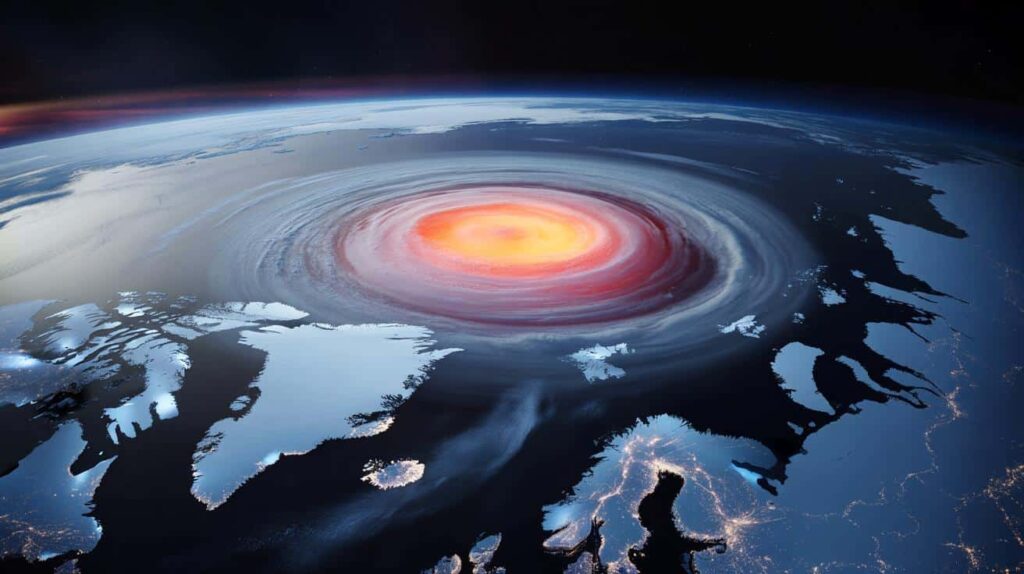
On satellite maps, the developing stratospheric warming looks almost unreal. A blob of intense red, right above the North Pole, where you’d normally expect deep blues of brutal cold. Instead of frozen stillness, temperatures around 30 km up are jumping by tens of degrees over just a few days. Down here on the ground, that sounds abstract. Up there, it’s a seismic event.

This isn’t your usual “mild spell” or “Arctic blast.” It’s a structural shock to the engine that steers winter across the Northern Hemisphere. And it’s arriving early, in January, before seasonal forecasters had fully locked in their bets.
For context, stratospheric sudden warmings – SSWs, in the jargon – typically happen once every two or three winters. Many of them peak in February, late enough to disrupt the season’s grand finale. This time, the main warming pulse is unfolding in early to mid‑January, and early model guidance shows the polar vortex, that ring of icy winds hugging the Arctic, wobbling badly.
In 2018, a powerful SSW blew apart the vortex and sent Arctic air tumbling into Europe and the eastern United States in early March. The “Beast from the East” turned quiet streets into Siberian scenes, delayed flights, and drained road-salt reserves in a matter of days. Not every SSW leads to a blockbuster cold wave like that. But the parallels mean forecasters are paying unusually close attention.
What’s happening physically is both simple and strangely elegant. Waves of energy from huge weather systems in the lower atmosphere – the kind that give us Atlantic storms or Pacific lows – ripple upward into the stratosphere. When those waves get strong enough, they punch into the polar vortex and slow it down. The vortex weakens, the air above the pole heats rapidly, and sometimes the whole circulation splits or flips.
When that happens, the usual conveyor belt that keeps cold air bottled up at high latitudes gets scrambled. Instead of spinning smoothly over the Arctic Ocean, chunks of frigid air can spill toward Europe, Asia, or North America. The change doesn’t hit overnight. It filters down over one to three weeks. But once it locks in, it can reshape the rest of winter.
Why this early stratospheric shock could rewrite winter forecasts
Meteorologists had already issued seasonal outlooks for this winter, many of them leaning on **El Niño** as the main character. El Niño winters often mean wetter conditions for the southern United States, milder stretches in parts of Canada and northern Europe, and a tug‑of‑war pattern of storms across the Atlantic. Then this warming showed up in the upper atmosphere, like an uninvited guest at a carefully arranged dinner.
➡️ Goodbye olive oil the beloved staple exposed as overrated while a shocking cheap alternative divides doctors and chefs worldwide
➡️ “Extremely flattering”: forget short cuts, this rejuvenating hairstyle is ideal after 50 according to a hairstylist
➡️ Goodbye air fryer: this new kitchen gadget goes far beyond frying, offering nine versatile cooking methods in one device
➡️ Meteorologists warn scientists alarmed that early February Arctic shifts may trigger a biological tipping point
➡️ A hidden tunnel has linked Earth to distant stars for millions of years
➡️ Psychology says people who say please and thank you without thinking twice may be the most emotionally controlling of all and these 7 qualities will change how you see polite people
➡️ How boiling orange peels instantly freshens the whole house and leaves a long-lasting natural scent during winter

➡️ Mixing vinegar and hydrogen peroxide triggers a chemical reaction that cleans deeper than expected and experts explain why this surprising combination is actually recommended at home
El Niño still matters. But early stratospheric disruption is the kind of wildcard that forces forecasters back to the drawing board, coffee in hand, refreshing model runs at 3 a.m.
Take northern Europe. Some long‑range projections had suggested a fairly average back half of winter: rain, wind, the occasional brief cold snap. Now, ensemble models – those huge clusters of simulations that try to map out possible futures – are starting to hint at higher odds of high‑latitude blocking. That’s the pattern where stubborn high pressure parks over Greenland or Scandinavia and diverts the jet stream south.
The last time a strong SSW followed this script, in 2018, London saw heavy snow drifts and frozen fountains while Rome woke up to rare flakes. In the US, a similar pattern in 2021 contributed to the deep freeze that hit Texas. The details differ, the scars remain. Cities don’t forget when the power grid fails or supermarket shelves empty.
Scientists are careful not to overpromise. The relationship between stratospheric warmings and surface weather isn’t a simple one‑to‑one. Some events stay “aloft,” with minimal impact for people on the ground. Others trigger long‑lived cold spells that last for weeks.
What’s driving the excitement – and anxiety – this time is the timing and apparent strength. Early‑season events tend to have more time to couple with the troposphere, the part of the atmosphere where daily weather unfolds. And the warming pulse now underway looks intense on multiple models. *It’s like seeing the chessboard flipped over halfway through the game.* You can still win, you can still lose, but all your planned moves need to be re‑checked.
How to read the signs from where you live
You don’t need a PhD in atmospheric science to track what this means for your street, your commute, your energy bill. The first practical move is surprisingly simple: start watching not just your local forecast, but also the broader pattern maps your favorite weather app or site quietly tucks away in the “insights” tab. Look for mentions of the polar vortex, North Atlantic Oscillation, or blocking highs.
When meteorologists start talking about persistent high pressure to the north of you and a “displaced vortex,” that’s your cue that this stratospheric event is finally reaching down to touch the weather you feel on your skin.
There’s another habit that separates the calmly prepared from the suddenly panicked. They don’t obsess over single, dramatic model runs posted on social media. They track trends over several days, watching whether cold shots, storm tracks, or snowfall probabilities keep repeating or vanish after one breathless update.
We’ve all been there, that moment when a viral weather map shows your town buried under a cartoonish snow bullseye ten days from now. Let’s be honest: nobody really cross‑checks three different model ensembles before they text the group chat. Yet this is exactly the kind of high‑uncertainty period when restraint pays off.
“Stratospheric warmings are not a forecast in themselves,” says one European climate scientist I spoke with. “They’re a big nudge to the system. Where that nudge ends up is what we spend the next few weeks trying to resolve.”
- Watch the 10–30 day outlooks
Those “subseasonal” forecasts are where the SSW signal is most likely to appear first, in hints of shifting jet streams and pressure patterns. - Follow reputable meteorologists, not just dramatic maps
Look for people who explain uncertainty and show multiple scenarios, instead of only posting the scariest chart of the day. - Prepare lightly, not frantically
Check winter gear, review heating or power‑outage plans, think about elderly neighbors or people who rely on deliveries if travel is disrupted. - Notice your local patterns
Some regions respond to SSWs with cold, others with stormy milder spells. Over a few winters, you start to see how your corner of the world tends to react.
Living with a winter whose script is constantly rewritten
The story of this winter is suddenly more open‑ended than it looked just a few weeks ago. A quiet, technical shift high above the Arctic has slipped into the plot, altering probabilities in ways you can’t quite feel yet when you step outside to walk the dog. That gap between what the data is whispering and what the air is telling your face can be unsettling.
Climate change already makes many of us feel that the seasons are coming unmoored. Early flowers, late snow, rain where it “used to” be dry. Now along comes a rare stratospheric jolt asking us to hold our forecasts a little more loosely, to treat winter not as a fixed schedule but as a negotiation between ocean patterns, polar winds, and our own expectations.
For some, that sparks curiosity. For others, it’s just one more thing that feels out of control in a world already full of surprises. Yet learning the basic language of these events – what SSW means, how a polar vortex can wobble, why a January warming may shape February and March – quietly shifts the balance.
You may not be able to change the jet stream, but you can change how blindsided you feel when the season suddenly flips. And maybe this is where the conversation goes next: not just “Will I get snow?” but “How do we, as cities, as families, as people with fragile routines, live with a winter whose rules are still being rewritten in the thin air above our heads?”
| Key point | Detail | Value for the reader |
|---|---|---|
| Early-season SSW is unusual | A strong stratospheric warming in January can influence the rest of winter more than a late‑season event | Helps you understand why forecasts may suddenly change and stay volatile |
| Impacts vary by region | Some areas may see severe cold and snow, others stormy but milder patterns, some feel little change | Encourages you to follow regional outlooks, not just dramatic global headlines |
| Track trends, not single maps | Looking at multi‑day model trends and expert commentary reduces overreaction to one extreme forecast | Supports calmer planning for travel, heating costs, and daily life during uncertain weeks |
FAQ:
- Question 1What exactly is a stratospheric sudden warming, in simple terms?
- Answer 1
It’s a rapid temperature rise high above the Arctic that disrupts the usual ring of strong winds (the polar vortex), which can later shift where cold and storms go in winter.- Question 2Does a strong SSW guarantee a big cold wave where I live?
- Answer 2
No. It raises the odds of unusual patterns, but your specific region might get cold, stormy, or barely notice a change, depending on how the jet stream rearranges.- Question 3How long after an SSW before we see effects at the surface?
- Answer 3
Typically between one and three weeks. Forecasters watch for the signal “dripping down” from the stratosphere into the weather patterns we experience.- Question 4Should I change my travel plans because of this January event?
- Answer 4
Not automatically. It’s wiser to keep a closer eye on 7–10 day forecasts around your travel dates and to build in flexible options if your route is prone to winter disruption.- Question 5Is climate change making SSWs more frequent?
- Answer 5
Research is ongoing. Some studies hint at links between a warming Arctic and changes in the polar vortex, but scientists haven’t reached a firm consensus on whether SSWs are becoming more common or just different in their impacts.
