
The first time you see it, you almost frown. On the screen in front of you, the comet doesn’t look like the soft, fuzzy cotton ball we’ve been trained to expect from space photos. It looks… sharp. Carved. As if someone had dragged a razor through the void and left a trail of cold, electric dust behind.
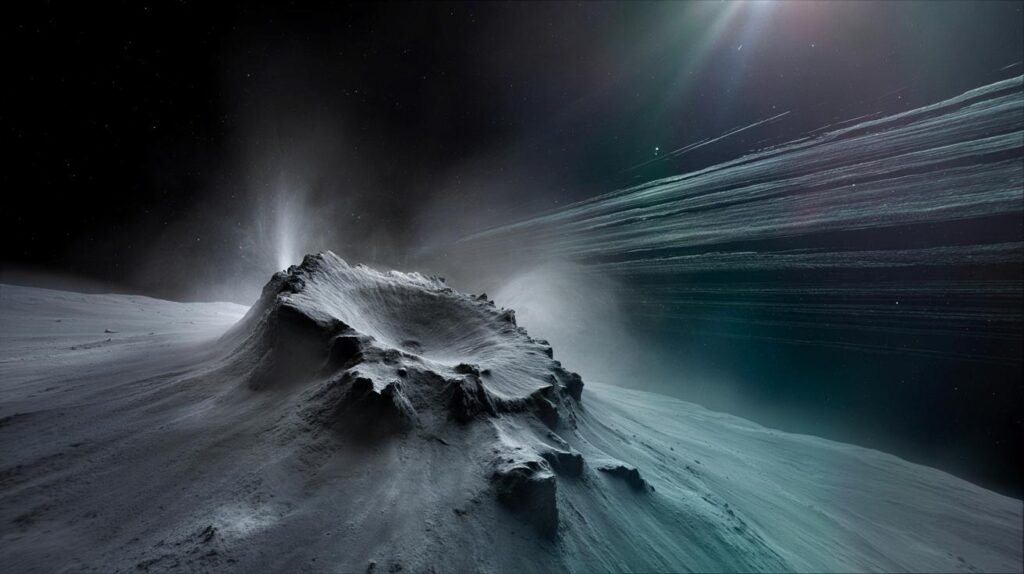
Astronomers have just released a new series of eight spacecraft images of the interstellar comet 3I ATLAS, and they’re so detailed they feel a little intrusive. You can trace the grain of the tail, sense the violent push of the solar wind, almost imagine the sound it would make if the vacuum of space let sound exist.

This thing came from outside our Solar System.

And in these pictures, you feel that foreignness.

A comet from somewhere else, finally seen up close
3I ATLAS is not a regular comet that follows a nice closed orbit around our Sun. It is an interstellar visitor made of ancient ice and rock that was thrown from another star system. Our telescopes caught sight of it for a brief moment before it will escape again into deep space. This object represents something quite rare in astronomy. Most comets we observe come from the outer reaches of our own solar system. They travel in predictable paths that bring them back around the Sun in regular cycles. Some return every few years while others take centuries to complete their journeys. But 3I ATLAS follows a different pattern entirely. Its trajectory shows that it came from beyond our solar system. Scientists can tell this by measuring its speed and direction. The object is moving too fast to be bound by the Sun’s gravity. Instead of looping back around like a normal comet it will continue outward after passing through our neighborhood. This makes 3I ATLAS only the third known interstellar object detected passing through our solar system. The first was Oumuamua in 2017 which had an unusual elongated shape. The second was comet Borisov in 2019 which looked more like a typical comet. Now 3I ATLAS joins this exclusive group of cosmic wanderers. These interstellar visitors give scientists a unique opportunity. They provide samples of material from other star systems without requiring us to travel there. By studying their composition & behavior astronomers can learn about conditions around distant stars. Each object tells a story about where it came from and what it experienced during its long journey through the galaxy.
For months it appeared as nothing more than a faint streak in data sets and survey images. It was a curiosity catalogued alongside names like Oumuamua and 2I/Borisov. These eight new spacecraft images have transformed that faint streak into something almost tangible. The object now shows clear structure and motion. Kinks are visible in the dust tail. Jets can be seen emerging from the surface. The sense of speed is palpable.
Picture a cluster of mission controllers gathered around a darkened screen. There’s the quiet hum of air conditioning, the glow of laptops, the understated tension that comes just before a big reveal. When the first of the new 3I ATLAS images loads, nobody says anything at first. Then someone whispers a low “wow”, and a tiny, almost guilty laugh breaks the silence.
We’ve all been there, that moment when reality suddenly has more pixels than your imagination. These frames come from a flotilla of instruments: a solar observatory catching the comet as it skimmed the inner system, a deep-space probe getting a side angle, a distant spacecraft watching from high above the ecliptic. Eight viewpoints. One alien traveler. A whole new way of seeing.
Why do these images feel unsettling? Part of it is scale. The tail stretches millions of kilometers, yet on screen it’s a narrow, knifed beam of light, intricate and fragile. Another part is precision. Our minds are used to Hubble’s soft-glow portraits of nebulae, to blurry comets that feel safely far away and romantic. This series doesn’t flatter.
Here, the coma looks ragged, like something being sandblasted. Bright knots reveal jets erupting from below the surface as ancient ices vaporize. The tidy, textbook idea of a comet dissolves, replaced by something more feral and less symmetrical. *You suddenly remember that space is not a backdrop, it’s a battlefield of forces and collisions.*
➡️ Boiling rosemary is the best home tip I learned from my grandmother, and it completely transforms the atmosphere of your home
➡️ Hygiene after 65 follows a different rhythm, and it’s not about showering every day or every week experts challenge norms
➡️ Before you redo your home: here are the 7 decor trends for 2026 that will last
# Boiling Rosemary is the Best Home Tip I Learned from My Grandmother & It Completely Transforms the Atmosphere of Your Home
My grandmother taught me countless household tricks over the years but one stands out above all the rest. She showed me how boiling rosemary can change the entire feel of a home in the most wonderful way. This simple practice has been passed down through generations in my family and now I want to share it with you. The method itself could not be easier. You just need fresh or dried rosemary sprigs and a pot of water. Fill the pot about halfway with water & add a generous handful of rosemary. Bring the water to a boil and then reduce the heat to let it simmer. As the water heats up the essential oils from the rosemary are released into the air throughout your home. The scent that fills your space is absolutely incredible. It has an earthy & refreshing quality that makes every room feel cleaner & more inviting. Unlike artificial air fresheners that can smell chemical and overwhelming this natural aroma is subtle yet powerful. The fragrance spreads naturally through your home without being too strong or artificial. Beyond just the pleasant smell there are actual benefits to this practice. Rosemary has natural antibacterial properties that can help purify the air in your home. The herb has been used for centuries in traditional medicine and aromatherapy. When you boil it the steam carries these beneficial compounds throughout your living space. Many people report feeling more relaxed and focused after boiling rosemary in their homes. The scent is known to reduce stress and improve mental clarity. Some studies suggest that rosemary aroma can even enhance memory and concentration. My grandmother always said it helped her think more clearly and I have found the same to be true. This technique works wonderfully before guests arrive. Instead of reaching for commercial air fresheners I boil rosemary about an hour before people come over. The natural scent creates a warm and welcoming environment that guests always comment on. They often ask what smells so good and are surprised to learn it is just a simple herb. You can also combine rosemary with other natural ingredients for different effects. Adding lemon slices creates a fresh & citrusy aroma perfect for spring & summer. Cinnamon sticks mixed with rosemary produce a cozy scent ideal for fall and winter months. A few drops of vanilla extract can add a sweet note to the blend. The practice is incredibly economical compared to buying expensive candles or plug-in air fresheners. A single rosemary plant can provide you with sprigs for months. Even buying fresh rosemary from the grocery store is affordable and a little goes a long way. Dried rosemary from your spice cabinet works just as well. I keep a pot of rosemary water simmering on particularly stressful days. The ritual of preparing it is calming in itself. Watching the water heat up and smelling the first hints of rosemary helps me slow down and reset. It has become a form of self-care that costs almost nothing but provides real comfort. This grandmother-approved tip has truly transformed how my home feels. The atmosphere becomes more peaceful and pleasant with such minimal effort. I am grateful she shared this wisdom with me & I hope you will try it in your own home.
➡️ A psychologist is adamant : the best stage of life begins when you start thinking this way
➡️ A growing lifestyle trend among seniors: “They call us the ‘cumulants,’ but working after retirement is how we manage to get by”
➡️ Meteorologists warn that an unusually sharp temperature plunge could reshape winter storm patterns across multiple regions

➡️ My cat is gone”: what to do right now to boost your chances of finding them
How you “read” an image of an alien comet
You don’t need an astrophysics degree to feel what these images are saying. Start with the shape. The tail of 3I ATLAS is narrower, more filamented than many classic Solar System comets, suggesting a different mix of dust and gas. Follow the brightness gradient: the intense glow near the nucleus means the comet is still actively shedding material, even after its long, cold drift between the stars.
Then look for asymmetry. One side of the coma looks thicker, almost lopsided, hinting at rotation and uneven vents on the surface. This is a body that spins, cracks, and outgasses in pulses, not a neat little snowball politely melting in the sun.
If you zoom in on the highest-resolution frames, small details start jumping out. Tiny striations in the tail trace the history of gusts of solar wind, like rings left on sand by receding waves. Faint, curved features show where charged particles have tugged at the comet’s gases, re-shaping them in slow motion.
Astronomers do something almost childlike here: they draw lines on these images. They measure the angle of the tail, compare brightness from frame to frame, track how the coma’s shape warps as the comet hurtles through different regions of the solar magnetic field. That’s how you turn a strange, unsettling photo into data: you treat it as a diary written in light.
Once the numbers start to pile up, the story of 3I ATLAS becomes more concrete. Scientist teams compare the color of its dust to previous interstellar visitor 2I/Borisov and to “homegrown” comets that formed near Jupiter or beyond Neptune. Early findings suggest a surprisingly rich mix of volatile ices, possibly hinting that its birth system had a reservoir of material similar to our own Oort cloud.
This is where the images punch above their aesthetic weight. They help map the trajectory with extreme precision, refine the comet’s orbit, and confirm that its path is truly hyperbolic — which means it’s not coming back. **This is a one-pass encounter with something from another sun.** These eight frames are our entire close-up visual memory of it, forever.
The quiet craft behind the cosmic portraits
Behind each of these haunting images is a methodical, almost obsessive routine. Spacecraft teams schedule exposures down to the second, balancing the comet’s apparent motion with the jitter of the spacecraft itself. Some cameras were never even designed to look at distant comets; they spend most of their lives watching the Sun or scanning the solar wind.
To capture 3I ATLAS the engineers adjust settings much like pushing an old DSLR camera to its maximum capability. They use longer exposures in some cases and tighter filters in others while timing everything carefully so the comet does not blur into an unreadable streak. For certain frames the spacecraft itself needs to roll slightly to track the target. This maneuver always involves some risk when operating hundreds of millions of kilometers from Earth.
There is a hidden vulnerability in these missions that people rarely discuss. You spend years building hardware and launch it at terrifying speeds. Then you entrust everything to software updates and distant commands that cross space at light speed. Sometimes when these rare events happen you realize how fragile the whole setup is. A once-in-a-lifetime comet or a passing interstellar object can expose these weaknesses. The systems we depend on seem robust until an unexpected opportunity arrives and tests their limits in ways nobody anticipated during the design phase.
Let’s be honest: nobody really runs through every possible scenario every single day. Teams improvise. They negotiate for a few extra minutes of pointing time. They argue gently over bandwidth. That’s why some of the most striking images exist: someone, somewhere, took a small professional risk for beauty and curiosity.
One sentence keeps appearing in mission logs and Slack channels during all of this. People copy and paste it because it captures the situation perfectly.
We are observing a visitor from another star using cameras that were designed to examine our own solar system. This mismatch between purpose and subject is precisely what gives these images their remarkable impact.
To understand what these eight views bring us, it helps to see them as a small toolbox:
- High-contrast tail shots
Reveal how the solar wind shapes interstellar material on the fly. - Multi-angle perspectives
Allow scientists to reconstruct the 3D structure of the coma and tail. - Time-spaced frames
Show how activity ramps up and down as the comet approaches and recedes from the Sun. - Color-filter images
Hint at the chemical cocktail of ices and dust, compared to local comets. - Background-star alignment
Gives ultra-precise position data, nailing down the orbit and confirming its interstellar origin.
What an alien comet does to your sense of home
The longer you look at 3I ATLAS in these eight images the more unusual our own Solar System starts to seem. This object is a fragment from another place passing through our region of space on a path that follows none of our usual orbits and cycles. It appeared in our sky without warning, remained for a short time, & then departed permanently while carrying signs of different chemistry and distant gravitational forces.
There is a subtle existential question that emerges from this observation. If this single object happened to pass through our telescopes at this moment how many similar objects went unnoticed for billions of years? How much of the cosmic dust we observe in our skies began its existence orbiting a completely different star? Every detailed image serves as evidence that the space we consider ours is not exclusively ours at all.
| Key point | Detail | Value for the reader |
|---|---|---|
| Eight unprecedented images | Captured from multiple spacecraft and angles as 3I ATLAS crossed the inner Solar System | Gives a rare, almost cinematic glimpse of an interstellar object in motion |
| Alien material, familiar forces | Foreign cometary dust shaped by our Sun’s heat and solar wind | Helps you grasp how “other” worlds interact with our own star |
| One-pass encounter | Hyperbolic orbit means 3I ATLAS will never return | Underlines the uniqueness of these images and the urgency of studying them now |
FAQ:
- Is 3I ATLAS dangerous for Earth?
No. Its trajectory takes it safely past our planet and out of the Solar System. It never came close enough to pose an impact risk.- Why is it called “3I ATLAS”?
“3I” means it’s the third confirmed interstellar object detected passing through our Solar System. “ATLAS” refers to the survey project that first spotted it.- How do we know it’s interstellar?
Its orbit is hyperbolic, meaning it’s moving too fast to be bound by the Sun’s gravity. The shape and speed of its path show it came from outside our Solar System and will not return.- Can amateur astronomers see 3I ATLAS?
During its brightest phase, advanced amateurs with good telescopes and dark skies had a chance. By the time these high-res spacecraft images were processed and shared, it was already too faint for most backyard setups.- What makes these new images special?
They combine high resolution, multiple viewing angles, and precise timing as the comet interacted with the solar wind. For scientists, that’s a goldmine of data. For the rest of us, it’s a rare, unsettlingly clear look at a visitor from another star.
