
The wind hits first. A dry breath rolling off the Gobi, carrying sand that pricks your cheeks and slips into every fold of clothing. On the horizon, where the dunes once marched forward each spring, a different line now rises: thin rows of poplars and pines, staked into the dust like a quiet fence. A farmer in northern China points with his shovel. “Ten years ago, the sand was there,” he says, gesturing toward his village. “Now it stops here.” The distance is barely a few hundred meters, but it feels like a wall between two futures.
Some walls are made of stone. This one is made of trees.
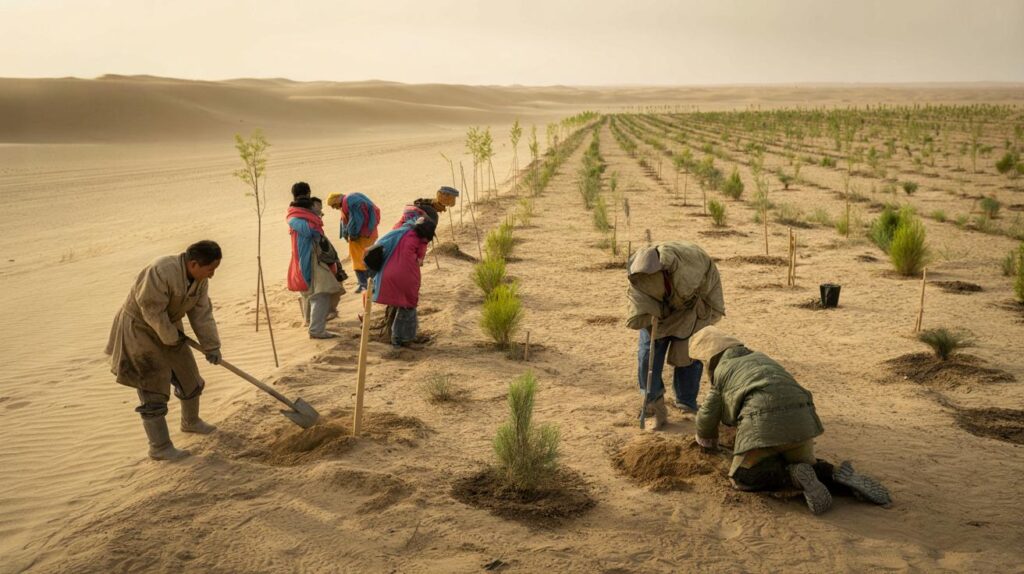
The day the desert met a line of saplings
Stand on a roadside near Yulin or Baotou in early spring and the scene doesn’t look like a grand climate project. It looks like people planting sticks into stubborn ground. A group of students in bright plastic ponchos. Old men in faded army coats. Workers from nearby factories on a day off. Rows and rows of saplings, some no higher than a walking cane, stretching into the haze.
The sky feels big and empty, but the grid of young trees gives the land a kind of nervous order.

Since the late 1970s, and with real intensity from the 1990s, China has been building what the world nicknamed the “Great Green Wall”. It sprawls across the country’s north like a broken necklace, from Xinjiang across Inner Mongolia and into Gansu and Hebei. The idea is simple enough: plant billions of trees to pin down the soil and halt advancing deserts. The scale is anything but simple. Official figures speak of more than 80 billion trees planted in the region over the past decades, part of a national target to seed **a forest belt as long as a continent**.
Some sections failed, some thrived, but the map of sand has shifted.

Satellite images tell a story that’s less romantic than the planting-day selfies, and far more decisive. In the 1990s, vast swaths of northern China were sliding into desert, driven by overgrazing, logging and climate stress. By the 2010s, researchers began to find a different pattern: in key areas, the boundary of the desert had stabilized or even pulled back. Not by magic. By roots. The new forests can’t stop every dust storm or erase decades of damage, yet they’ve slowed the spread. On the ground, that translates into fewer sand-buried fields, reclaimed pastureland, and villages that no longer have to sweep dunes off the main road after each storm.

How you plant a “wall” one shovel at a time
The method behind this green curtain looks oddly low-tech. First, technicians walk the land and mark out a grid, sometimes with GPS, sometimes just with flags and string. Holes are dug in staggered lines to break the wind, often by hand, sometimes by auger or small tractors. Then comes the selection ritual: which species stands a chance here? Poplar and pine in some places. Drought-hardy shrubs like saxaul or sea buckthorn in others. Each tiny tree gets its moment — a splash of water, a pat of soil, a bamboo stake for support.
It’s repetitive work, but repetition is how a landscape turns.
Planting for the sake of planting was the mistake of the early years. Whole hillsides were coated in one fast-growing species, often water-hungry poplars that shot up quickly, then withered. Local people remember those “soldier trees” that lined roads for a few proud summers and then died in rows like a defeated army. We’ve all been there, that moment when effort doesn’t quite match reality on the ground. The newer approach leans more on mixed species and native shrubs, spacing trees farther apart, and pairing planting with grazing bans. Less dramatic for photos, surprisingly effective for the soil. *A forest is not a uniform carpet; it’s a patchwork that knows how to survive lean years.*
Local ecologist Zhang Li puts it bluntly: “We started out planting trees for the statistics. Now we’re planting for survival. That means soil first, water first, people first.”
- Fewer thirsty trees per hectare: gives each root system a fighting chance in dry years.
- More shrubs and grasses: their tangled roots anchor the topsoil better than lonely tall trunks.
- Grazing control zones: herders are paid or supported to rest land so seedlings aren’t eaten down to stubs.
- Farmer contracts: families earn cash or subsidies to maintain young trees, not just stick them in the ground and walk away.
What this green experiment really changes for people
# Text
For villagers living at the edge of the desert the biggest climate policy moment is not found in any speech. It happens during the first spring when sand stops blowing into their kitchens. In parts of Ningxia and Inner Mongolia locals describe a shift they can feel in their lungs. They experience fewer days with orange-grey skies. There is less grit between their teeth during the walk to school. Schools no longer cancel as many classes during peak storm season. Farmers who once watched dunes creep toward their houses now see grass and shrubs reclaiming bare patches. The transformation remains fragile but daily life becomes a little less about bracing for the next storm and a little more about planning the next harvest.
There’s a quieter story too: income. Reforestation policies pushed millions of farmers to retire marginal fields and plant trees or shrubs instead. Some turned to fruit and nut trees, others to medicinal plants under the canopy. For herding families, grazing bans were a bitter pill, yet many received subsidies or moved into new housing with alternative jobs. Not all of this went smoothly. Some people lost traditional livelihoods or felt forced into urban life. Let’s be honest: nobody really reads the policy brochure and thinks, “Yes, this is exactly how I wanted my life to change.” Still, where replanting was paired with long-term support, communities often report more stable land and steadier income than in the days of rolling dust.
The broader lesson reaches far beyond China’s borders. A billion trees do not erase coal plants or rewrite global climate math, and scientists have called out exaggerated claims about “solving” warming with forests alone. Yet the data from northern China shows a stubborn truth: human-caused desertification can be slowed, and sometimes reversed, when policies, money, and local knowledge line up. The emotional pull of seeing green where there was once only beige is powerful, but the real test will come in hotter, drier decades ahead. Will these new forests adapt, or will they fade like the first wave of thirsty poplars? The answer matters for every country staring at its own advancing sand.
➡️ This country could face a historic winter due to a rare mix of La Niña and the polar vortex
➡️ Humanity produces 952 tonnes of it every second – and Australians think they’ve found a way to shrink concrete’s carbon footprint
➡️ Satellites have detected colossal 35 metre waves raising fears of climate chaos as experts clash over whether humans are to blame
➡️ Heating: why the 19°C rule is outdated and what experts now recommend
➡️ Goodbye olive oil new research crowns a dirt cheap fat as healthier and sparks outrage among Mediterranean diet believers

➡️ Goodbye to classic high kitchen cabinets as more households switch to a space-saving, more comfortable alternative
➡️ This old-school moisturizer, not from big brands, is now ranked number one by dermatology experts
# Every Autumn Gardeners Make the Same Mistake with Their Leaves
When autumn arrives and leaves begin to fall, many gardeners automatically reach for their rakes. They spend hours gathering every single leaf from their lawn and garden beds. Most people bag these leaves and send them to the curb for disposal. This common practice seems like the responsible thing to do. However, it turns out that removing all fallen leaves from your yard might be one of the biggest mistakes you can make as a gardener. Leaves are not waste material that needs to be eliminated. They are actually a valuable natural resource that can benefit your garden in numerous ways. When you remove every leaf from your property, you throw away free mulch & fertilizer. You also disrupt the natural ecosystem that exists in your yard.
## Why Leaves Matter More Than You Think
Fallen leaves play an essential role in nature. In forests & wild areas, leaves accumulate on the ground each year. They break down slowly & return nutrients to the soil. This natural cycle has been happening for millions of years. Trees and plants have evolved to depend on this process. When leaves decompose, they release nitrogen and carbon back into the earth. These nutrients feed the soil microorganisms that keep your garden healthy. The layer of leaves also protects plant roots from extreme temperature changes during winter. It acts as insulation that keeps the soil warmer and prevents frost from penetrating too deeply. Many beneficial insects and small creatures rely on leaf litter for survival during cold months. Butterflies, beetles & native bees often overwinter in fallen leaves. When you remove all the leaves you eliminate habitat for these helpful garden allies. Some of these insects are important pollinators that you want to attract to your garden in spring.
## The Problems with Removing All Your Leaves
Raking and bagging leaves requires significant time & physical effort. For people with large yards, this task can take many hours spread across several weekends. The repetitive motion of raking can cause back pain and muscle strain. All this work essentially throws away something valuable. Sending leaves to landfills creates unnecessary waste. Many municipalities now recognize this problem and have started composting programs. However, transporting leaves still uses fuel and resources. Keeping leaves on your property is the most environmentally friendly option. When you remove the natural leaf layer, you expose your soil to erosion. Rain and wind can wash away or blow away the topsoil more easily. This leads to nutrient loss and can create bare patches in your garden. You might then need to buy commercial mulch or fertilizer to replace what nature would have provided for free.
## How to Use Leaves Effectively in Your Garden
You do not need to leave your yard looking messy to gain the benefits of fallen leaves. There are several smart ways to use leaves that keep your property looking neat while improving your garden health. One simple method is to mow over the leaves with your lawn mower. This chops them into small pieces that settle between the grass blades. The shredded leaves break down quickly & feed your lawn. Studies show that lawns mulched with chopped leaves actually grow thicker and healthier than lawns where all leaves are removed. The key is to mow before the leaf layer gets too thick. If you can still see grass blades through the leaves, you can safely mow over them. For garden beds you can rake leaves directly onto the soil around your plants. A layer of whole leaves about three to four inches thick works well. This creates a natural mulch that suppresses weeds & retains moisture. As the leaves break down they improve your soil structure & add organic matter. By spring, many of the leaves will have decomposed significantly. If you have more leaves than you can use immediately, create a leaf pile in a corner of your yard. Let the leaves sit and decompose naturally. After a year or two, you will have rich leaf mold that makes excellent compost. This dark crumbly material is prized by gardeners for improving soil quality. You can also add leaves to your regular compost bin. Mix them with green materials like grass clippings or kitchen scraps. The combination of brown leaves and green materials creates the ideal conditions for fast composting. Shredding the leaves first speeds up the decomposition process.
## When You Should Remove Some Leaves
While leaves are generally beneficial, there are situations where you should remove at least some of them. If leaves completely smother your lawn in a thick mat, they can kill the grass underneath. This happens when leaves get wet and pack down into a dense layer that blocks light & air. In this case you should remove enough leaves so that your grass can still breathe. Keep leaves away from the crowns of perennial plants that are prone to rot. Some plants need good air circulation around their base to stay healthy through winter. Hostas & other moisture-sensitive perennials fall into this category. Remove leaves from walkways & driveways where they create slipping hazards. Wet leaves can be surprisingly slippery and dangerous. They can also stain concrete surfaces if left in place too long. Clear leaves away from your home’s foundation and out of gutters. Leaves piled against your house can trap moisture & lead to problems with your foundation or siding. Clogged gutters can cause water damage to your roof & walls.
## The Best Approach for Most Gardens
The ideal strategy is to redistribute your leaves rather than removing them entirely. Take leaves from areas where they cause problems and move them to areas where they provide benefits. Rake leaves off your lawn & walkways but pile them in garden beds and around trees and shrubs. This approach gives you the best of both worlds. Your lawn and paths stay clear and safe. Meanwhile your garden beds get free mulch and fertilizer. You save time and effort compared to bagging everything. You also create better habitat for beneficial wildlife. Think of fallen leaves as a gift from your trees rather than a burden. They represent nutrients that your trees pulled from deep in the soil and from the air. When leaves fall and decompose, those nutrients become available to all your plants. This natural recycling system costs nothing & requires minimal work from you. Many gardeners who switch to leaving leaves in place notice improvements in their gardens within a single growing season. Their soil becomes darker and richer. Their plants grow more vigorously. They see more butterflies and beneficial insects. These results come from working with nature instead of against it. The traditional approach of removing every leaf is based on outdated ideas about what a tidy garden should look like. Modern ecological gardening recognizes that some natural messiness actually indicates a healthy ecosystem. A garden with no leaves, no fallen twigs and no plant debris is essentially a sterile environment. It might look neat but it lacks the complexity that supports diverse life. By changing your autumn routine you can save yourself work while making your garden more productive & environmentally friendly. Instead of spending every weekend raking and bagging, you can spend that time enjoying your yard or working on other projects. Your garden will thank you with healthier plants and richer soil. The wildlife in your area will benefit from the habitat you provide. This simple shift in thinking about fallen leaves can transform your relationship with your garden and with the natural cycles that sustain it.
| Key point | Detail | Value for the reader |
|---|---|---|
| Desert spread has slowed since the 1990s | Satellite data and field studies show stabilization or retreat of dunes in parts of northern China | Gives concrete proof that large-scale restoration can change a bleak trend |
| Tree choice and spacing are crucial | Shift from single-species, dense poplar belts to mixed, drought-resistant species and shrubs | Highlights why “what” and “how” we plant matter more than raw planting numbers |
| Local communities sit at the center of success | Farmer contracts, grazing bans, and income support influence whether forests survive past year three | Shows that any restoration plan must be social as much as ecological |
FAQ:
- Is China’s tree-planting really stopping the Gobi Desert?In several regions, dune advance has slowed or reversed, but the Gobi isn’t “stopped”. The forest belts act more like brakes on a moving truck than a permanent wall.
- How many trees has China planted so far?Official figures point to tens of billions of trees nationwide since the 1980s, with a large share in northern drylands. Independent audits focus less on raw numbers and more on survival rates.
- Do all the planted trees survive?No. Early projects had high failure rates, especially with water-hungry species. Newer programs are improving survival by using native plants, better spacing, and follow-up care.
- Does this really help with climate change?The new forests store carbon and cool local climates, yet they can’t offset China’s emissions on their own. Their bigger impact may be on soil, water, and resilience for nearby communities.
- Can other countries copy this “Great Green Wall” model?Parts of it, yes. Especially combining tree planting with local jobs and grazing management. Any copy needs its own mix of species, rules, and community leadership, not a one-size-fits-all blueprint.
