
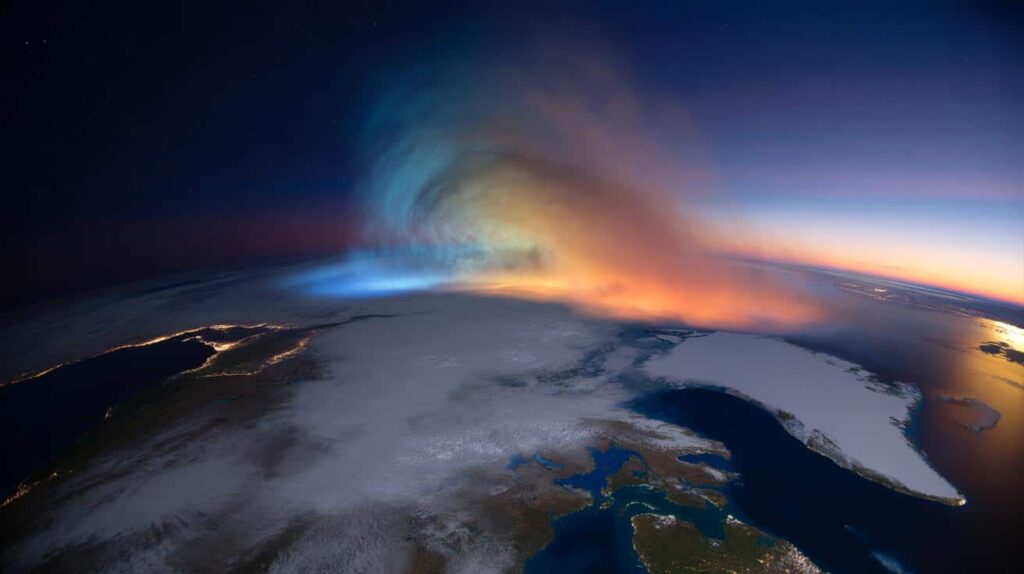
The sky over the North Atlantic looked deceptively calm on the weather maps this week. No monster blizzard, no roaring hurricane spiral. Just a neat swirl of pressure systems drifting across continents. Yet in the quiet, upper reaches of the atmosphere, about 30 kilometers above our heads, something rare and powerful has started to stir.
# The Polar Vortex is Breaking Down
Weather scientists looking at high altitude maps are seeing colors change from cold blues to warning reds. The polar vortex is that invisible winter system that normally keeps Arctic cold air trapped in place. Right now it is being pushed & pulled & warmed from within. This process has a name that sounds like science fiction: sudden stratospheric warming. This event happens when the upper atmosphere above the North Pole suddenly gets much warmer. The polar vortex is essentially a large area of low pressure & cold air that sits over the Arctic during winter. Strong winds circle around it like a fence and keep the frigid air contained. But when sudden stratospheric warming occurs that fence weakens or breaks apart. The warming starts very high up in the atmosphere where most people never think about. Temperatures can jump by 50 degrees or more in just a few days. This dramatic temperature spike disrupts the circular wind pattern. The vortex can stretch into an oval shape or even split into two separate pieces. When this happens the cold air that was locked up in the Arctic spills southward into places that are usually much warmer. Scientists track these events carefully because they often lead to severe winter weather across North America and Europe. The effects do not show up immediately. It can take one to three weeks for the disruption in the stratosphere to work its way down to ground level where people actually feel it. But when it does arrive it can bring dangerous cold snaps and heavy snowstorms to regions far from the Arctic. The current situation has meteorologists paying close attention. The data shows clear signs that the polar vortex is under stress and may be heading toward a significant breakdown. If the warming continues & the vortex splits or displaces far enough the result could be a prolonged period of harsh winter conditions across large parts of the Northern Hemisphere.

# This Year It Arrives Early and Strong & Could Transform Late Winter
The phenomenon is showing up ahead of schedule this season. It carries considerable force and has the potential to completely change the typical patterns we expect during the final weeks of winter. Meteorologists have been tracking its development closely. The system demonstrates unusual intensity for this time of year. Weather models suggest it will influence conditions across large portions of the continent. Traditional late winter weather often brings a mix of cold snaps and early hints of spring. This year looks different. The current pattern could disrupt that familiar sequence. Forecasters anticipate significant departures from normal temperature ranges. The timing matters considerably. An early arrival means extended influence over weather conditions. Communities that usually experience certain patterns may see something entirely different. Planning for typical late winter scenarios might not prove useful this time around. The strength of the system adds another layer of complexity. Stronger systems generally produce more dramatic effects. Temperature swings could be more pronounced. Precipitation patterns might shift in unexpected ways. Areas accustomed to dry conditions could see moisture while typically wet regions might experience the opposite. What makes this situation particularly noteworthy is the potential for a complete reversal of expected conditions. Late winter usually follows predictable trends in most regions. This year those trends face serious disruption. The flip could mean warmer temperatures where cold usually dominates or sudden cold where mild weather typically prevails. Scientists point to several factors contributing to this unusual setup. Atmospheric patterns have aligned in ways that differ from historical norms. Ocean temperatures play a role as well. These elements combine to create conditions that favor this early and powerful development. The implications extend beyond simple weather curiosity. Agriculture depends on predictable seasonal transitions. Transportation systems plan around typical winter conditions. Energy demands follow expected temperature patterns. When these assumptions no longer hold true adjustments become necessary across multiple sectors. Residents in affected areas should stay informed about developing conditions. What worked in previous years might not apply now. Preparation strategies may need revision. Flexibility will prove valuable as the situation continues to evolve throughout the coming weeks.
Nobody on the ground can feel it.
Not yet.
A hidden heat wave where winter begins
On the screens at Europe’s main weather centers, February’s upper-air maps almost look wrong. Temperatures in the stratosphere above the Arctic are surging by 40 to 50°C in a matter of days, turning what should be a deep-freeze into something closer to late autumn. Forecasters call this a sudden stratospheric warming event, or SSW, and this one is arriving ahead of schedule.
February cold snaps are not unusual but this particular event is hitting the polar vortex with remarkable force. The polar vortex is a rotating mass of extremely cold air that typically stays confined near the Arctic pole. When this system gets disrupted the winter weather patterns across other regions can change dramatically and quickly. The spinning column of freezing air normally acts as a barrier that keeps Arctic temperatures contained in the far north. However when something interferes with this circulation the cold air can spill southward into areas that don’t usually experience such extreme conditions. This disruption creates noticeable shifts in weather that people on the ground can feel almost immediately. What makes this February event particularly noteworthy is the strength with which it is affecting the vortex structure. While winter disturbances to this system occur periodically the intensity of this one stands out compared to typical seasonal variations. The result is that regions far from the Arctic may experience temperature drops and weather conditions more severe than what they normally see during winter months. The polar vortex functions like a containment system for Arctic air masses. When it remains stable & strong the cold stays where it belongs in the polar regions. But when external forces weaken or displace it the protective barrier breaks down. Cold air then flows into mid-latitude areas bringing winter weather that can feel harsh & unexpected to populations unaccustomed to such extremes. This particular disruption demonstrates how interconnected atmospheric systems are across the globe. A disturbance in the Arctic doesn’t stay isolated there. Instead it triggers a cascade of effects that alter weather patterns across entire continents. Understanding these connections helps explain why a single event near the North Pole can lead to significant temperature changes thousands of miles away.
We have all experienced that moment in late February when we pack away our winter coat and begin thinking about spring. Then a harsh cold wave suddenly arrives & erases any sign of warmer weather. Some of the worst late winter cold periods in Europe and North America happened after a strong SSW event. Examples include the 2010 snowstorm that hit the U.S. East Coast the 2018 cold snap called the Beast from the East in Europe, and the February 2021 freeze in Texas.
Back then, scientists traced the chain: stratospheric warming, a fractured polar vortex, and then, weeks later, stubborn blocking highs and cold air pouring south. It didn’t happen the day after. It crept in, piece by piece, as the atmosphere “remembered” the shock from above.
What’s unfolding this February follows a similar script, but with some twists. This warming is early-season for such intensity, hitting while parts of the Northern Hemisphere are still locked in a pattern shaped by El Niño and a persistently warm globe. That mix complicates the usual playbook.
When the stratosphere heats so fast, the polar vortex can weaken, split, or be shoved off the pole. That shift tends to ripple downward, layer by layer, over two to three weeks. The result can be blocking highs over Greenland or Siberia, a wavier jet stream, and cold air that spills into places that thought winter was nearly done. Not every SSW guarantees a deep freeze, but **it strongly tilts the odds**.
➡️ Here’s the precise age when making new friends gets harder, according to researchers
➡️ 9 old-school habits people in their 60s and 70s refuse to drop and why they’re happier than tech?obsessed youngsters
➡️ Restaurants are panicking as this viral Japanese egg trick shows customers they can cook perfectly without expensive traditional frying oils
# In two weeks the Game of Thrones universe returns with an all-new series
The highly anticipated expansion of the Game of Thrones world is set to arrive in just fourteen days. Fans who have been waiting for new content from this beloved fantasy realm will soon have fresh material to enjoy. This upcoming series promises to bring viewers back into the complex and dramatic setting that made the original show such a cultural phenomenon. The new series represents a significant moment for the franchise as it continues to build upon the foundation established by its predecessor. Production teams have worked extensively to ensure that this addition maintains the quality and depth that audiences expect from stories set in this particular universe. The creative direction aims to capture both the epic scale & intimate character moments that defined the original series. Viewers can expect the same level of production value that characterized the earlier installments. The show will feature elaborate sets and carefully crafted costumes along with the sweeping cinematography that became a hallmark of the franchise. Behind the scenes talent includes experienced writers and directors who understand what made the original series resonate with millions of viewers worldwide. The timing of this release has generated considerable excitement among the fan community. Social media platforms show increasing discussion about plot possibilities and character developments. Many longtime followers of the franchise have marked their calendars & are making plans to watch the premiere episode as soon as it becomes available. This new chapter in the Game of Thrones saga offers an opportunity to explore different aspects of the world that may not have received full attention in previous iterations. The storytelling approach will likely balance familiar elements with fresh perspectives to appeal to both dedicated fans and newcomers to the franchise.
➡️ Psychology reveals quiet people who watch your every move see your fears and lies while loud extroverts stay clueless and comfortable
➡️ Cut after 40: here are the 5 “least flattering” bob haircuts, according to this professional hairdresser
➡️ Greenland declares a state of emergency as scientists link the growing presence of orcas to accelerating ice melt
➡️ A rare polar vortex shift is taking shape, and experts warn that February could bring unusually extreme winter conditions
How this could rewrite late-winter forecasts
For short-range forecasts meteorologists focus on the troposphere which is the lowest layer of atmosphere where clouds & rain & daily weather happen. When a powerful SSW occurs they shift their attention to higher altitudes. The advice passed along through Slack channels & late-night emails is straightforward: monitor the polar vortex closely. Meteorologists who predict weather a few days ahead spend most of their time studying the troposphere. This bottom section of the atmosphere is where all the action takes place including cloud formation and rainfall and the weather patterns we experience every day. But when a strong sudden stratospheric warming event happens they quietly begin looking at what is happening much higher up in the atmosphere. The guidance that gets shared among forecasters in their work channels and through emails sent at odd hours is direct and clear: keep a very close eye on the polar vortex. Weather forecasters working on short-term predictions normally concentrate on the troposphere. This is the atmospheric layer closest to the ground where weather systems develop and where clouds form and where precipitation falls. However when a significant SSW takes place these professionals discreetly turn their focus upward to higher atmospheric levels. The recommendation that circulates through their communication channels and email exchanges often late at night is uncomplicated: pay careful attention to what the polar vortex is doing.
The craft is subtle. They look for the vortex to slow, to stretch, maybe to split into two lobes over Eurasia and North America. They test ensemble runs that show high pressure building over the Arctic, and they start to adjust their messaging. Not an instant Arctic outbreak, but a “heightened risk of late-season cold and snow” for specific regions two to four weeks out.
This is where many of us get tripped up as readers of weather apps. You open a 10‑day forecast, see mild temperatures, and assume winter is basically done. Then headlines about “polar vortex disruption” appear, and it feels like clickbait. There’s a gap between what the models see in the stratosphere and what your favorite app shows at the surface.
Let’s be honest: nobody really scrolls down to those boring anomaly charts and ensemble spreads every single day. Yet that’s exactly where the hints live. When forecasters talk about an SSW this intense, they’re not promising a blockbuster snowstorm. They’re saying: from late February into March, the dice for cold, blocked patterns are being quietly loaded.
Inside the forecast offices there is a real mix of excitement & caution. Sudden stratospheric warmings are one of the rare times when seasonal outlooks can swing sharply in a matter of days. Scientists know the public dislikes forecasts that keep changing direction.
People believe we keep changing our opinions said one senior climatologist to me this week. But when the stratosphere does something this dramatic we are not just guessing randomly. The entire situation transforms completely. The scientist explained that major atmospheric events force researchers to reconsider their predictions. These shifts in the upper atmosphere create new conditions that affect weather patterns across the globe. Scientists must adapt their models when such significant changes occur in the stratosphere because these alterations influence climate systems in ways that previous data could not account for. Understanding these atmospheric changes requires constant observation and analysis. Researchers monitor temperature variations and wind patterns in the stratosphere to predict how these changes will impact surface weather. When unusual activity happens at these high altitudes it signals that fundamental aspects of our climate system are responding to new pressures. The climatologist emphasized that updating scientific understanding based on new evidence is not the same as being uncertain or inconsistent. Science progresses through careful observation and willingness to adjust theories when confronted with compelling new information. What appears to outsiders as changing minds is actually the scientific method working as intended.
The top experts are now explaining the signal in simple everyday language that anyone can understand.
- Where the polar vortex is likely to weaken or split
- Which regions gain higher odds of late winter cold snaps
- Where mild, wet patterns may cling on despite the disruption
- How long the SSW’s fingerprint could linger into March
- What this event might reveal about a warming climate and future winters
Living with a sky that keeps surprising us
This early season warming in the stratosphere works like a stress test for the atmosphere and for how much we trust weather predictions. It shows up during a winter that has already been influenced by El Niño and unusually warm ocean temperatures. The public has become accustomed to news reports that swing back and forth between announcing record breaking heat and warning about dangerous cold snaps ahead. The event tests our understanding of how the upper atmosphere behaves & whether forecasting models can accurately predict what happens next. People now expect to see extreme weather headlines that seem to contradict each other from one week to the next. This warming event adds another layer of complexity to a season that was already unusual before it began. Meteorologists watch these stratospheric changes carefully because they can affect weather patterns for weeks or even months afterward. The warming happens high above where normal weather occurs but it can still influence the jet stream & temperature patterns that people experience at ground level. Scientists use these events to improve their models and learn more about how different parts of the atmosphere connect with each other.
The simple reality is that our basic understanding of winter no longer matches what actually happens. We used to think the north would be cold and the south would be mild with a smooth transition into spring. The data tells us something different now. Some years produce constant gray rain instead of heavy snow even after a major SSW event. Other years the same type of event breaks the season apart & sends Arctic air to places that rarely see it. This February’s disruption shows us once again that the atmosphere does not follow a predictable pattern.
| Key point | Detail | Value for the reader |
|---|---|---|
| Stratospheric warming is underway | Temperatures in the Arctic stratosphere are jumping by 40–50°C, weakening the polar vortex | Helps you understand why late‑winter forecasts may suddenly change |
| Weather impacts are delayed | Surface effects usually show up 2–4 weeks after the initial warming event | Prevents confusion when current 10‑day forecasts still look calm or mild |
| Risks, not certainties | SSWs tilt the odds toward cold spells and blocking, but don’t guarantee a specific storm | Encourages you to read “risk of patterns” rather than chasing exact dates and snowfall totals |
FAQ:
- Question 1What exactly is a sudden stratospheric warming event?
- Answer 1It’s a rapid temperature jump in the winter stratosphere above the Arctic, often 40–50°C in a few days, which disrupts the polar vortex and can reshape weather patterns weeks later.
- Question 2Does this automatically mean a huge snowstorm where I live?
- Answer 2No. An SSW raises the chance of colder, blocked patterns in some regions, but local storms still depend on timing, moisture, and the exact track of the jet stream.
- Question 3When could we start feeling the effects at the surface?
- Answer 3Typically 10–20 days after the peak warming, so late February into March is the window to watch for pattern changes in Europe, North America, and parts of Asia.
- Question 4Can my weather app capture this kind of event?
- Answer 4Short‑range app forecasts focus on the next few days. The SSW signal shows up more clearly in ensemble and long‑range outlooks, which are often buried in expert discussions and specialist charts.
- Question 5Is climate change linked to these polar vortex disruptions?
- Answer 5Research is ongoing. Some studies suggest that a warming Arctic can favor more frequent or intense disruptions, others find weaker links. What’s clear is that a hotter background climate is changing how winter patterns play out.
