
The woman in the salon chair is staring at herself in the mirror like she’s meeting a stranger. Under the bright neon lights, her balayage—so perfect last summer—looks tired. The caramel ribbons have turned brassy, the roots are stark, and those wiry silver strands seem to shout from her temples. Her colorist smiles and says softly, “We could do a melting. You’ll barely see the gray.” The word hangs in the air, strange and promising. Around them, hairdryers roar, foils crinkle, and someone laughs at a TikTok video showing yet another “miracle” hair hack. She hesitates for a second, then nods. The foils stay in the drawer. The bowl of color comes out instead, liquid and glossy like melted chocolate. The old balayage is about to disappear into something subtler, softer, less shouty. Something that doesn’t scream, just whispers. Something that lets gray blend in and almost vanish.
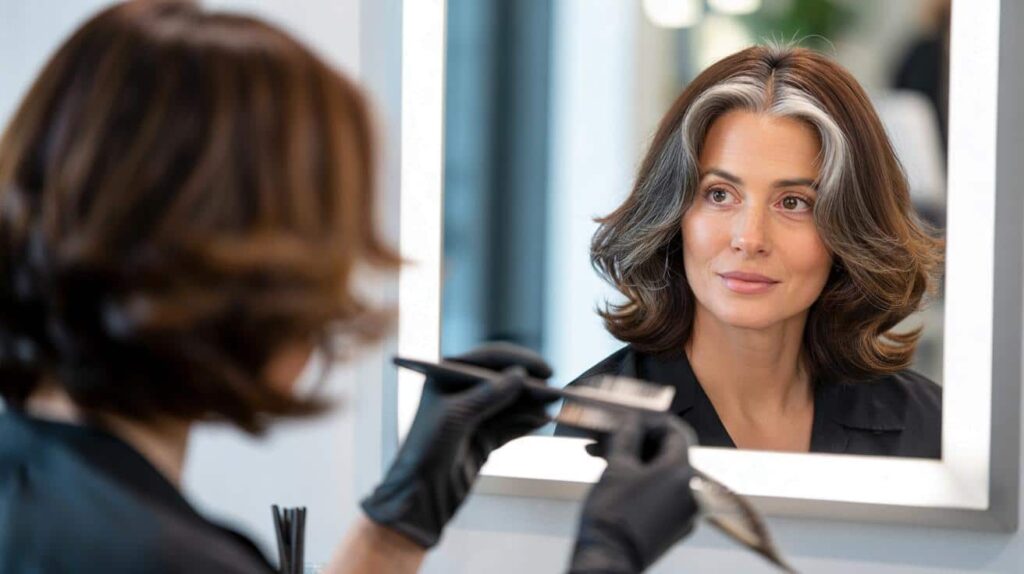
From statement balayage to invisible gray: why “melting” is taking over
Walk into any urban salon right now and you’ll hear it at least once: “Forget balayage, I want something easier.” People are tired of the stripey grow-out, the constant touch-ups, the race against the incoming gray. Hair melting responds to this quiet fatigue. It’s a coloring technique where shades are fused so smoothly that you can’t see where one color begins and another ends. No more chunky contrast between root and lengths. No clear “line” of highlights. Just a soft transition, like light fading at sunset. It’s less about “look at my color” and more about “something just looks right”.
Picture this scenario. A 42-year-old journalist with naturally dark brown hair & about 20% gray at the front comes in with two-year-old balayage. The ends are blonde and the roots are dark and the gray stands out under the studio lights. Her colorist skips the traditional foiling method. Instead they apply a deeper natural-looking shade at the roots and then a lighter tone on the mid-lengths and a subtle gloss toward the ends. Using a brush and fingers they blur the areas in between and stretch the product like watercolor. After rinsing the gray is still technically there but visually it blends into the rest. The eye no longer focuses on the silver strands but instead sees the whole picture.

What’s happening is almost optical. Our brain notices harsh contrasts. A dark root against a pale blonde mid-length. A white hair against a uniform brown background. Melting reduces those contrasts with a gradient of neighboring tones that overlap slightly. The gray isn’t erased; it’s surrounded by tones that are close to it, so it stops screaming. The result is **softer, less high-maintenance, more forgiving**. Especially when life doesn’t leave space for monthly salon appointments and complex home routines. It’s hair color that works with reality, not against it.
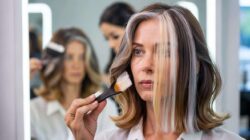 Goodbye balayage: “melting,” the new coloring technique that makes gray hair almost unnoticeable
How hair melting actually works (and how not to ruin it at home)
From a technical perspective melting involves more than simply blending roots. The process begins by selecting three shade groups: a base color for the roots, a transitional tone for the middle sections & a lighter or more vibrant finish for the ends. All shades must belong to the same color family whether cool warm or neutral. The colorist first applies the root shade, which is typically slightly darker than your natural color to create a solid foundation. Next a second mixture appears with a gentler tone that overlaps the first application. Finally a lighter glaze is worked through the ends and then softened into the middle sections. The application uses gentle diagonal brush movements and often includes finger blending to eliminate any harsh lines.
At home the biggest mistake is trying to maintain your color by using any box dye & applying it everywhere from roots to tips. This is the fastest way to ruin the gradient effect. The color becomes flat and the gray shows up again with harsh lines after just two weeks. Your expensive melting treatment suddenly looks like a single flat color. Another common error is choosing very dark shades to cover everything. On hair that tends to go gray dark colors actually make white roots stand out even more. The beauty of melting comes from its semi-transparent quality and how light moves across your hair rather than complete coverage. The truth is that almost nobody maintains a professional coloring schedule every month.
The colorists who are really good at melting talk about it almost like painting. One Paris stylist put it this way:
“Balayage was about drawing. Melting is about blurring. I’m not fighting the gray anymore, I’m diffusing it.”
To keep the effect as long as possible, they usually recommend:
- Using sulfate-free, color-friendly shampoos that don’t strip the gloss
- Spacing washes when you can, to avoid fading the subtle tones too fast
- Booking a simple toner or gloss every 6–10 weeks instead of a full color marathon
- Staying within your natural tone family: warm stays warm, cool stays cool
- Accepting that *a little* gray showing through can actually look chic and modern
Gray hair, self-image, and this quiet new kind of chic
Something deeper is happening behind this shift from balayage to melting. There’s a generational movement where we don’t necessarily want to look “forever 28”, yet we’re not ready to let gray take over in one go either. Melting lands right in that tension. It doesn’t promise eternal youth. It promises soft transitions. The hair matches the age of the face, without that harsh gap between ultra-bleached ends and grown-out roots. It feels like saying, “Yes, I have some gray. No, it doesn’t define me.” Gray becomes a note in the chord, not the entire soundtrack. A lot of women say they feel strangely relieved walking out of the salon: less “done”, more themselves.
➡️ Under Antarctica, There’s A Hidden World

➡️ More and more people are wrapping their door handles in aluminum foil — and the reason behind this odd habit is surprisingly practical
➡️ Pensions will rise from February 8 but many retirees will be brutally cut off because the state buried the paperwork in fine print
➡️ Few people realize it, but France has become the only European nation able to build fighter jet engines with such extreme precision, raising questions about innovation and military escalation
➡️ Nine shocking things you should still be doing at 70 if you really want people to envy your old age and say I hope I am not that boring when I am older
➡️ Scientists drill through two kilometers of Antarctic ice to reach a 34 million year old lost world and now face accusations of playing god with a planet that is already breaking down
➡️ They are building the world’s longest high-speed underwater train : it will run beneath the ocean and link two continents in minutes
# The Star Haircuts of 2026: A Hairstylist Reveals the 4 Styles to Adopt Right Now
Hair trends are constantly evolving & 2026 promises to bring fresh and exciting styles to the forefront. A professional hairstylist has identified four key haircuts that are set to dominate salons and red carpets this year. These cuts combine practicality with modern aesthetics and offer something for everyone regardless of hair type or personal style. The first standout style is the textured bob. This versatile cut sits somewhere between chin & shoulder length & features layers that create natural movement. Unlike the blunt bobs of previous years this version embraces a more relaxed and lived-in appearance. The textured bob works particularly well for those who want a polished look without spending hours on styling. It flatters most face shapes and can be adapted to suit both straight and wavy hair textures. Next on the list is the modern shag. This cut has made a strong comeback and continues to gain popularity heading into 2026. The modern shag features choppy layers throughout and creates volume at the crown while maintaining length at the ends. This style works beautifully on medium to long hair and gives off an effortlessly cool vibe. It requires minimal styling effort as the layers naturally fall into place and the intentionally messy finish means perfection is not the goal. The third trending haircut is the blunt lob with curtain bangs. The long bob remains a classic choice but adding curtain bangs gives it a contemporary update. These face-framing bangs part down the middle and sweep to either side softening facial features and drawing attention to the eyes. The blunt cut at the ends creates a clean and sophisticated line while the bangs add a touch of playfulness. This combination suits oval & heart-shaped faces particularly well. Finally the pixie cut with longer layers is making waves in 2026. This is not the ultra-short pixie of the past but rather a more grown-out version with added texture and dimension. The longer layers on top allow for styling versatility while the sides and back remain shorter for that signature pixie shape. This cut is perfect for those who want a bold statement without committing to extremely short hair. It highlights facial features and works especially well for those with fine hair as it creates the illusion of thickness. All four of these haircuts share common characteristics that make them ideal for the modern lifestyle. They are relatively low maintenance compared to more complex styles and they grow out gracefully without requiring frequent salon visits. Each cut can be personalized with different styling techniques & products to match individual preferences. When considering a new haircut it is important to consult with a professional stylist who can assess your hair type & face shape. What works beautifully on one person may need adjustments for another. A skilled hairstylist will take into account your daily routine & styling abilities to recommend the best option. The beauty of these 2026 trends is their adaptability. Whether you prefer a sleek and polished finish or a more casual and tousled look these haircuts provide the foundation for multiple styling options. They work for both professional settings and casual weekends & transition easily between different occasions. Hair color also plays a significant role in enhancing these cuts. Balayage & subtle highlights can add depth to the textured bob and modern shag while a solid color can emphasize the clean lines of the blunt lob. The pixie cut looks stunning with bold color choices or can be kept natural for a more understated elegance. These four haircuts represent the direction that hair fashion is taking in 2026. They move away from overly structured styles and embrace natural texture and movement. The focus is on cuts that enhance rather than fight against your hair’s natural tendencies. This approach not only saves time but also promotes healthier hair by reducing the need for excessive heat styling and chemical treatments. As you consider updating your look this year keep these trending styles in mind. They offer a perfect blend of contemporary style and practical wearability that fits seamlessly into busy modern lives.
| Key point | Detail | Value for the reader |
|---|---|---|
| Melting diffuses gray | Uses close, overlapping tones to reduce visible contrast with silver strands | Makes gray less noticeable without the pressure of total coverage |
| Lower maintenance than balayage | Softer regrowth, can be refreshed with glosses and toners instead of full foils | Saves time, money, and stress between salon visits |
| More natural, age-harmonious result | Roots, lengths, and ends flow together in a subtle gradient | Hair looks modern and flattering without feeling artificial or “try-hard” |
FAQ:
- Is melting better than balayage for hiding gray hair?For partially gray hair, melting often works better because it softens contrast instead of creating light streaks that can highlight silver strands. Balayage can still be gorgeous, but melting is usually kinder to regrowth.
- Can melting be done on very dark hair with gray?Yes, as long as the colorist stays close to your natural depth and uses slightly lighter or neutral tones around the gray to blend it, not fight it. Going too dark will make the white regrowth pop more.
- How long does a hair melting service last?On average, the effect stays soft for about 8–12 weeks. The gradient grows out quietly, so you can often stretch appointments longer than with classic root touch-ups or strong balayage.
- Can I maintain hair melting at home?You can maintain the shine and tone with color-depositing masks and gentle shampoos, but the blending itself is best left to a pro. At home, think “refresh”, not “redo”.
- Does melting damage hair less than balayage?Usually, yes, because it often involves more glossing and toning and less heavy bleaching, especially on already-colored hair. The key is working with a good colorist and not stacking aggressive processes too close together.
