
Just before dawn, the kind of cold that bites through two layers of clothing settles on the neighborhood. Breath hangs in the air like tiny clouds, car doors stick a second longer than they should, and the dog refuses to leave the front step. The weather app still says “-4°C feels like -9°C,” but it feels worse when you’re fumbling for keys with numb fingers. Somewhere far above this sleepy street, satellites and radar are watching the same chill we’re feeling, stacking up, consolidating.
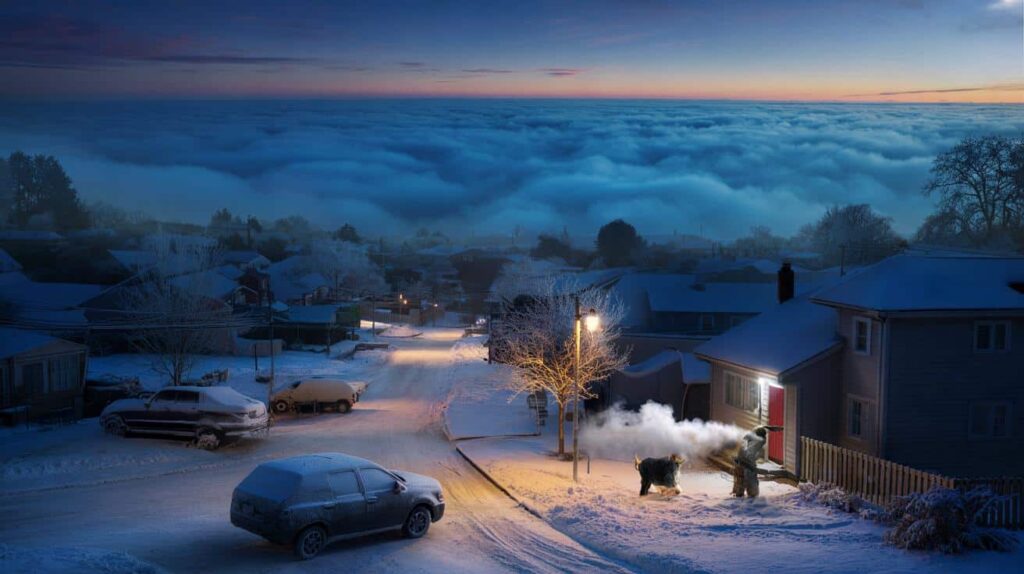
Meteorologists have a name for what’s building: a “cold dome.”

The quiet weather monster building above our heads
Across forecasting centers this week, screens are turning an alarming shade of blue. High-altitude charts show a bulge of dense, frigid air sagging southward, like a slow-motion avalanche in the sky. This is the cold dome: a thick pool of heavy Arctic air that settles close to the ground and refuses to move.

On paper it looks technical and sterile, just numbers and isobars. Down here, at human level, it will mean biting wind, frozen pipes, and fields that crunch underfoot for days without thawing. The real trouble starts when that dome locks into place.

In central and eastern regions, forecasters are already quietly adjusting their early-February maps. A few days ago, the models hinted at a short cold snap. Now, run after run, they’re converging on something more stubborn, and frankly more brutal.
One European model shows nighttime lows dropping 8 to 10 degrees below seasonal norms and then staying there. Another American model suggests the dome could deepen if fresh Arctic air slides over the top like a lid. We have all experienced that moment when the forecast suddenly changes from chilly to dangerously cold overnight. That is what has meteorologists concerned right now.
A cold dome happens when thick cold air gathers near the ground beneath a powerful high-pressure system that stays in place. Picture it like a heavy lid pressing down on the atmosphere that keeps freezing air stuck close to the surface. The warmer air floating above cannot easily sink down and mix with it so the cold air simply remains there for days at a time. This weather pattern creates a stable situation where the cold air becomes trapped. The high-pressure system acts as a barrier that prevents the normal movement of air masses. Without this mixing the temperature stays consistently low across the affected region. The cold dome can last for extended periods because the atmospheric conditions that created it remain steady and unchanged.
Snow cover in the area can make the situation more severe by reflecting sunlight away from Earth and letting the ground lose heat into the open sky at night. When you combine this with cloudless evenings and calm air the temperature can drop rapidly. This is the process by which a minor cold period gradually develops into a stronger frost event in early February.
How to live under a ‘cold dome’ without losing your mind (or your pipes)
The first rule of a cold dome is simple: act two days earlier than you think you need to. Don’t wait for the “extreme cold warning” banner to flash on your phone. If meteorologists start whispering about an entrenched Arctic air mass, that’s your cue.
Wrap exposed pipes, bleed outdoor taps, and check the weak spots in older windows where drafts slide through like invisible knives. If you park outside, lift your wipers, check your battery, and throw a blanket and scraper in the trunk. It sounds dull compared with the drama of satellite images, yet this is the kind of prep that turns a dangerous week into an annoying one.
# Good News: Gas Stations Must Display New Mandatory Information at Pumps Starting February 12
Starting February 12 all gas stations will be required to show new mandatory information directly at their fuel pumps. This change aims to provide drivers with clearer details about the fuel they are purchasing. The new regulation means that every time you pull up to fill your tank you will see additional information displayed on the pump itself. This requirement applies to all service stations across the country without exception. The mandatory information will help consumers make more informed decisions when choosing their fuel. Gas station owners have been given advance notice to prepare their equipment and ensure compliance with the new rules. This initiative is part of broader efforts to increase transparency in the fuel industry. Drivers will benefit from having important details readily available at the point of purchase rather than having to search for information elsewhere. The regulation takes effect on February 12 and all gas stations must comply by that date. Stations that fail to display the required information may face penalties or fines from regulatory authorities. For consumers this means a more straightforward experience at the pump. The new labels will be standardized across all locations making it easier to compare options & understand what you are buying. Gas station operators have been working to update their pumps ahead of the deadline. The changes represent a significant step forward in consumer protection and market transparency. This development has been welcomed by consumer advocacy groups who have long pushed for better information disclosure at fuel retailers. The new requirement ensures that essential details are visible to every customer at every visit.
➡️ Goodbye hair dye : the new trend to cover gray hair and look younger
➡️ Did French politics kill a €3.2 billion Rafale deal a bitter fallout over a last minute decision that could haunt the defense industry
➡️ A true living fossil: French divers capture the first-ever images of an iconic species in the depths of Indonesian waters
# Sleep: Why Night Owls Face a 16% Higher Risk of Cardiovascular Events
People who stay up late and sleep in may face serious health consequences. Recent research shows that night owls have a 16% higher risk of experiencing cardiovascular problems compared to early risers. This finding adds to growing evidence that our sleep patterns affect more than just how tired we feel during the day. The human body operates on an internal clock called the circadian rhythm. This biological system regulates when we feel alert and when we feel sleepy. It also controls many other bodily functions including hormone release & blood pressure. When people consistently go against their natural circadian rhythm by staying up late, they may be putting extra strain on their cardiovascular system. Scientists have studied thousands of people to understand the connection between sleep timing and heart health. The research reveals that those who prefer evening activities & late bedtimes show higher rates of heart disease and stroke. This increased risk remains even after accounting for other factors like diet and exercise habits. Several mechanisms may explain why night owls face greater cardiovascular danger. Late sleepers often have irregular eating patterns and may consume more unhealthy foods during nighttime hours. They also tend to get less exposure to natural daylight which affects vitamin D levels & mood regulation. Also, staying up late can disrupt the body’s natural repair processes that typically occur during sleep. The modern world often forces people to wake up early regardless of their natural preferences. Night owls who must rise early for work or school may accumulate sleep debt over time. This chronic sleep deprivation can lead to elevated blood pressure and increased inflammation throughout the body. Both of these conditions are known risk factors for heart disease. Experts recommend that people try to align their sleep schedule with their natural tendencies when possible. However, they also acknowledge that work and family obligations make this difficult for many individuals. For those who cannot change their schedule maintaining consistent sleep & wake times even on weekends may help reduce some of the negative health effects. Understanding your chronotype or natural sleep preference can be the first step toward better health. While some people cannot completely change when they sleep they can make adjustments to minimize cardiovascular risk. These changes might include getting more morning light exposure, avoiding caffeine in the afternoon, & creating a relaxing bedtime routine. The 16% increased risk may seem small but it becomes significant when applied to large populations. Millions of people identify as night owls, which means this sleep pattern could contribute to substantial numbers of preventable cardiovascular events. Public health officials are beginning to recognize that sleep timing deserves as much attention as sleep duration in health recommendations.
 Heavy snow expected starting tonight
➡️ Frugal living expert Kate Kaden shares 6 practical and realistic tips for living comfortably below your means
➡️ A bowl of salt water by the window in winter: this simple trick works just as well as aluminum foil in summer
➡️ Gray hair: the “micro contour crop” is the ideal short haircut to rejuvenate salt and pepper hair after 50
People often underestimate the grind of multiple frost days in a row. The first morning feels almost refreshing, a reminder that winter still has teeth. By day four, your skin is raw, the house feels drier than a desert, and every door handle is a small act of courage.
The biggest mistake? Treating an extended frost like a one-night cold snap. Thin gloves, quick dashes outside without a hat, running the heating low “to save a bit” – these habits slowly stack up into colds, fatigue, and burst pipes. *Cold domes don’t punish one bad decision, they punish repeated tiny ones.*
Meteorologist Claire Dubois put it bluntly on local radio this week: “What worries us isn’t the single -12°C night. It’s four or five nights in a row, with no real thaw during the day. That’s when the stress on homes, roads, and bodies really shows up.”
During a prolonged frost, think in layers, not heroics. That goes for clothing and for your daily routine. Plan short, purposeful trips instead of lingering outside. Warm the car fully before long drives, especially with kids or older relatives.
- Inside your home: Open cupboard doors under sinks at night so warm air reaches pipes. Let a small trickle run from taps during the iciest hours if your plumber recommends it.
- On the road: Keep fuel above half a tank, carry a charger, gloves, and a basic blanket. Black ice loves extended cold spells.
- Your body: Hydrate more than you think, use lip balm and hand cream, and take warm breaks instead of “toughing it out.”
- Your schedule: Batch errands for the warmest hours of the day. Rearrange early-morning activities if the deep freeze peaks before sunrise.
Let’s be honest: nobody really does this every single day. Yet the people who suffer least from a cold dome are the ones who treat it more like a marathon than a photo moment for social media.
The bigger story behind the early-February frost
Behind the local forecasts and school-closure debates lies a larger, uneasy question: why are these intense, locked-in cold domes showing up against a backdrop of overall warming? It feels paradoxical. The planet averages hotter, yet your front step feels like Siberia. Scientists have been wrestling with this too.
Some research suggests that the polar vortex has become less stable & the jet stream has been disrupted. This allows Arctic air to move south more frequently or stay in place for longer periods. Other studies take a more careful approach and point out that natural climate patterns still have a major influence on these events. What scientists do agree on is that communities are experiencing more severe temperature extremes in both directions.
What this developing cold dome might really expose isn’t just weak infrastructure, but fragile routines. Heating systems running at full tilt show where homes leak energy. Transport networks built for “typical winters” creak when frost bites for a week straight. Neighbors who barely nod hello in autumn suddenly swap salt, blankets, and extension cords like lifelines.
There’s a strange, almost old-fashioned intimacy that comes with shared cold. People text, “You okay? How’s your boiler? Need anything?” That quiet thread of care may end up being as crucial as any radar loop or forecast chart.
As early February approaches, the forecast is still a living thing. Models will sharpen, the exact path of the cold dome will be nudged by tiny shifts in wind and cloud. Maybe your town catches the worst of it, with ice fog and roads that sparkle in a way that’s beautiful and slightly menacing. Maybe you sit just on the edge, watching headlines about “historic frost” while your own thermometer only flirts with it.
Either way, this kind of weather leaves stories behind. The week your pipes just held. The morning the car refused and a stranger gave you a jump start. The walk where the air hurt but the sky was so clear you could almost touch the stars. These are the kind of cold snaps we end up talking about years later, long after the charts have vanished from the meteorologists’ screens.
| Key point | Detail | Value for the reader |
|---|---|---|
| What a “cold dome” is | Pool of dense Arctic air trapped near the ground under high pressure | Helps you understand why the cold feels so intense and persistent |
| Why early-February frost may intensify | Model agreement on several days of below-normal temperatures with snow cover feedback | Gives you time to prepare your home, car, and routine |
| How to cope practically | Simple steps: protect pipes, adjust outings, layer clothing, check on others | Reduces risk of damage, health issues, and stressful last-minute reactions |
FAQ:
- What exactly is a “cold dome” in weather terms?A cold dome is a large, stable mass of very cold, dense air that settles near the surface under a strong high-pressure system. Because the air is heavy and the atmosphere is stable, it can linger for days, locking in frost.
- How long can a cold dome and its frost last?Typically from a few days up to a week or more, depending on how quickly the pressure pattern shifts. The danger grows when nighttime lows stay well below freezing for several days without daytime thaw.
- Is this kind of early-February frost linked to climate change?The relationship is complex and still studied. While the planet is warming overall, some researchers think a disrupted jet stream may allow more frequent or persistent cold outbreaks in certain regions.
- What’s the best way to protect my home during a deep freeze?Insulate or wrap exposed pipes, close drafts, keep consistent heating, open under-sink doors on the coldest nights, and follow local guidance. For very vulnerable areas, a slow drip from taps can help prevent freezing if recommended by a professional.
- How early should I start preparing if meteorologists mention a cold dome?As soon as forecasts show a strong, sustained cold spell in the 3–5 day window, start with basic checks: heating, pipes, car, and winter clothing. Acting early spreads tasks out and reduces last-minute stress when the real frost hits.
