
The first thing you notice isn’t the absence of a kitchen island.
It’s the way people move. No one squeezes sideways past a hulking block of marble, no one shouts “excuse me” with a hot pan in their hands. In this newly renovated 2026 apartment, the kitchen feels almost… calm. The central space is wide open, the light reaches every corner, and where you’d expect a massive island, there’s something else entirely: a slender, elegant peninsula that hugs the wall, half bar, half workspace, with stools tucked neatly underneath.
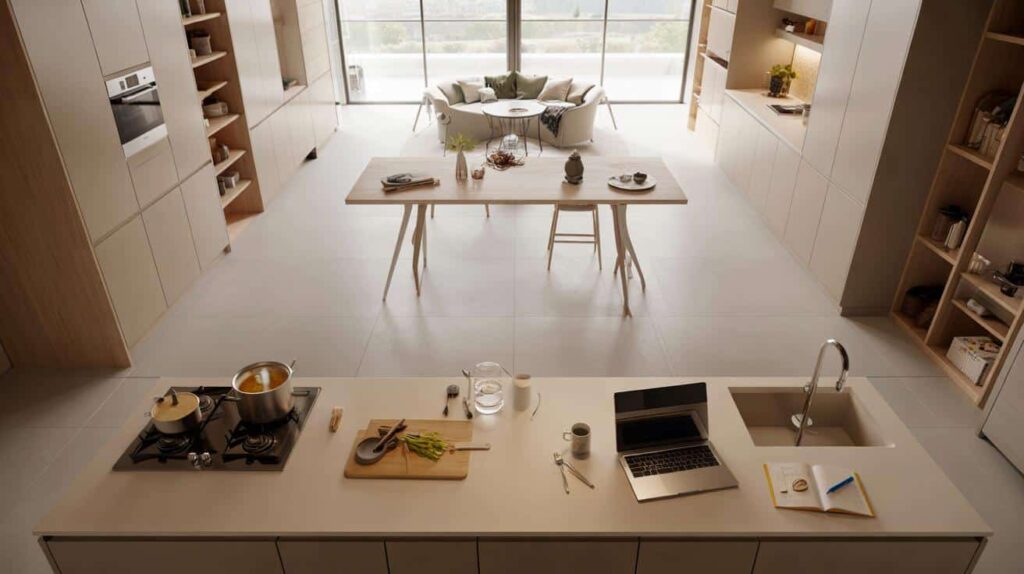
Friends lean against it, kids do homework there, a laptop is open next to a simmering pot. The room feels social without being cramped.
Something has quietly changed in the heart of the home.

Why the classic kitchen island is slowly stepping aside
Walk into any new-build brochure from the 2010s and you’ll see it: the glorified kitchen island.
A glossy rectangle planted in the middle of the room like a monument, surrounded by four perfect stools and a bowl of lemons. On Pinterest, it still looks dreamy. In real life, especially in smaller or long, narrow spaces, it often feels like placing a sofa smack in the center of a hallway. You end up bumping into corners, circling around constantly, and losing precious circulation space.

The 2026 trend isn’t about giving up counter space or storage.
It’s about reclaiming how a kitchen actually works when people cook, talk, and live there every day.

Talk to renovators right now and they’ll tell you the same story. A Paris couple tears out their oversized island and replaces it with a slim peninsula attached to the wall. A family in Austin ditches a solid block of cabinetry and brings in a freestanding “kitchen table” on wheels: drawers below, butcher block on top, power outlet discreetly integrated in the leg.
Estate agents are noticing it too. Some report buyers walking into open-plan kitchens and saying, “Love the light, but this island is way too big.”
The new dream isn’t a giant slab in the middle, it’s a flexible central zone that can shift between breakfast bar, prep area, buffet station and home office.
The logic is simple: islands ate up floor space to prove you had one.
The new trend, a mix of peninsulas, integrated dining counters and double-duty kitchen tables, gives that space back to your body. Movement becomes more fluid, cleaning is easier, and the room can adapt to different moments of the day. When you push furniture away from the center and anchor it to walls or semi-open partitions, circulation lines straighten, sightlines open and the kitchen breathes.
Let’s be honest: nobody really uses a massive island like a TV ad every single day.
People perch for a quick coffee, scatter paperwork, open parcels, drop bags. The 2026 replacement trend accepts this messy reality and designs for it, instead of fighting it.
The 2026 replacement: peninsulas and hybrid kitchen tables
So what’s actually taking the place of the island?
Designers talk about it as a hybrid: a **kitchen peninsula or table-bar**, attached on one side or visually anchored, that extends your main counter instead of blocking the middle. Think of an L-shaped or U-shaped layout where one arm stretches out like a pier into the room, rather than a detached block.
The trick is proportion.
Depths of 60–80 cm instead of 100–120. Slim legs instead of full cabinetry underneath, at least on the side facing the living room. One or two stools, not six. This small shift turns what used to be a static chunk into a light, versatile piece that works as both dining surface and prep space.
➡️ After 250 years, a lost explorer’s ship is found perfectly preserved off Australia’s coast, a true time capsule from another era
➡️ Good news: from February 12, gas stations will have to display this new mandatory information at the pump
➡️ A veterinarian explains the simple method that stops dogs from barking without shouting or punishment
The ranking of the worst European airlines for 2025 shows Wizz Air in third place while Ryanair has been pushed off the podium. Recent evaluations of European airline performance have revealed significant changes in customer satisfaction rankings. The latest assessment places Wizz Air among the bottom three carriers operating across the continent. This represents a notable position for the budget airline that has faced ongoing criticism regarding its service standards. Ryanair has experienced an unexpected shift in the rankings. The Irish low-cost carrier no longer occupies one of the three worst positions despite its historical reputation for controversial customer service policies. This development suggests either improvements in Ryanair’s operations or a decline in performance among competing airlines. The methodology behind these rankings typically considers multiple factors including punctuality rates, baggage handling efficiency, customer service quality & overall passenger experience. Airlines receive scores based on complaint volumes, delay statistics & satisfaction surveys conducted throughout the year. Budget carriers have traditionally dominated the lower end of these rankings due to their business model prioritizing cost reduction over passenger comfort. However the specific positioning of airlines can vary significantly from year to year based on operational changes and customer feedback trends. The presence of Wizz Air in third place indicates persistent challenges for the Hungarian airline. Common complaints about Wizz Air include hidden fees uncomfortable seating arrangements & limited customer support options. The airline has expanded rapidly across Europe in recent years but this growth has apparently come at the expense of service quality. The identity of the two airlines performing worse than Wizz Air remains a point of interest for travelers planning European trips. These rankings serve as valuable guidance for passengers weighing cost savings against potential service frustrations when booking flights. Industry analysts note that low-cost carriers face inherent tensions between maintaining profitability and meeting customer expectations. The competitive European aviation market forces airlines to make difficult choices about where to allocate resources.
A polar vortex anomaly is moving closer and forecasters say the speed and configuration of this system challenge decades of winter climate data. Weather experts are tracking an unusual polar vortex event that differs significantly from typical winter patterns. The system is developing faster than historical records show and its structure does not match previous observations from the past several decades. Meteorologists note that this polar vortex behaves differently than expected based on established climate models. The rapid development and unique characteristics of the current system have prompted scientists to examine whether this represents a new pattern in atmospheric behavior. The polar vortex is a large area of cold air that normally circulates around the Arctic region. When this system weakens or shifts position it can send frigid air southward into regions that typically experience milder winter conditions. Current data shows this particular vortex is moving & changing shape in ways that do not align with conventional forecasting methods. Scientists are monitoring the situation closely to understand what factors might be driving these unusual characteristics. This event raises questions about whether climate patterns are shifting in ways that existing models have not fully captured. Researchers are comparing current observations with historical data to determine if this represents an isolated incident or part of a larger trend. The implications for winter weather could be significant depending on how this system continues to develop. Forecasters are working to predict potential impacts while acknowledging the uncertainty created by the unusual nature of this polar vortex event.
➡️ “I used to overfeed my plants” until I noticed this clear sign of imbalance
➡️ Sorry, the Matrix doesn’t exist: new mathematical proofs suggest the universe cannot be a simulation
➡️ Scientists celebrate monstrous snake discovery in remote wilderness but locals ask if worshipping a predator this size is insanity or progress in the name of science

The most successful examples are the quiet ones.
In a renovated 1970s house outside Milan, the owners extended their worktop along the wall, then curved it gently at the end to form a peninsula for two stools. No huge stone waterfall, no show-off lighting. Just a warm oak surface where one person can chop vegetables while another scrolls on their phone with a glass of wine.
In a compact London flat, the “island” is actually a high table on casters, locked into place most of the time but free to move when they host.
During the week, it hugs the wall as a desk and breakfast spot. On Friday nights, they pivot it and suddenly the whole kitchen-living space feels like a bar. *You can almost hear the room exhale when the furniture cooperates with real life.*
These solutions work because they obey a few quiet rules.
They respect the cooking triangle between sink, hob and fridge, instead of blocking it. They leave at least 90 cm, ideally 110–120 cm, of circulation around the cooking zone so more than one person can pass without touching. They keep the bulk of storage on the perimeter and treat the central element as lightweight: open shelves, bar structure, or just legs.
Psychologically, removing a big block from the middle changes how you feel.
The kitchen stops being a fortress and becomes a generous corner of the living space. A peninsula or hybrid table feels like an invitation, not a border you have to walk around.
How to pivot away from an island without ruining your layout
If you already have an island, the idea of saying goodbye to it can feel radical.
Start by watching how you move in your kitchen for a few days. Do you constantly walk around the island to reach the sink or fridge? Does it become a dumping ground for everything that comes through the door? Do guests tend to lean on just one side, leaving the rest unused?
Once you’ve seen the patterns, sketch a version of your kitchen with the island removed.
Then test a peninsula: extend your main run of cabinets into the room on one side, either fixed to a wall or back of a tall cabinet. Leave a generous open core in the middle. If you’re renting or not ready for major works, you can mimic the effect with a slim bar-height table attached to the wall with brackets and one visible leg.
Many people fall into the same trap: replacing one bulky piece with another.
They rip out an island, then bring in an oversized farmhouse table jammed into the gap. The room still feels blocked, just with different furniture. Renovation fatigue makes you cling to the idea that “more surface solves everything”, when what you actually need is smarter surface.
Be kind to yourself if this sounds familiar. We’ve all been there, that moment when you’re balancing a chopping board on the tiniest bit of clear counter and wondering why the kitchen looks like a showroom but works like a puzzle.
Try aiming for a bit less volume and a bit more emptiness. That breathing space is what turns a pretty kitchen into a livable one.
A designer who has been following the change explained it in simple terms:
“People don’t want a stage in the middle of the room anymore, they want a friendly edge to lean on,” says interior architect Lena Ortiz. “The peninsula, the high table, the integrated bar — they’re all just different versions of that friendly edge.”
To translate this “friendly edge” idea at home, focus on three levers:
- Lightness: choose slimmer worktops, open legged bases, or partial cabinetry so the central piece doesn’t feel like a wall.
- Connection: orient the seating side toward the living room or window, not toward the hob, so conversations feel natural.
- Flexibility: integrate power outlets, a dimmable pendant and maybe wheels or removable legs so the element can evolve with you.
A kitchen that allows for small adjustments as your needs evolve will see more daily use and remain a valued space in your home for many years. Designers consistently emphasize this straightforward principle when planning functional cooking areas.
A kitchen without an island, but with a stronger soul
If the 2000s were obsessed with the idea of a “statement island”, 2026 feels like the quiet revenge of layouts that simply work.
The new generation of peninsulas and hybrid kitchen tables doesn’t scream for attention at first glance, yet they shape how families talk, eat and move every day. A teenager doing homework on a bar edge while someone stirs a sauce, a partner sending one last email from a stool while the kettle boils, a friend leaning on the corner during a long conversation — these are small gestures, but they write the real story of a home.
You might discover that clearing the center of the room helps you notice other details. Light moves differently from window to window. Walking directly from the sink to the fridge becomes easier. Your kitchen feels larger even though the actual size has not changed.
Trends will continue to change over time. Kitchen islands might return someday in a more subtle and streamlined version. Right now a quiet shift is already happening in kitchen design. This is not about having less kitchen space but rather creating a different type of focal point. The new approach places key elements along the walls and keeps the middle area open so daily activities can flow through the space more easily.
| Key point | Detail | Value for the reader |
|---|---|---|
| Shift from island to peninsula/hybrid table | Anchored surfaces along walls or cabinets, slimmer and lighter | More circulation space, easier movement, less visual clutter |
| Design rules that actually work | Respect work triangle, keep 90–120 cm clearances, treat center as “empty” | Reduces daily frustration and makes cooking with others more pleasant |
| Focus on flexibility over showpiece design | Movable tables, integrated outlets, adaptable seating and lighting | Layout evolves with changing needs, extending the life of your renovation |
FAQ:
- Do I need a huge kitchen to skip the island trend?
No. Smaller and medium kitchens benefit the most from losing a central block. A slim peninsula or wall-attached bar can create more useful surface without shrinking your walking space.- Will removing my island hurt my home’s resale value?
Buyers are increasingly looking for kitchens that feel open and easy to move in, not just “islands at any cost”. A well-designed peninsula or hybrid table can be just as attractive, sometimes more.- What if I love hosting and need space to serve food?
A peninsula or mobile kitchen table works perfectly as a buffet zone. You can push stools aside when guests arrive and treat the surface like a bar, then roll or slide it back for everyday life.- Can I keep storage if I say goodbye to a bulky island?
Yes, by shifting storage to tall perimeter units, deep drawers and smart corners. The central element can still hide some storage, just with lighter volumes or open shelves.- Is this just another passing trend?
Trends come and go, but the underlying logic — better circulation, flexible furniture, less visual weight — solves real daily problems. That’s usually a sign it will age well, even if styles change around it.
