
At 6:15 in the morning the bus shelter on the edge of town looks like a temporary waiting room for a world that has forgotten its older people. They wear coats pulled tight against the wind & keep shopping trolleys near their feet while balancing plastic lunch boxes on their knees. These people are not workers heading out to build a future. They are retired people trying to make it through one more month.
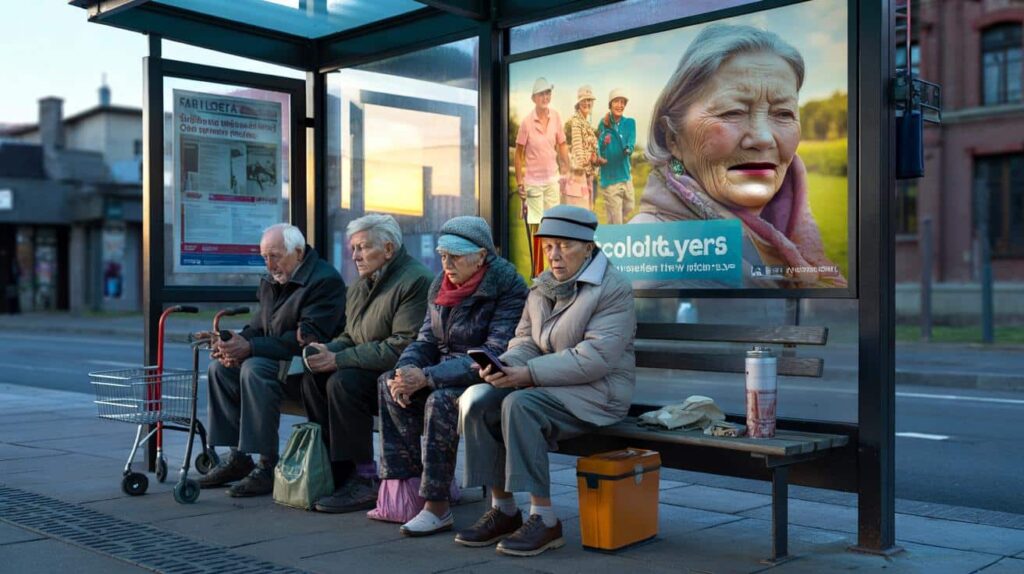
One woman, grey hair tucked under a faded cap, scrolls through her phone as a TV anchor beams about “record employment” and “historic growth”. She snorts quietly, then tucks the phone away and hoists her cleaning bag.

The bus arrives. They climb on slowly, joints cracking, tickets beeping.

Behind them, the ad on the shelter gleams with perfect teeth and the slogan: “Enjoy your golden years.”

Nobody laughs.
When “retirement” comes with a punch clock
Across Europe and North America, an invisible workforce is quietly expanding: exhausted seniors who were told they’d earned a rest and now find themselves punching back in. Some have official part-time jobs. Others stack odd gigs, paid in cash or via apps, just to keep their heads above water.
The political story sounds so bright: unemployment at lows, stock markets at highs, growth curves pointing up. Yet at eye level, the reality looks different. You see it in supermarket aisles at 10 p.m., when a 72-year-old is still filling shelves. You hear it in drained voices calculating whether they can pay rent and heating from the same pension cheque.
Retirement for an increasing number of people who combine pensions and work now means one thing: working twice while earning once. Many retirees today find themselves in a frustrating situation. They continue to work during their retirement years but do not see their income increase proportionally. The system allows them to collect pension benefits while remaining employed. However the financial reality often disappoints them. This trend reflects a broader shift in how retirement functions in modern society. The traditional model of complete withdrawal from the workforce has given way to a hybrid approach. People maintain some level of employment while accessing their retirement benefits. The motivation varies from person to person. Some work because they need additional income to maintain their standard of living. Others continue working because they enjoy staying active & engaged. The term “cumulants” refers to individuals who accumulate both pension income and wages from continued employment. This group has expanded significantly in recent years. Economic pressures and longer life expectancies have made pure retirement less feasible for many. Healthcare costs continue to rise and pension benefits often fail to keep pace with inflation. The complaint about working twice but earning once highlights a key frustration. These workers feel they contribute labor without receiving fair compensation for their efforts. Tax structures and benefit calculations sometimes create situations where additional work yields minimal financial gain. The marginal benefit of continued employment can be surprisingly small after accounting for taxes and potential reductions in other benefits. This phenomenon raises important questions about retirement policy & economic fairness. Society must consider whether current systems adequately support people in their later years. The expectation that retirees should supplement their pensions through work may indicate structural problems with retirement security.
Take José, 69, a former factory worker who thought his last day on the line five years ago was the end of alarms at dawn. His pension lands in his account each month: 1,120 euros. His rent alone is 780. Electricity, food, public transport, a few pills his health insurance doesn’t cover – the math collapses in seconds.
So three nights a week, José cleans offices in a business park where young executives praise the “strong quarter” and ring bells when sales targets are hit. At 11:30 p.m., while they toast over craft beer, he wipes fingerprints off glass doors and empties bins full of catered sandwiches. He gets home close to 1 a.m., legs buzzing, back on fire.
➡️ One simple bathroom product is enough: why rats refuse to overwinter in gardens where it’s used
➡️ Meteorologists warn early February could expose extreme Arctic behavior unseen in decades
➡️ They pumped water into abandoned oil fields for years to keep great cities from sinking now geologists argue the cure may be worse than the disease
➡️ A solar belt around the Moon by 2035?
➡️ Landlord walks into tenant garden to pick fruit claiming it is all his a controversial story that questions what renting really means
➡️ Thousands of fish nests under Antarctic ice set off a storm as critics claim scientists are putting fragile life at risk for glory
# Meteorologists warn early February may bring Arctic conditions impacting animal navigation & survival
Weather experts are issuing alerts about potentially severe Arctic conditions expected to arrive in early February. These extreme cold weather patterns could create significant challenges for wildlife across affected regions. The incoming Arctic air mass is predicted to bring dangerously low temperatures that may disrupt normal animal behavior patterns. Many species rely on consistent environmental cues for navigation during winter months. When temperatures drop to unusual extremes these natural guidance systems can fail. Wildlife biologists express concern about how the cold snap will affect different animal groups. Migratory birds that typically pass through the region during this period may struggle to find food sources. Frozen water bodies will limit access to fish and aquatic plants that many species depend on for nutrition. Mammals face their own set of challenges during Arctic outbreaks. Deer and other herbivores will have difficulty accessing vegetation buried under ice & hardened snow. Predators may find hunting more difficult as prey animals change their movement patterns or seek shelter in protected areas. The extreme cold also threatens animals that are not fully adapted to Arctic conditions. Species living at the southern edge of their range may experience higher mortality rates. Young animals and those already weakened by winter conditions face the greatest risk. Marine life in coastal areas could also feel the impact. Sudden temperature drops in shallow waters may force fish to move to deeper areas or cause stress that makes them vulnerable to disease. Seabirds that feed in these zones may need to travel farther to find adequate food supplies. Conservation groups are preparing response plans to help wildlife during the cold period. Some organizations will set up feeding stations for birds and other animals. Wildlife rehabilitation centers are increasing their capacity to handle animals that may need emergency care. Meteorologists emphasize that residents should also take precautions. People who encounter distressed wildlife should contact local animal control or wildlife agencies rather than attempting direct intervention. Proper training is necessary to safely handle animals under stress. The duration of the Arctic outbreak remains uncertain. Current forecasts suggest the extreme cold could persist for several days to over a week. Extended periods of severe weather increase the cumulative stress on animal populations. Climate researchers note that while cold snaps are natural occurrences these events are becoming less predictable. Shifting weather patterns make it harder for wildlife to adapt using strategies that worked in previous generations. Animals that time their migrations or breeding cycles based on historical temperature patterns may find themselves out of sync with current conditions. Farmers and ranchers in affected areas are also taking steps to protect livestock. Providing adequate shelter & ensuring water sources remain accessible are top priorities. Domestic animals can suffer frostbite and hypothermia just as wild animals do. The situation serves as a reminder of how interconnected weather systems and ecosystems are. What begins as an atmospheric phenomenon in the Arctic can cascade through food webs & animal communities thousands of miles away. Understanding these connections helps scientists predict and prepare for wildlife impacts. Authorities recommend that people keep pets indoors during the coldest periods. Animals accustomed to indoor living lack the physical adaptations that help wild animals cope with extreme cold. Even breeds with thick coats can suffer when temperatures drop to dangerous levels. As the Arctic conditions approach wildlife agencies are monitoring animal populations closely. Early detection of problems allows for faster response & better outcomes. The coming weeks will test the resilience of many species and the effectiveness of conservation efforts designed to help them survive extreme weather events.
 Goodbye to the angled bob : the “anti-ageing” cut that restores volume to thinning hair after 55
➡️ Psychology explains how emotional exhaustion can feel exactly like a lack of motivation, and why the two are often confused
On paper, he’s retired. On his body, he’s not.
Economists refer to this as labour force participation among older adults. Politicians describe it as active aging and frame it as freedom of choice. The reality is much harsher: when pensions fail to keep pace with inflation and housing consumes half of every payment and health expenses continue to rise people do not choose to work. They simply have no other alternatives. The situation becomes clear when you examine the numbers. Retirement savings that seemed adequate a decade ago now fall short. The cost of basic necessities has increased while fixed incomes have remained stagnant. Medical bills arrive with increasing frequency and prescription costs climb steadily higher. Many older workers find themselves in positions they never anticipated. They expected to retire comfortably after years of employment & careful planning. Instead they face a choice between financial hardship and continuing to work well past traditional retirement age. This is not about seeking fulfillment through employment or staying mentally active. It is about paying rent and buying groceries and affording medication. The gap between political rhetoric and lived experience grows wider each year. Government officials speak about empowering seniors to remain engaged in the workforce. They highlight the benefits of staying active and contributing to society. Meanwhile the people they discuss are calculating whether they can afford both heating and eating. They are postponing medical appointments because of the cost. They are working despite chronic pain & exhaustion because the alternative is worse. This represents a fundamental shift in what retirement means. Previous generations could reasonably expect that their working years would end and their savings combined with pension support would carry them through. That social contract has eroded. The systems designed to provide security in old age no longer function as intended for many people.
The term “cumulants” sounds administrative, almost clean. In real life, it means double fatigue, double schedules, double anxiety. One eye on the calendar for the day your small contract ends. The other on the mailbox, waiting for yet another bill that eats your remaining margin.
This growing anger isn’t abstract. It’s a tired, low flame, fed day by day by the gap between press conferences and price tags.
Survival strategies in a world that forgot you
Behind every senior who keeps working, there’s a set of small tactics that most never imagined needing after 65. The lucky ones manage to negotiate *lighter* jobs: sitting at reception rather than lifting boxes, driving a school bus instead of working a full construction shift. Others scan local groups and town noticeboards for a few hours of babysitting, tutoring, or guarding a neighbour’s home.
A quiet resistance is growing: older workers are learning to say no to the most physically destructive shifts. Some demand written contracts rather than cash-only arrangements that vanish the moment they get sick. A few negotiate split weeks, working three intense days and resting four, so their bodies don’t completely give up.
These aren’t dreams of late-life travel. They’re tactical moves in a long endgame: hold on without breaking.
The mistake many seniors confess, with a mix of shame and bitterness, is having waited too long to bring others into their financial reality. Pride kept them silent. Children weren’t told the numbers. Friends never heard that the fridge was emptier than it looked.
So they accepted any job, at any rate, at any time. Night shifts that wrecked their sleep. Cleaning tasks that aggravated arthritis. Sales positions paid purely on commission, where a bad week meant zero. Let’s be honest: nobody really reads the fine print on a four-page contract when the rent is due in ten days.
Social workers and older activists suggest that a better approach begins with openly acknowledging that simply getting by is not something to be ashamed of. The struggle to survive reflects deeper problems in how society is organized rather than any personal shortcoming. These systemic issues show up in the form of individual burnout & exhaustion.
People tell Marianne that she seems so energetic and that it is wonderful she stays active. The 73-year-old woman works at a bakery six days every week. But they do not see her at home in the evening when she removes her shoes carefully because her feet have turned purple. She does not work to maintain her youth. She works because she needs to prevent the bank from taking her apartment.
- Push for transparency: Asking employers clearly about schedules, breaks, and benefits protects you more than polite silence.
- Talk money early with family: Sharing your real budget can open doors to shared housing, bill-splitting, or at least emotional backup.
- Use every local resource: Social centres, city halls, unions, senior associations often know about top-ups, subsidies, or safer job offers.
- Watch for burnout signs: Chronic pain, constant irritability, blank moments at work are not “normal for your age”. They’re warning lights.
- Refuse guilt: You didn’t “fail at planning” because the cost of living exploded after you retired. That one isn’t on you.
A quiet revolt that could change the story
The frustration of these tired older people seldom appears on television. It shows up in minor moments like a sharp reply to a cheerful bank employee or a quiet remark when a government official talks about great job numbers on the waiting room monitor. Sometimes a letter to the community newspaper unexpectedly spreads widely online.
Underneath the fatigue, something else is forming: a refusal to stay invisible. Children watch their parents’ struggle and question the promise of their own pensions. Neighbours compare bills and realize they are living different versions of the same story. Unions that once focused mainly on young workers are slowly waking up to the political weight of this grey, underpaid army.
Nobody really knows where this will lead. But you can feel the shift in the way people talk at bus stops and in markets & on benches outside pharmacies where prices creep up every month.
| Key point | Detail | Value for the reader |
|---|---|---|
| Invisible “cumulant” workforce | Many retirees are forced back into low-paid, tiring jobs despite political claims of prosperity | Names a reality readers see around them or live themselves, reducing isolation and confusion |
| From shame to shared stories | Talking openly about money, fatigue and bad contracts helps expose systemic issues, not “individual failures” | Encourages readers to seek support, advice and solidarity rather than suffering in silence |
| Everyday resistance tactics | Negotiating lighter tasks, using local resources, and saying no to destructive shifts | Offers concrete ideas for seniors and families trying to survive an unfair late‑life job market |
FAQ:
- Question 1Why are so many retirees working again if the economy is supposedly doing well?
- Question 2Isn’t working after retirement a personal choice for people who “like to stay active”?
- Question 3What kinds of jobs are “cumulants” usually taking on?
- Question 4How can families support an older relative who’s clearly too tired to keep working?
- Question 5Can this growing anger among seniors really influence political decisions about pensions?
