
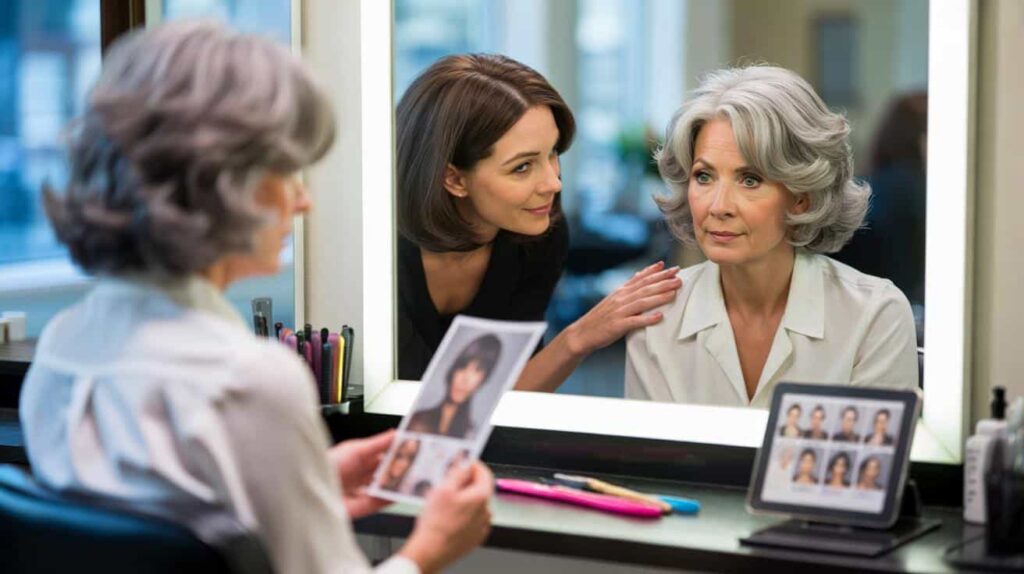
The salon is already buzzing when she slides into the chair, handbag clutched on her lap like a shield. “I’m fifty‑seven,” she tells the hairdresser, “so I guess it’s time. Chop it short, right?” She laughs, but her eyes are searching his face for reassurance. On the trolley: the usual photos printed from Pinterest. Silver pixies. Graduated bobs. “Age-appropriate cuts for women over 50.” The captions are kind, the algorithms less so.
He pauses, scissors in hand. Takes a step back. Looks at her, not just her hair. Then he says the sentence that makes her stiffen, just a little: “Who told you you have to go short because you turned 50?”
The dryer roars at the next station, foils rustle, someone is scrolling on their phone.
What he says next is the part many women won’t want to hear.
“Short hair after 50” isn’t the rule you think it is
Walk into any neighborhood salon and you’ll hear the same line on repeat: “Just give me something easy, I’m over 50 now.” Stylists smile, nod, reach for the clippers. The myth runs deep, like a script so many women learned by heart: hit a certain birthday, cut your hair, disappear quietly into a neat little bob.
Yet when you really start listening, you hear something else behind the request. Tiredness. Pressure. Fear of “trying too hard”. As if long hair past 50 was an act of rebellion instead of… just hair.
The hard truth some hairdressers whisper, when the salon is quiet, is not about age. It’s about courage.

Ask any experienced stylist and they’ll tell you about the moment that repeats every week. A woman in her fifties or sixties sits down and announces, “I know I should go short now, everyone does.” Some bring screenshots of celebrities who quietly cut off their signature hair after a certain age. Others confess their daughters told them long hair is “aging.”
Then come the numbers. Salon chains report that women over 50 are the most likely group to request a “drastic chop” after a life event: divorce, illness, retirement. Short hair becomes a symbol of starting over. It’s not always a style decision. It’s survival.
But when those same women come back eight weeks later, a surprising share say the same thing: “I don’t feel like myself.”

Here’s the quiet logic behind the hairdresser’s hard truth. Short hair doesn’t magically take ten years off your face. What it does is frame every line, every shadow, every shift in texture. On some women, that creates sharp, chic structure. On others, it throws all the focus onto features they feel most self-conscious about: neck, jawline, thinning hair at the crown.
Age alone doesn’t decide whether short hair will flatter you. Bone structure, density, wave pattern, lifestyle, even how strong your arms are for styling – those matter far more. *A pixie that looks effortless on Instagram might demand 15 minutes of daily coaxing in your real bathroom mirror.*
The real shock for many women over 50 is discovering that “short and easy” can be anything but.

The cut that flatters you is rarely the cut you were told to get
The hairdresser who dared to tell his client the truth that day didn’t put the scissors away. He just changed the question. Instead of “How short should we go now that you’re older?” he asked, “How do you want to feel when you catch yourself in the mirror?” Then he watched her body language, not her Pinterest board.
If you’re over 50 and flirting with the idea of a chop, start there. Think less about the number on your birthday cake and more about your daily gestures. How you tuck hair behind your ear. Whether you reach for a brush or just your fingers. How humid your city gets in July. Those tiny, practical details tell a better story than any age rule.
The best “age-appropriate” cut is the one you can actually live in.
One stylist I spoke to told me about a 63‑year‑old client, a retired nurse, who arrived with photos of spiky silver pixies. “I’m ready,” she said. “I’m not young anymore.” Her hair was fine, flat at the roots, with soft waves through the mid‑lengths. Her hands shook a little from arthritis. Blow‑drying every morning wasn’t realistic.
Instead of the cropped cut she’d been told was “right” for her age, they settled on a layered lob brushing her collarbones, with lighter pieces around her face. Long enough to tie back on bad days, short enough to feel intentional. She left the salon visibly taller. Two months later, she came back glowing, not apologizing.
Her comment at the basin? “I thought I had to look my age. Turns out I just had to look like myself again.”
There’s a reason some short cuts fall flat on women over 50, and it’s less about wrinkles and more about texture math. Hormones shift. Hair often gets drier at the ends, thinner at the temples, weaker at the roots. When you cut it very short without planning for that, you remove the weight that was quietly helping it behave. Suddenly it sticks out, collapses, or reveals sparse patches that used to hide under length.
On the flip side, a cleverly cut short style can give the illusion of volume you don’t actually have. Strategic layers, softened edges, fringe that skims the brow instead of sitting like a helmet. **The science of a good cut at 50+ is part geometry, part empathy.**
The hairdresser’s hard truth? Age is not the enemy of your haircut. Rushing into the wrong “age rule” is.
The questions a good hairdresser will ask you before they ever go short
Before any dramatic chop, great stylists run through a quiet checklist that has nothing to do with your birth year. How often do you color your hair? Do you wear glasses every day? Do you sweat at night? Are you the type who can’t stand hair touching your neck, or do you feel naked when it’s above your shoulders?
One London hairdresser told me she always asks clients over 50 one unexpected question: “How do you wear your neckline?” Turtlenecks, scarves, collars – they all change how short hair sits. A crisp crop can fight with a high collar and suddenly feel too stark. A soft, layered bob might slide perfectly over it and soften everything.
These questions aren’t small talk. They decide whether a cut liberates you or traps you in styling homework you never wanted.
The biggest mistake women over 50 confess, weeks after a big chop, is not the length itself. It’s the lack of a plan. They walked into the salon tired of wrestling with long hair, said “Just cut it off,” and walked out with a style that demands tools they don’t own and products they hate. Let’s be honest: nobody really does this every single day.
If you rely on air‑drying, say it. If you only own one sad old hairbrush, say that too. A good hairdresser would rather adjust the vision now than watch you disappear under baseball caps. **Short hair that only looks good on salon day isn’t flattering. It’s exhausting.**
Being clear about your limits isn’t being difficult. It’s being smart.
One veteran stylist summed it up simply: “Stop asking, ‘Am I too old for this cut?’ and start asking, ‘Does this cut respect the life I actually live?’ The calendar is not your stylist. Your reflection is.”
➡️ “I’m a hairdresser, and this is the short haircut I recommend most to clients with fine hair after 50”
➡️ Help birds survive the coldest winter nights: the one food that truly helps them retain warmth and energy
# Scientists Express Concern Over Early February Arctic Changes That Could Lead to Critical Environmental Threshold
Meteorologists and climate researchers are raising alarms about unusual atmospheric patterns occurring in the Arctic during early February. These shifts in weather systems may push delicate ecosystems toward a point of no return. The Arctic region has been experiencing abnormal temperature fluctuations and wind pattern changes that differ significantly from historical norms. Scientists monitoring these developments worry that the changes could disrupt the biological balance that Arctic wildlife and plant life depend on for survival. Early February typically represents a critical period in the Arctic annual cycle. Many species rely on stable conditions during this time to complete essential life processes. When atmospheric conditions deviate from expected patterns the consequences can cascade through entire food chains. Research teams have documented several concerning indicators. Sea ice formation has been delayed in multiple regions. Temperature readings have exceeded normal ranges by notable margins. Wind patterns have shifted in ways that affect ocean currents and nutrient distribution. The concept of a biological tipping point refers to a threshold beyond which ecosystems cannot recover their previous state. Once crossed these boundaries lead to permanent alterations in how natural systems function. The Arctic is particularly vulnerable because its ecosystems evolved under specific conditions that are now changing rapidly. Marine mammals that depend on ice platforms for hunting and breeding face immediate challenges. Fish populations that thrive in cold water environments may need to migrate to new areas. Bird species that time their migrations based on seasonal cues could arrive to find their food sources unavailable. Scientists emphasize that what happens in the Arctic does not stay in the Arctic. Changes in polar regions influence weather patterns across the entire Northern Hemisphere. The jet stream which guides storm systems across continents is directly affected by Arctic conditions. Researchers continue to monitor the situation closely while calling for increased attention to these developments. Understanding whether current changes represent temporary variations or the beginning of a fundamental shift remains a priority for the scientific community.
➡️ Goodbye balayage the permanent grey hair solution that fans call a miracle and critics call a health gamble
If you grew up in the 1960s or 1970s you were probably taught life lessons that have quietly disappeared from modern education. Back then children learned values & skills that shaped their character & prepared them for the real world. These lessons were not just about academics but about becoming responsible & capable adults. Many of these teachings have faded away over the decades. Schools today focus heavily on test scores & technology while some fundamental life skills get left behind. The older generations often notice this shift. They remember when certain principles were considered essential for every child to learn. These lessons taught them how to handle challenges & interact with others in meaningful ways. Some of these disappeared teachings include basic manners and respect for authority figures. Children were expected to say please and thank you without being reminded. They learned to address adults properly & to show consideration for others in their daily interactions. Practical skills were also emphasized much more than they are now. Young people learned how to handle money & understood the value of saving. They were taught basic home maintenance and cooking skills that would serve them throughout their lives. Personal responsibility was another cornerstone of education during that era. Children understood that their actions had consequences & they were held accountable for their choices. This helped them develop self-discipline and good judgment. The concept of delayed gratification was regularly reinforced. Kids learned that they could not always get what they wanted immediately. This patience helped them develop stronger character and better decision-making abilities. Physical education and outdoor activities played a bigger role in daily life. Children spent more time playing outside and developing coordination & social skills through unstructured play. These lessons may seem old-fashioned to some people today but they provided a foundation that many believe is missing in current education systems. The question remains whether modern society would benefit from bringing some of these traditional teachings back into the classroom.
# Tardigrades Stole Genes from Other Species to Become Almost Immortal
Tardigrades are microscopic creatures that have fascinated scientists for decades. These tiny animals can survive in conditions that would kill almost any other living thing on Earth. They can withstand extreme temperatures ranging from near absolute zero to well above boiling point. They survive intense radiation that would be lethal to humans. They can go without food or water for more than thirty years. They even survive in the vacuum of space. Scientists have long wondered how these remarkable creatures developed such incredible abilities. Recent research has revealed a surprising answer. Tardigrades appear to have stolen genes from other organisms throughout their evolutionary history. This process is called horizontal gene transfer. Unlike normal inheritance where genes pass from parent to offspring, horizontal gene transfer involves taking genetic material from completely unrelated species. Bacteria do this regularly, but it is much less common in complex organisms like animals. Researchers discovered that tardigrades have acquired approximately seventeen percent of their genes from other organisms. This is an extraordinarily high percentage for any animal. The stolen genes come from bacteria, plants fungi and even other microscopic creatures. Each borrowed gene appears to serve a specific purpose in helping tardigrades survive extreme conditions. Some of the acquired genes help tardigrades produce protective proteins. These proteins act like shields when the animal faces environmental stress. Other stolen genes help repair damaged DNA. When radiation or extreme temperatures damage their genetic material, these borrowed genes help fix the problems quickly. The genes that protect against dehydration are particularly interesting. When tardigrades dry out they enter a state called cryptobiosis. In this state they appear completely dead. Their metabolism stops almost entirely. They can remain in this suspended animation for decades. When water becomes available again, they simply rehydrate and continue living as if nothing happened. Scientists believe tardigrades acquired many of their survival genes during periods of extreme environmental stress. When their DNA breaks down under harsh conditions, it becomes easier for foreign genetic material to slip in during the repair process. Over millions of years, tardigrades kept the borrowed genes that proved useful & passed them on to future generations. This discovery has important implications beyond understanding tardigrades. Scientists are studying these mechanisms to develop new technologies. The protective proteins that tardigrades use might help preserve vaccines and medicines without refrigeration. The DNA repair mechanisms could lead to treatments for genetic diseases or protection against radiation for astronauts. Tardigrades demonstrate that evolution can work in unexpected ways. By borrowing genetic tools from other species, these tiny animals became nearly indestructible. They survived five mass extinction events that wiped out countless other species. They will likely outlive humans and most other complex life forms on Earth. The study of tardigrades continues to reveal new surprises about the limits of life and the creative solutions that evolution can produce.
➡️ Heavy snow is set to begin tonight as authorities urge drivers to stay home, even while businesses push to operate as usual
➡️ He donated a box of DVDs “then found them resold as collectibles”

- Ask for a cut that works with your natural texture, not against it.
- Bring photos of styles on women with similar hair type and face shape, not just similar age.
- Talk honestly about styling: time, tools, arm strength, patience.
- Consider a “transitional” length first instead of jumping straight to a crop.
- Book a follow‑up trim in six weeks so you can tweak the shape once you’ve lived with it.
Short hair after 50 can be powerful – when it’s truly your choice
There’s a quiet revolution happening in salons, far from the glossy makeover shows. Women in their fifties, sixties and beyond are walking in with long silver braids and walking out with them still attached. Others are cutting everything off and feeling more themselves than they did at 35. The common thread isn’t the length. It’s the authorship.
When a cut is chosen from a place of “I should,” it tends to age you, no matter what the mirror says. When it’s chosen from “I want,” even a drastic crop carries a different kind of energy. You move differently. You touch your hair with curiosity instead of regret. You stop apologizing before anyone has even commented.
Maybe that’s the real hard truth the hairdresser was trying to give his client: the bravest thing you can do with your hair after 50 isn’t to go short. It’s to stop letting other people’s timelines decide when you’re allowed to change.
| Key point | Detail | Value for the reader |
|---|---|---|
| Age is not a haircut rule | Face shape, texture and lifestyle matter more than the number 50 | Helps you question default “short after 50” advice and choose freely |
| Plan before you chop | Discuss styling habits, tools and comfort with your hairdresser | Reduces regret and prevents high‑maintenance cuts disguised as “easy” |
| Choose how you want to feel | Use emotion and self‑image, not fear, to guide your decision | Leads to a cut that supports your confidence, not just follows a trend |
FAQ:
- Should women over 50 avoid long hair altogether?Not at all. Long hair can look fresh and modern at 50, 60 or 70 if the ends are healthy, the shape is intentional, and the style fits your lifestyle. The “too old for long hair” rule is more cultural than aesthetic.
- Does short hair really make you look younger?Sometimes it sharpens features and creates lift, which can read as youthful. On the wrong face shape or hair texture, it can do the opposite and highlight things you’d rather soften. The effect depends on cut, not just length.
- What is the most flattering haircut length after 50?For many women, somewhere between jawline and collarbone is the sweet spot. That mid‑length offers movement, volume options and flexibility to tie it back, without the heaviness of very long hair.
- How often should I trim short hair at my age?Short cuts usually need reshaping every 4–7 weeks to keep their structure. If your budget or schedule doesn’t allow that, ask for a slightly softer shape that grows out more gracefully.
- Can thinning hair handle a very short cut?Yes, but it needs thoughtful design. Cropped styles with textured layers and a bit of lift at the crown can disguise thinning, while blunt, super‑short cuts can expose the scalp. Talk openly about areas you’re worried about before the scissors come out.
