
The first hint was almost invisible on the maps – a faint wobble in a ring of wind ten miles above the North Pole. Down at street level, people were just zipping coats, scrolling weather apps, arguing about whether winter had even really started. Yet on the screens inside a few quiet forecast centers, something rare was taking shape in the atmosphere, weeks earlier than usual.
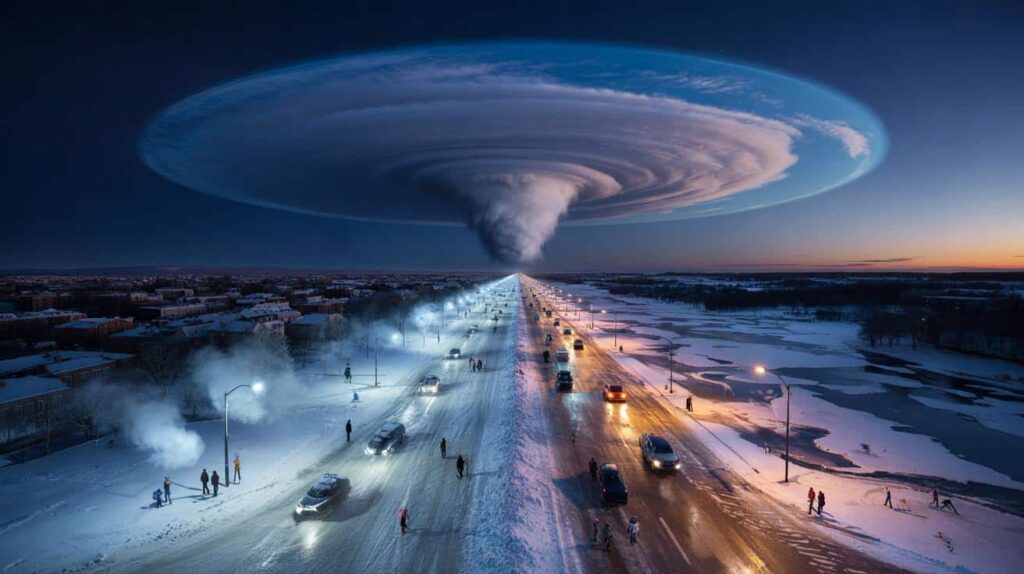
Meteorologists stared at charts that didn’t look like January or February, but like the prelude to a winter plot twist. A polar vortex shift, the kind that can flip seasons upside down, was starting to buckle out of its usual place.

They knew what that sometimes means for February.

And this time, the early signal looks…different.

A polar vortex wobble that’s showing up ahead of schedule
Most winters, the polar vortex stays politely parked over the Arctic like a spinning top, keeping the deepest cold bottled up near the pole. This year, high above the clouds, that spinning top is already starting to tilt and stretch. The shift is subtle on the ground for now, but in the upper atmosphere the pattern is loud, messy, and unsettling to people who watch this for a living.
What concerns them is not simply that the vortex is changing shape. It is how early and how fast the change is taking place.
On recent model runs, the classic tight circle of icy winds at about 30 kilometers up is beginning to look more like a peanut than a ring. That’s a classic sign of a “displaced” or weakening polar vortex. In some simulations, that lopsided shape drifts away from the pole and slumps toward Eurasia or North America.
The last time we witnessed a mid-winter disruption of this magnitude parts of the United States Canada and Europe experienced severe cold snaps while other areas dealt with unusually warm temperatures. This year’s pattern shows similar characteristics but the timing has arrived a month earlier than most forecasters anticipated.
To be clear, a polar vortex shift doesn’t automatically guarantee a February catastrophe. The atmosphere is more like a tangled web than a light switch. Yet the physics are straightforward: when the vortex weakens, waves from lower latitudes can punch northward, shoving cold Arctic air south and pulling milder air north.
This chain reaction can pull the jet stream into dramatic loops and turn what should be a normal late winter pattern into a series of wild temperature changes along with storms & icy outbreaks. Experts are watching carefully and feeling concerned about what February might bring.
➡️ A rare polar vortex shift is taking shape, and experts warn that February could bring unusually extreme winter conditions
➡️ Expert explains how recent freezing temps could impact pest populations
The highway code has officially resolved the ongoing discussion about age restrictions for drivers. The debate is no longer about whether the limit should be 65 or 75 years old. Authorities have now established a clear age threshold that determines when someone can continue driving legally. This decision ends years of uncertainty and conflicting opinions regarding older drivers and road safety. The new regulation provides a definitive answer to questions that have concerned both elderly motorists & their families for a long time.
# Hairstyles After 50: Reverse Coloring Rejuvenates Gray & White Hair Without Root Regrowth
Women over 50 often face a common dilemma when it comes to their hair. Gray and white strands become more prominent & traditional coloring methods require constant maintenance. The dreaded root regrowth appears just weeks after a salon visit and creates a never-ending cycle of touch-ups. Reverse coloring offers a fresh solution to this problem. This innovative technique works differently than conventional hair dye applications. Instead of covering gray hair completely the method blends lighter tones throughout the hair to create a natural transition. The process involves adding highlights & lowlights strategically placed around the face and crown. Stylists use shades that complement the natural gray and white hair rather than fighting against it. This approach creates dimension and movement while making the gray less noticeable. One major advantage is the elimination of harsh demarcation lines. Traditional single-process color creates obvious roots as hair grows out. Reverse coloring blends seamlessly with natural hair growth and extends the time between salon appointments significantly. The technique also reduces damage to hair. Mature hair tends to be more fragile and repeated all-over coloring can weaken strands. By focusing on select sections rather than the entire head the hair maintains better condition and strength. Stylists customize reverse coloring based on individual needs. Some women prefer warmer tones like honey or caramel while others choose cooler shades such as ash or platinum. The goal remains the same regardless of color choice: creating a youthful appearance without obvious artificial results. Maintenance becomes much simpler with this method. Women can go two to three months between appointments instead of the typical four to six weeks. This saves both time & money while keeping hair looking fresh and intentional. The psychological benefits matter just as much as the practical ones. Many women feel liberated from the pressure of covering every gray hair. Reverse coloring allows them to embrace their natural color while still feeling polished & put together.
Lidl is set to launch a gadget approved by Martin Lewis next week just in time to help households get through winter. The discount supermarket will stock a product that has received backing from the money saving expert as families look for ways to reduce their energy bills during the colder months. The item is expected to arrive in stores soon and could provide a practical solution for people trying to manage their heating costs. Martin Lewis has previously recommended similar products as effective tools for cutting down on household expenses. His endorsement carries significant weight with consumers who trust his financial advice. The gadget coming to Lidl shelves represents an affordable option for those seeking to make their homes more energy efficient. Winter brings increased pressure on family budgets as heating costs rise. Many households are searching for ways to stay warm without spending excessive amounts on energy. This new product could offer some relief by helping people use their heating systems more effectively. The timing of this launch is particularly relevant given ongoing concerns about energy prices. Families are looking for any advantage they can find to keep their bills manageable. A gadget that comes with expert approval and is available at Lidl’s competitive prices could prove popular with shoppers. The supermarket chain has built a reputation for offering quality products at lower prices than many competitors. Adding an energy saving device to their range fits with their approach of providing value to customers. The combination of affordability and practical benefits may attract significant interest from budget conscious shoppers looking to prepare for winter.
➡️ Short haircut for fine hair the truth no one tells you about these 4 viral volume cuts that can make your hairline look even thinner
➡️ This 2-ingredient “impossible to mess up” pudding is taking over the internet
 Hairdresser reveals hard truth about short hair for women over 50 that many won’t want to hear
Ferrari has revealed its new oblong piston technology and engineers believe this surprising redesign might transform engine performance well beyond what current models can deliver. The Italian automaker introduced the innovative piston design as part of its ongoing effort to push the boundaries of internal combustion engine efficiency. The oblong shape represents a departure from the traditional circular piston design that has dominated engine manufacturing for over a century. Engineers at Ferrari claim the new geometry allows for better combustion chamber optimization and improved thermal efficiency. The oblong design creates a more favorable surface area to volume ratio which helps reduce heat loss during the combustion cycle. This means more of the fuel’s energy converts into useful work rather than being wasted as heat. The technology also enables a more compact engine design without sacrificing displacement or power output. Ferrari’s development team spent years testing various configurations before settling on the final oblong shape. Computer simulations & extensive dynamometer testing validated the concept before any prototype engines were built. Early results from track testing show promising improvements in both power delivery and fuel economy. The engines equipped with oblong pistons demonstrate smoother power curves and reduced vibration compared to conventional designs. These benefits come without requiring exotic materials or significantly higher manufacturing costs. Ferrari plans to integrate this technology into its future road car lineup gradually. The first production vehicles featuring oblong pistons should arrive within the next few years. Racing applications may come even sooner as the company evaluates the technology’s potential in competitive environments. This development represents Ferrari’s commitment to advancing internal combustion technology even as the automotive industry shifts toward electrification. The company believes there remains substantial room for improvement in traditional engine design & the oblong piston concept proves that innovation in this field continues.
Why February could feel unlike any winter you remember
If you live in a mid-latitude city, the impact of a polar vortex shift doesn’t hit as a line on a chart. It shows up as that Monday morning when the sidewalk is a sheet of glass and the bus never arrives. Or as a week where you leave the house in a hoodie and come home through biting, painful wind.
When the upper-atmosphere vortex buckles, the weather on the ground tends to follow in bursts – sudden flips from mild to vicious cold, from calm skies to snowstorms stacked like dominoes. This year, forecasters are quietly preparing for February to be one of those “burst” months.
You can already see the prelude in the data. Stratospheric temperatures above the Arctic are climbing unusually fast, a classic red flag for a sudden stratospheric warming event that can crack the vortex. Some forecasting centers are flagging a high chance of a major disruption that peaks in early to mid-February.
Past events like this have been infamous. The 2018 “Beast from the East” in Europe, the February 2021 deep freeze that knocked out power across Texas – both were linked to polar vortex disturbances that sent frigid air surging way south of where it “belongs.” No two winters are identical, but the skeleton of that story is starting to look uncomfortably familiar.
Climate scientists continue to debate whether global warming has a lasting connection to an unstable polar vortex. Recent research increasingly suggests that shrinking Arctic sea ice and warmer ocean temperatures along with changing Siberian snow patterns may push the upper atmosphere toward more regular or stronger disturbances.
What makes this year different is not just the disruption on its own. The real issue is how everything comes together: an unstable start to the season combined with unusual warmth already settled in certain areas & a climate that runs hotter now than it did during the major vortex events ten years back. This mix could deliver more than just intense cold spells. It might bring extreme swings between conditions with blizzards hitting one week and wet melting periods following right after while our infrastructure gets tested far past what it was built to handle.
How to live through a wild February without losing your mind
There’s the weather we talk about, and then there’s the weather we actually live. A polar vortex shift shows up in the second category: frozen locks, frozen pipes, salt-streaked boots, and kids wearing mismatched mittens because you can’t find the rest.
The smartest move right now is simple: act as if February will swing hard, even if it ends up only half as bad as the models hint. That means small, boring steps – checking drafts around windows, knowing where your extra blankets and flashlights are, backing up work in case power or internet cut out during a storm. Those quiet moves matter far more than doomscrolling through dramatic maps.
We all experienced that moment when cold weather arrives suddenly and we realize we should have prepared earlier. The car refuses to start the grocery store has run out of essential items, & the weather app displays a warning symbol that we ignored two days before. This situation happens more often than we like to admit. Most people understand they should prepare for winter weather but somehow the days pass and nothing gets done. The forecast might mention dropping temperatures or possible snow but daily routines take priority. Then the storm arrives and everything becomes more difficult. Preparation does not require extreme measures or expensive purchases. The key is starting before the weather turns bad. A working vehicle matters most for many people since transportation affects work & emergency situations. Checking the battery & keeping the gas tank above half full prevents common problems. Tire pressure drops in cold weather so monitoring that helps too. Food & water supplies deserve attention as well. Keeping extra non-perishable items at home means avoiding crowded stores when everyone else panics. Canned goods and dried foods work well. Bottled water serves multiple purposes if pipes freeze. Having these items already stored removes stress when bad weather approaches. The house itself needs some consideration. Knowing where the water shutoff valve is located can prevent serious damage. Keeping flashlights & batteries in an accessible spot helps during power outages. Extra blankets provide warmth if heating systems fail. These simple steps make a significant difference. Many people also forget about medications and important documents. Prescriptions should be filled before storms arrive since pharmacies might close or become unreachable. Keeping copies of insurance papers and identification in a waterproof container protects against various problems. The pattern repeats each year because preparation feels unnecessary until the moment it becomes critical. Breaking this cycle requires only a small amount of planning during calm weather. Making a basic list & gathering supplies over time costs less and creates less stress than last-minute shopping. Weather warnings exist for good reasons. Paying attention to forecasts and taking them seriously prevents most emergency situations. That warning symbol on the phone app provides valuable time to take action. Waiting until conditions worsen limits options and increases risks. they’ve
Let’s be honest: nobody really does this every single day. Most of us prepare reactively, after the first real punch of winter lands. This year, experts are gently urging people to get ahead instead of chasing the forecast. Think “winter audit”: do you have a backup heat source, phone chargers that don’t rely on a single outlet, enough layers if the indoor temperature drops for a few hours?
“From a risk perspective, what stands out this year isn’t just the potential for a strong polar vortex event,” says one senior European meteorologist. “It’s the mismatch between the calm people feel now and the volatility the atmosphere is signaling for February. That gap is where problems happen.”
- Watch the pattern, not the daily noise
Follow trusted weather services and look for phrases like “sudden stratospheric warming” or “major pattern change.” These are your early alarm bells. - Think in 3–5 day chunks
Instead of planning around a single big day, organize your life in short windows: food, meds, transport, school or remote work. - Protect the fragile stuff first
Pipes, elderly neighbors, pets, and medications that need specific temperatures – these break down fastest in extreme swings. - Have a “cold snap plan”
Who checks on whom, where to go if heat fails, how you’ll communicate if phones die or roads glaze over. - Stay flexible, not fearful
*Weather chaos feels worse when your expectations are rigid.* Build in slack: backup routes, extra time, alternate meeting options.
A winter that doubles as a stress test
A significant weather pattern is developing over the Arctic right now and it matters for more than just meteorology enthusiasts. This event serves as a preview of how communities will handle extreme weather that used to happen once every ten years but now arrives more frequently and in unexpected ways. An unusual early polar vortex shift does more than stress our power systems and transportation networks. It also tests something less tangible which is our capacity to adjust to these changes without exhausting ourselves. This atmospheric phenomenon represents a practical challenge for modern society. When weather patterns that were once rare become more common the infrastructure we rely on faces repeated strain. Roads need clearing more often. Power grids must handle sudden demand spikes. Supply chains get disrupted with greater frequency. Each individual event might seem manageable but the cumulative effect creates a different kind of pressure. The real test goes beyond physical systems. People and organizations must find ways to respond effectively to these recurring disruptions without depleting their resources or morale. Emergency services get called out more regularly. Households face higher heating costs and potential outages. Businesses deal with transportation delays and worker absences. The challenge lies in building resilience that can withstand not just one crisis but a steady increase in difficult conditions over time.
Some people will shrug, some will panic, most will just carry on – layering up, rebooking flights, refreshing their apps at midnight and cursing at icy sidewalks in the morning. Between the headlines and the hype, there’s room for a different kind of response: one that mixes respect for the science with a grounded sense of what you actually need to change this week, not in some abstract future.
February might pass as a close call, or it might carve itself into memory like 2018 or 2021 did. Either way, this early polar vortex wobble is a reminder that our seasons are less “fixed” than we like to pretend. How we talk about it, prepare for it, and help each other through it may matter just as much as what the thermometers eventually show.
| Key point | Detail | Value for the reader |
|---|---|---|
| Early polar vortex shift | Unusual weakening and displacement of Arctic winds in January | Signals higher odds of intense and erratic February weather |
| Potential February impact | Sharper cold snaps, stronger storms, and rapid temperature swings | Helps readers mentally and practically brace for disruptions |
| Practical preparation | Small steps: home checks, backup plans, short planning windows | Reduces stress and vulnerability during extreme conditions |
FAQ:
- Question 1What exactly is the polar vortex, and should I be scared of it?
- Question 2Does a polar vortex shift always mean record-breaking cold where I live?
- Question 3How far ahead can scientists really predict these February extremes?
- Question 4What are three simple things I can do this week to prepare?
- Question 5Is climate change making polar vortex events worse or just different?
