
In Japan, compassion looks strangely like restraint.
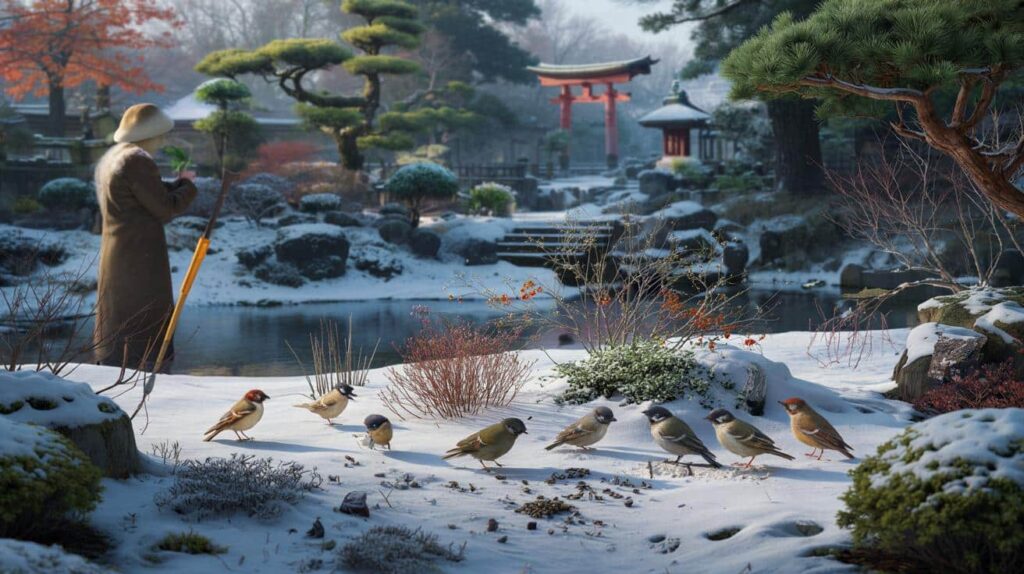
As French gardens fill with fat balls and seed trays each January, Japanese parks stay eerily quiet of feeders, even under snow. Behind that apparent absence lies a very deliberate choice about how, when and whether humans should step in to “help” wildlife through the cold months.

When helping means stepping back
Walk through a Kyoto temple garden or a Tokyo neighbourhood park in mid-winter and you’ll hear birds calling, see them hopping through shrubs, but you won’t spot bright plastic feeders or nets of suet hanging from branches. For many European visitors, it feels almost neglectful.
 Hairstyles after 50: this cut that was very trendy in the 60s is coming back into fashion in 2026
In France and much of Western Europe, feeding birds is treated as an act of civic virtue. Supermarkets devote whole aisles to winter seed, suet cakes and fancy steel dispensers. Children are encouraged to top up feeders on frosty mornings. In Japan, the instinct runs in the opposite direction.

In Japanese gardens, love for birds often means refusing to turn them into regular customers.
The underlying idea is simple and a little uncomfortable: genuine care for wild animals means protecting their autonomy. Human “help” should not rewrite their survival strategies or tie their fate to our schedules, our holidays or our budget for birdseed.
Why many Japanese avoid winter feeding altogether
In Japan, recreational bird feeding in urban gardens is far less common than in Europe. The practice is not totally unknown, but it sits on the fringes, and conservation messages tend to caution against it.
The main fear is dependency. If birds can count on a guaranteed pile of sunflower seeds every morning, they shift their behaviour. They spend less time searching bark and leaf litter, and more time queuing at what is essentially a free buffet.
Once a feeder becomes the main food source, birds start planning their entire winter around a single address.
That shift carries several risks:
- Loss of foraging skills: Birds gradually invest less effort in seeking wild food such as insect eggs, larvae and native seeds.
- Energy trap: A reliable feeder encourages larger winter populations than the habitat can naturally sustain. If the feeding stops, many birds are left with too little food in the wild.
- Skewed migration decisions: Species that would normally move to milder areas may stay put because of abundant artificial calories, then struggle in harsh late cold snaps.
For Japanese ecologists, that dependency is not just a technical issue, but an ethical one. Feeding might save individuals in the short term, while weakening the resilience of populations across decades.
The hidden health risks of the winter buffet
An equally strong argument concerns disease. Feeders concentrate multiple species in a tiny space. Beaks and feet repeatedly touch the same tray edges, the same clumps of seed, the same branch. Droppings fall on perches, mould grows in damp seed, and viruses or parasites find ideal conditions.
Studies in Europe and North America have already linked certain outbreaks of finch diseases to busy garden feeders. The Japanese response is largely preventative: avoid setting up the epidemiological hotspot in the first place.
By keeping birds dispersed across hedges, fields and woods, Japanese gardeners reduce both dependency and contagion risks in a single move.
There’s also a behavioural angle. Birds hooked on feeders may become bolder around humans and cats, lingering low and close to houses. Natural caution erodes, and with it, survival odds in a landscape still full of cars, windows and predators.
Letting winter be tough – and why that can strengthen birds
The idea of not helping during a hard winter sounds almost cruel to many Europeans. Yet Japanese thinking leans on a basic ecological reality: winter is a filter. Only the fittest, most adaptable individuals make it through. Those survivors pass on genes that favour alertness, efficient foraging and disease resistance.

Flooding the system with extra calories can blunt that filter. Birds that would not normally survive harsh conditions can breed in spring. In the long run, that might slightly shift populations towards individuals less well equipped for abrupt changes – exactly the kind of stress climate change is already bringing.
Refusing to intervene is not a celebration of suffering, but a bet on long-term resilience.
At the same time, there’s a very practical gardening argument. A hungry tit or warbler will spend hours combing fruit trees for insect eggs and overwintering larvae. A bird stuffed with sunflower seeds is less motivated to perform that unpaid pest-control service.
Planting food instead of hanging it
None of this means Japanese gardens are barren or hostile. Quite the opposite: many are quietly engineered to offer shelter, berries and insects all year, without the need for sacks of imported seed.
Instead of installing a plastic feeder, the Japanese-inspired approach is to plant a living larder. Shrubs, climbers and small trees provide berries, seeds, insects and roosting sites across seasons.
Examples of a “self-feeding” bird garden
| Type of plant | What it offers birds | When it helps most |
|---|---|---|
| Berry-bearing shrubs (holly, cotoneaster, rowan) | Energy-rich fruits, dense cover from frost and predators | Late autumn to late winter |
| Climbers like ivy | Late-winter berries, insect-rich foliage, nesting spots | End of winter, when other food runs low |
| Ornamental crab apples | Persistent fruits, perches for hunting insects | First hard freezes to early spring |
| Mixed native hedges | Insect habitat, seeds, safe corridors for movement | Year-round, with a peak in the hungry gap |
This approach asks for patience rather than constant topping up. Plants take years to mature, but once established they quietly feed birds, insects and small mammals without the need for human refills. Birds in turn disperse seeds and help those same plants spread, closing a loop that runs on photosynthesis rather than shop-bought grain.
Could French and British gardens shift towards the Japanese model?
For anyone in France or the UK with feeders already in use, wildlife groups warn against simply stopping mid-winter. Birds may now rely on that food source. They adjust daily routes and energy budgets around it. Cutting them off in January or February is closer to pulling the rug than letting nature “take over”.
A more realistic scenario is gradual change. One strategy for the coming years could look like this:
- Keep feeding through the current winter if you’ve already started, while improving hygiene and spacing between feeders.
- Begin planting berry-rich shrubs and climbers this year, focusing on native species that suit your soil and region.
- Shorten the feeding season in future years, ending earlier in late winter as your garden’s natural food base grows.
- Shift from constant daily feeding to occasional support during extreme weather spikes only.
Such a transition mirrors the Japanese philosophy without demanding a sudden cultural about-turn. Gardeners keep their daily contact with birds, while slowly handing more responsibility back to the ecosystem itself.
What “non-intervention” really means in practice
Non-intervention doesn’t literally mean doing nothing. In Japan, park managers still make decisions that shape habitats: which trees to plant, when to prune, how much leaf litter to leave on the ground. The difference lies in the focus on structures rather than rations.
The core idea is to manage landscapes, not individual stomachs.
For readers curious about adopting some of this thinking, a few terms are useful:
- Carrying capacity: The number of animals a habitat can support with its natural resources. Heavy feeding can artificially raise winter numbers beyond that threshold.
- Ecological trap: A situation where animals are attracted to a site that looks rich in resources — like a feeder — but where conditions become dangerous if those resources vanish.
- Resilience: The ability of a community of species to absorb shocks, such as a severe cold spell, without collapsing.
Thinking in these terms nudges the conversation away from “Am I nice to birds?” towards “Will these birds still cope if I move house, fall ill, or forget to restock?” That mental shift sits at the heart of the Japanese approach.
For households still keen to feel actively involved, there are middle paths. You might limit feeding to short, clearly defined cold snaps, or focus your efforts on cleaning and spacing feeders to cut disease risk. In parallel, every winter weekend spent planting another shrub or leaving a corner of the lawn untidied does quiet work in the background, building the kind of garden where birds can survive with or without you.
