
At 6:15 a.m., the fog over Puget Sound is still hanging low when the first buses start emptying out. Lines of workers in hi-vis jackets and worn sneakers file toward a building so huge it seems to eat the horizon. Floodlights carve yellow rivers in the gray morning as badge readers beep in a constant, metallic rhythm. Coffee in one hand, lunchbox in the other, 30,000 people flow into a single factory like a slow, human tide.
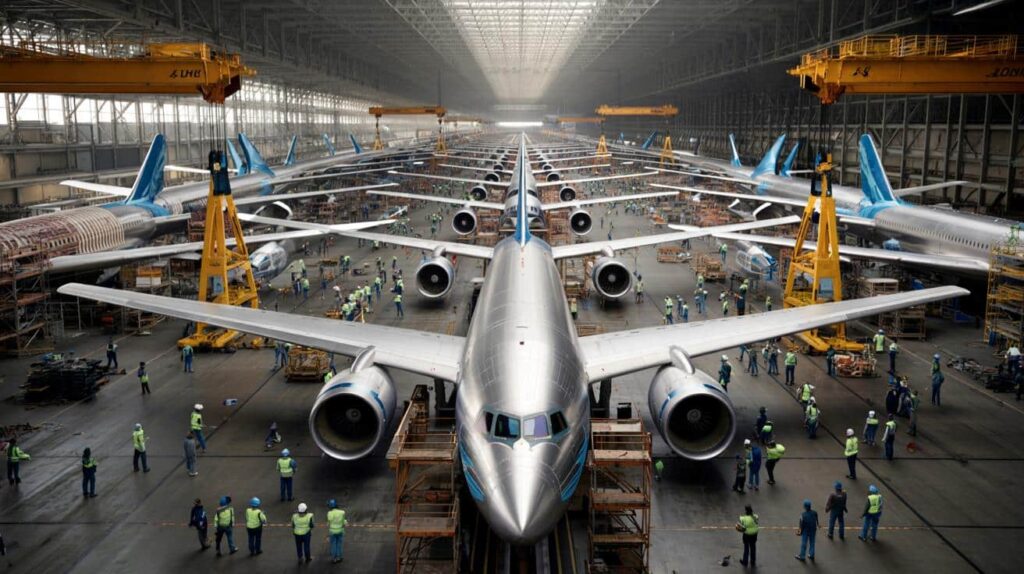
Inside, the air changes. The smell of metal shavings, jet fuel residue, and fresh paint hangs under a ceiling so high you lose it in the rafters. You hear drills, forklifts, the crackle of radios. Somewhere above all that noise, eight aircraft bodies sit nose to tail, quietly becoming planes that will cross oceans.

This is the largest factory on Earth, and it feels a little like walking into the inside of a country.

A building the size of a small city
The first time you see Boeing’s Everett plant from the outside, your brain misfires. It doesn’t read as a building, more like a man-made cliff. The walls stretch for almost a kilometer, flat and blank and unnervingly calm. Trucks look like toy cars as they slide past loading bays the size of houses.

On a clear day, you can stand in the parking lot and see snow on the Cascade Mountains behind it. Yet your eyes keep coming back to this rectangle of steel and panels, because you know that under this shell, entire jets are being born.
The numbers sound like someone is joking. The floor area of 399,000 square meters could hold roughly 3,753 Olympic swimming pools. That’s not a metaphor. That’s math.
Inside, the scale hits differently. The Everett factory’s volume is so massive that it has its own microclimate. Warm air rises from the lights and machinery, cools near the roof, and can literally form clouds under the ceiling. Workers tell stories of looking up and seeing a thin, ghostly layer of mist drifting above the fuselages.
Below that artificial sky, production lines run in parallel. At peak, this plant could assemble eight commercial jets at the same time, each one longer than a blue whale and worth hundreds of millions of dollars. It’s like watching an industrial ballet staged on the floor of a hangar the size of 50 football fields.
And yet, between the forklifts and cranes, you still notice little human details. A faded sticker on a toolbox. A family photo taped to a workstation lamp.
What makes this place feel almost unreal is how calmly it functions despite the madness of the scale. You’d expect chaos with 30,000 people, miles of conveyor tracks, and components arriving from every continent. Instead, the factory breathes in quiet rhythms, like a huge mechanical lung.
This order is no accident. The Everett plant was designed not just to be big, but to choreograph complexity. Wings, engines, and fuselage sections arrive from Japan, Italy, Kansas, and dozens of other locations, all timed down to the hour. The building swallows them, shuffles them along its lines, and rolls out finished aircraft at the far end.
It’s industrial logistics pushed to a level where the floor plan of a factory starts to look like the wiring diagram of a brain.
How do you even run a place like this?
Running the world’s largest factory starts with a surprisingly simple idea: break the impossible into slices you can hold. The Everett plant is carved into zones, then lines, then stations. Each station has a narrow, clear role. Attach this wing panel. Route this bundle of cables. Test this hydraulic valve.
From the catwalks, you can see the logic. Aircraft move nose-forward, rolling through checkpoints like giant, slow-moving patients in an assembly hospital. At each stop, a different “surgery” happens. The structure closes a little more, the systems inside get denser, the plane looks less like a shell and more like something that could leave the ground.
No one person “builds a jet.” Thousands of people each repeat a specific gesture, again and again, with the awareness that a mistake here might be flying at 35,000 feet next year.

Of course, that sounds neat on paper. On the ground, it’s messy, human, and sometimes exhausting. New hires get lost just trying to find their work cell. Veterans can tell you which corner gets the coldest draft in January, or which vending machine never eats your coins. We’ve all been there, that moment when your job suddenly feels like a tiny cog in a machine that’s simply too big.
The risk in a place like Everett is thinking, “My task is so small, it doesn’t matter.” That’s how shortcuts creep in, how tools don’t get checked, how inspections become box-ticking. Let’s be honest: nobody really does this every single day with perfect focus and zero fatigue.
So the factory doesn’t just rely on individual goodwill. It builds in checklists, visual controls, and peer reviews that catch the bad days before they become bad outcomes.
There’s a phrase you hear a lot in aviation factories: “Trust the process, but also trust the people.” At Everett, that tension defines daily life. The system is designed so one missed step should not doom a plane, yet everyone knows those layers are only as strong as the culture underneath.
“From the street, you see a building,” one longtime mechanic told me, leaning against a yellow safety rail. “From the inside, you see 30,000 people trying not to let each other down.”
That mindset shows up in small, repeated patterns:
- Morning briefings where teams review safety notes and yesterday’s snags.
- Shadowing programs that pair rookies with veterans for the first months.
- Quiet “red flags” anyone can raise when something just doesn’t look right.
- Visible dashboards showing quality metrics in plain language.
- Celebrations when a line hits a clean milestone, not just a fast one.
*In a space that could swallow a downtown district, the only thing that scales all the way to the roof is shared responsibility.*
What this mega-factory says about us
Stand on a viewing deck as eight half-finished jets wait in a row and you start to wonder what, exactly, you’re looking at. It’s more than aluminum, carbon fiber, and engines the size of tiny houses. It’s a physical map of global ambition, fear, pride, and compromise. These planes will carry honeymooners, business travelers, nervous first-time flyers, and exhausted migrants heading home.
The Everett factory exists because we collectively decided that crossing oceans in a single day is normal. That we want strawberries in winter, fast logistics, cheap weekend escapes, and face-to-face meetings with people on other continents. This one building in Washington state silently absorbs that decision and turns it into hardware.
Yet the very scale that amazes us also feels slightly uneasy now. Climate pressure is rising. Aviation faces hard questions about emissions, noise, and resources. Walking among eight brand-new jets, you feel both the genius of human engineering and the weight of what it costs. Is this the future, or the peak of a certain kind of past?
Workers here sense that tension. Some talk excitedly about more efficient designs, lighter materials, sustainable fuels. Others just hope the production schedule holds and their kids can afford rent. The grand arcs of technology and policy eventually land on individual lives clocking in at 6:15 a.m.
Places like Everett are mirrors more than monuments. They reflect what we value as a species at a given moment in history: speed, connection, scale, control. They also show our blind spots, those pieces of the bill we prefer not to read too closely. You don’t have to be an aviation geek to feel something standing under that impossible ceiling, watching a jet slowly come together panel by panel.
You might think about your last long-haul flight, the way the cabin lights dimmed as the world outside turned to nothing but stars and engine hum. Somewhere, years earlier, someone here tightened a bolt or ran a final test so that moment could exist. This giant factory turns anonymous labor into unforgettable hours of human experience, and that thought stays with you long after you step back into the rain.
| Key point | Detail | Value for the reader |
|---|---|---|
| Scale you can’t ignore | Largest factory by volume, enough space for about 3,753 Olympic pools and eight jets in parallel | Helps you picture what “world’s largest factory” really means in concrete terms |
| Humans inside the machine | 30,000 workers, tight roles, rituals, and culture to keep complexity under control | Shows how huge systems still rely on everyday decisions and small gestures |
| Mirror of our priorities | Global air travel, logistics demands, and environmental pressure all converge here | Invites you to rethink your own relationship to travel, tech, and scale |
FAQ:
- Where is the world’s largest factory located?
The largest factory by volume is Boeing’s Everett plant in Everett, Washington, about 40 km north of Seattle in the United States.- How big is the Everett factory exactly?
The building’s floor area is around 399,000 square meters, with an internal volume of roughly 13.3 million cubic meters, enough to contain thousands of Olympic-size pools.- How many people work there and what do they do?
Around 30,000 people work on the site, including assembly workers, engineers, logistics staff, maintenance crews, quality inspectors, planners, and support roles like catering and security.- Which aircraft are built in this giant factory?
Historically, Everett has assembled widebody jets like the Boeing 747, 767, 777, and 787. The exact mix changes over time as programs phase out or shift, but its specialty is large, long-haul aircraft.- Can visitors tour the Everett plant?
Yes, Boeing has offered public tours through the Future of Flight facility, allowing visitors to see parts of the production lines from observation areas, though schedules and access can change and need to be checked in advance.
