
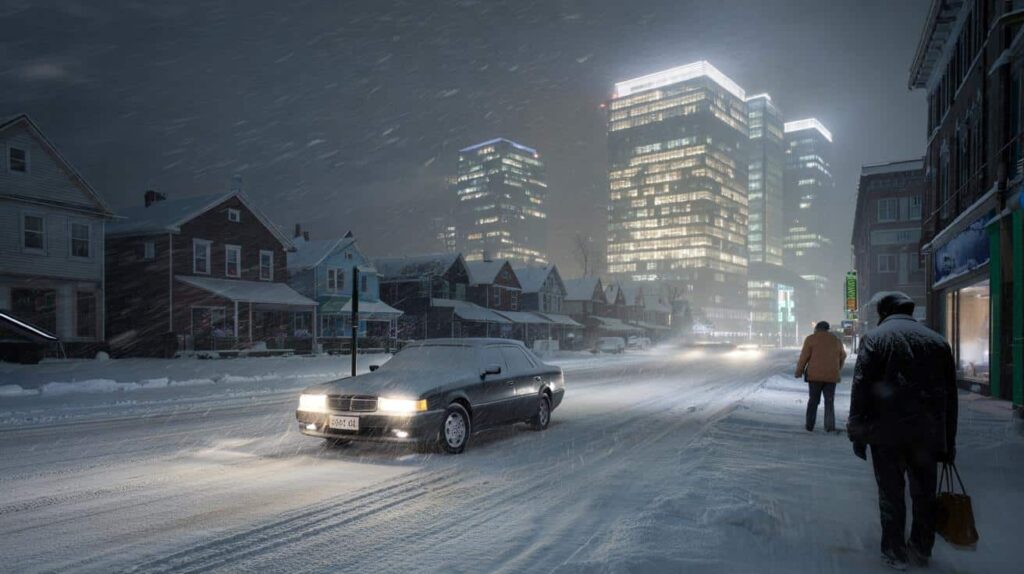
At 6:40 p.m., the snowflakes inched from “pretty” to “threatening” somewhere around the edge of town. Headlights bounced off the thickening curtain of white, wipers squeaked in a losing battle, and you could almost hear the collective sigh: not again. On the radio, the emergency alert siren cut through a Christmas playlist, warning drivers to stay off the roads after 9 p.m. unless it was “absolutely essential.”
Two minutes later, a phone buzzed in the cup holder. Company-wide email. Mandatory attendance tomorrow. “Operations will continue as normal.” No mention of ice, no mention of jackknifed trucks, no mention of the bus driver who already slid through a light at 5.

The storm has a name.
 A bay leaf under the pillow : the small night routine I once mocked, until it changed my sleep
The people standing between those two orders don’t.

The clash playing out on your commute tonight
By early evening, snowplows were already tracing orange arcs through the suburbs, sparks sometimes flying as their blades scraped bare patches of asphalt. The forecast is blunt: heavy snow through the night, ferocious gusts, visibility occasionally dropping to near zero. Police departments are pleading on social media for residents to stay home, posting photos of spinouts and overturned SUVs like a grim real-time slideshow.
At the same time, downtown towers glow like nothing’s wrong. Security badges still beep at turnstiles. Slack channels light up with nervous jokes about “see you at 9” as if that somehow keeps the storm at bay. The gap between public safety advice and corporate expectation has rarely felt so wide.
Ask Amanda, a 34-year-old call center supervisor who lives 40 minutes from her office on a good day. Last January, she skidded through an intersection on black ice, missed another car by inches, then sat shaking in the parking lot before her shift. Tonight, she’s already gotten two conflicting messages: one from the city urging residents to avoid non-essential travel, and one from her employer reminding staff that “attendance is critical to meeting client needs.”
Her husband, a delivery driver, got an even shorter text: “All routes running. Dress warmly.” The threat is so routine it almost sounds boring, until you remember that in the last decade, winter weather has been blamed for thousands of crashes each year. When authorities say “stay home,” they’re speaking from morgue reports, not from theory.
So why the stubborn insistence on business as usual, even as snow emergencies are declared and schools quietly shift to remote? Part of it is money, yes, but it’s more tangled than pure greed. Many companies are locked into contracts, service-level agreements, and razor-thin margins that treat any pause like a crisis. Some industries genuinely can’t hit pause without serious ripple effects: hospitals, utilities, public transport. Then there are the gray areas, offices and warehouses that *could* slow down but won’t unless someone higher up says the magic word.
Let’s be honest: nobody really builds their business model around “what if people didn’t risk their lives getting here?” That blind spot shows up every time the weather turns dangerous and the corporate calendar refuses to bend.
How to walk the tightrope between safety and pressure
One concrete step tonight: draw your own red line before the snow hits its peak. Decide, in plain language, what conditions are unsafe for you. That might be “if the city declares a travel advisory” or “if I can’t see the end of my street.” Write it down, even just in a note on your phone. Then tell a coworker, a partner, or your manager: “If X happens, I’m staying home.”
This sounds small, almost silly in the face of a storm, but it shifts the balance a little. You’re not waiting until 6 a.m., doomscrolling weather apps and employer emails in bed. You’re not making a panicked decision holding a coffee in one hand and car keys in the other. You’re choosing in advance what you’re willing to risk.
A lot of people feel guilty about putting safety first when the company line is “we’re still open.” There’s that not-so-quiet fear: Will I be seen as less committed? Am I the only one who’s scared to drive? We’ve all been there, that moment when you look out at the whiteout and think, “Maybe I’m overreacting.”
That guilt is quietly reinforced by the emails that praise “dedication” and “resilience” when people show up during bad weather, as if sliding across untreated highways is some kind of loyalty test. The trick is to separate genuine responsibility from performative risk-taking. Being a reliable worker doesn’t mean turning your commute into a roulette wheel. It means reading the situation honestly and not pretending your tires have superpowers.
“Snow doesn’t care about your deadlines,” says Luis Ortiz, a tow truck operator who’s pulled too many office workers out of ditches. “Every big storm night, I see people in business clothes, shaking, standing on the shoulder like they can’t believe they’re actually in the ditch. They all say the same thing: ‘My boss said we had to be there.’”
- Before the stormCheck your company’s bad-weather policy and screenshot any mention of remote work, excused absences, or flexible hours.
- That nightTake photos or short clips from your window or street if visibility drops fast. They’re useful if you need to explain why you didn’t drive.
- Early morningSend a short, calm message: “Roads are unsafe here, local advisory is in place, I will work remotely / use a personal day.” No apologies for existing.
- On the road, if you must goCut your speed way down, triple your following distance, and leave earlier. That email is not worth your life or someone else’s.
- After the stormNote who pressured you and how. It might be exactly the data you need to push for a real policy change when the snow melts.
Why this storm feels like more than “just weather”
Tonight’s forecast is about visibility in more ways than one. On the highway, blowing powder will turn brake lights into vague red smudges, and the same thing is happening socially: lines are blurring between personal safety, economic necessity, and corporate responsibility. Some workers genuinely can’t afford to stay home, even when the police say don’t drive. Others technically could log in from their kitchen table, but their workplace culture still treats “remote” as suspicious.
More storms like this are coming in the years ahead. That’s not alarmist, it’s just where the climate trends are heading. The question isn’t only “Will the roads be plowed?” It’s “Who gets protected?” Are we ready to normalize the idea that staying off deadly roads is not laziness, but common sense? Or are we going to keep pretending a snow emergency is just a productivity challenge with cute memes and chain-restaurant coffee?
What you choose tonight, and what your company demands of you, says a lot about where that line is being drawn. It might be worth talking about tomorrow, if tomorrow arrives without a crash report with your name on it.
| Key point | Detail | Value for the reader |
|---|---|---|
| Reading the conflict | Authorities urge people to stay home while many employers push for normal operations | Helps you frame mixed messages and trust your own safety limits |
| Setting boundaries | Defining your personal “no-drive” conditions before the storm hits | Reduces panic decisions at 6 a.m. and supports safer choices |
| Practical steps | Documenting policies, conditions, and communication with managers | Gives you leverage to protect both your job and your life |
FAQ:
- Can my boss really force me to drive in dangerous snow?They can require attendance, but they can’t physically force you onto the road. Employment law varies by country and state, yet your basic right to refuse clearly unsafe work is stronger than many people think. Document the conditions and their request if you feel pressured.
- What if I don’t have a remote work option?Talk to your manager about late arrival, carpooling from a safer pickup point, or adjusting shifts around the worst hours of the storm. Even small flexibility can cut risk. If they refuse everything, note it down for future conversations with HR or a union rep.
- Should I send photos or videos of road conditions to my employer?Yes, briefly and calmly. A quick street photo, a screenshot of a travel advisory, and a short message can make your case clear without drama. You’re showing facts, not asking for sympathy.
- Will I get fired if I refuse to drive?Sometimes that fear is bigger than the real risk. Check your contract, local labor rules, and any collective agreements if you have them. If you belong to a union, call them first. If you get threatened for choosing safety, that’s a red flag about the workplace itself.
- How do I talk about this with coworkers without sounding dramatic?Stick to concrete details: “The highway was closed last time,” or “Police are asking us to stay off the road.” When people hear specifics, they’re more likely to voice their own worries. That quiet chorus can nudge managers toward safer decisions next storm.
