
One of those details is hiding in plain sight: the hole in the handle of your pans and pots. Most people see it as a simple way to hang cookware on a wall rail. Yet that small circle of metal can do more than save cupboard space. Used differently, it can keep your hob cleaner, your food safer and your cooking a lot more relaxed.
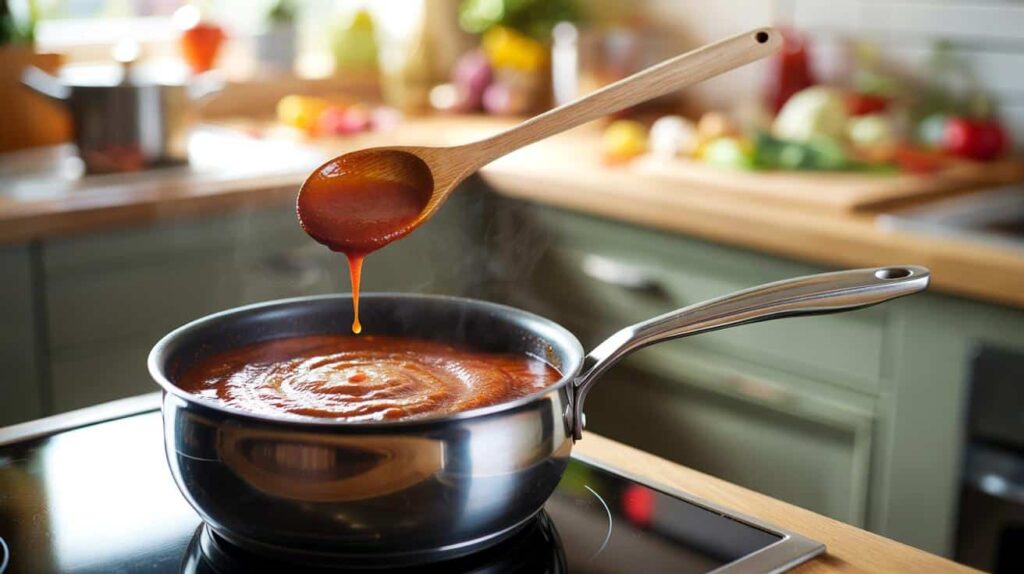
The surprising second job of that handle hole
Ask ten home cooks why there’s a hole at the end of a pan handle, and nine will say: “for hanging it up”. They’re not wrong. Manufacturers do design handles so pans can be stored on hooks or racks.
 Neither boiled nor raw : the best way to cook broccoli to preserve maximum antioxidant vitamins
But that same hole can double as a built‑in rest for your spoon, spatula or wooden stirrer while you cook. No extra gadget. No extra space on the worktop.

That tiny hole can hold the handle of your spoon so it stays above the pan, not on your counter.

The principle is simple: instead of dropping your spoon on a saucer, or letting it drip onto the hob, you slide its handle through the hole in the pan’s handle. The working end stays over the pan, catching any sauce or oil that runs off.
How to use the handle hole as a spoon rest
Step-by-step, in real kitchen conditions
- Place your pan or saucepan on the hob as usual.
- Stir your dish with a wooden spoon, spatula or silicone spoon.
- When you want to put the utensil down, thread its handle through the hole in the pan handle.
- Angle it so the spoon head hangs above the inside of the pan, not outside it.
- Adjust until it feels stable and doesn’t tip the pan.
Most standard wooden spoons fit easily. The trick is to keep the heavy end over the pan, so any drips fall straight back into the food you’re cooking.
Used this way, the handle hole becomes an instant, space‑saving spoon rest built into your cookware.
Why this tiny hack changes your cooking routine
Keeping the worktop cleaner with zero effort
During weeknight cooking, surfaces fill up fast: chopping boards, ingredients, opened tins, the inevitable splashes of sauce. A wet spoon laid on the worktop adds another sticky patch to wipe later.
Letting your utensil rest on the handle solves that. The sauce or stock runs off into the pan instead of onto the counter. Less wiping, fewer cloths, and you finish cooking with a kitchen that looks less like a battlefield.
Cutting down the risk of cross‑contamination
Food safety experts talk a lot about cross‑contamination: bacteria moving from one surface to another, then into your meal. Raw meat, unwashed vegetables and even crumbs can leave microbes on the worktop.
When you park a spoon on that surface, then put it straight back into a simmering sauce, you create an easy route for bacteria. Resting the spoon on the pan handle keeps it away from questionable spots.
Suspending the spoon over the pan helps break the chain between your worktop and your food.
This becomes especially useful when you handle raw chicken or seafood. Using one spoon for tasting and stirring, and keeping it off the counter, reduces how many times you need to wash or change utensils during a busy cook.
Always having the right tool within reach
There’s also a timing benefit. When you’re juggling pasta water, a pan of sauce and a tray in the oven, seconds matter. If your spoon is dangling conveniently from the handle, you can react more quickly when something starts bubbling too hard or sticking.
No rummaging around, no lifting lids to see where you abandoned the spatula. The tool you need is literally attached to the pan that needs attention.
 If you feel responsible for other people’s emotions, psychology explains where it comes from
Which utensils work best in the handle hole?
Not every tool in your jar will fit or balance well. Some shapes are awkward, others are simply too heavy. The most reliable candidates tend to be:
- Wooden spoons – slim handles, light weight, ideal for sauces and stews.
- Wooden spatulas – great for risottos, stir-fries and dishes that need frequent stirring.
- Silicone spoons or spatulas – as long as the handle is narrow enough and not too heavy.
Thick metal ladles, heavy whisks or tongs can drag the handle down or make the whole pan feel unbalanced. If the pan lifts or tilts even slightly, pick another utensil.
Protecting your pans and tools while you use this trick
There are a few small checks that help avoid damage or mishaps.
- Check the fit: the hole should be big enough that the utensil passes through smoothly, but not so wide that it swings and knocks the pan.
- Watch out with non‑stick: if you use a metal utensil and it swings towards the interior of a non‑stick pan, the edge can scratch the coating. Stick to wood or silicone with delicate surfaces.
- Test stability: once the spoon is in place, lightly nudge the handle. If the pan shifts or the utensil wobbles, adjust the angle or choose a lighter tool.
A five‑second stability check avoids a pan of tomato sauce tipping towards the edge of the hob.
Other clever features hiding in your cookware
The hole in the handle isn’t the only overlooked detail sitting in your kitchen cupboards. Manufacturers often build in small features that solve everyday annoyances, if you know what you’re looking at.
- Curved or flared rims on pans help you pour soup or sauce without dribbling it down the side.
- Heat‑sensitive indicators printed on some handles change colour when the pan reaches ideal searing temperature.
- Detachable handles make it easier to slide pans into the oven or stack them neatly in small cupboards.
Paying attention to these design touches can shave time off cleaning, improve cooking results and free up precious storage space, especially in compact city kitchens.
When the handle hole trick is less suitable
There are scenarios where using the hole as a spoon rest is not the best idea. On gas hobs with very large flames, for instance, the handle can sit close to the heat source. A wooden spoon projecting from the handle could be exposed to higher temperatures than you expect.
In that case, keep an eye on any charring or drying of the wood, or just stick to a separate spoon rest. Also, in very small kitchens where people pass close to the cooker, a long spoon sticking out of the handle can be easy to knock. For crowded households, turning the handle slightly inwards can reduce the chance of accidents.
Practical examples from everyday cooking
Busy pasta night
You’re boiling pasta, reducing a tomato sauce and frying mushrooms on the side. The pasta spoon, the wooden spoon and the spatula all need a home. Letting the sauce spoon hang from the handle of the saucepan frees space for the other tools. Any extra sauce falls back into the pan, not onto the hob.
Slow-cooked dishes
When you simmer chilli or curry for an hour, you tend to stir it every few minutes, then wander off. Instead of dirtying a plate for the spoon each time, you park it in the handle hole. The spoon is ready whenever you come back for another stir, and you end the cook with one less dish to wash.
A few terms worth clarifying
Manufacturers sometimes use jargon in product descriptions, which makes these small details easy to miss. Two expressions crop up often:
- “Ergonomic handle”: usually means the handle shape is designed to sit comfortably in your hand. The end hole often sits just beyond the main grip area.
- “Integrated hanging loop”: a marketing way of saying the handle has a hole or loop, mainly for storage, but still perfect for using as a spoon rest.
Next time you shop for a pan, it can be worth checking the size and placement of that loop. A slightly larger, well‑placed hole can make this little trick easier to use daily.
A handle hole that fits your favourite wooden spoon turns an ordinary pan into a tidier, smarter cooking partner.
