
The video starts with a shaky phone shot of a frozen lake in northern Sweden, but something is off. Snow should be sealing everything in white. Instead, thin gray ice glistens under a drizzle, and in the background you hear it: the frantic calls of birds that shouldn’t be there yet. A local wildlife guide whispers behind the camera that cranes have arrived nearly three weeks early, confused by the warmth. A few hours later, the temperature plunges back below freezing and the scene turns deadly quiet.
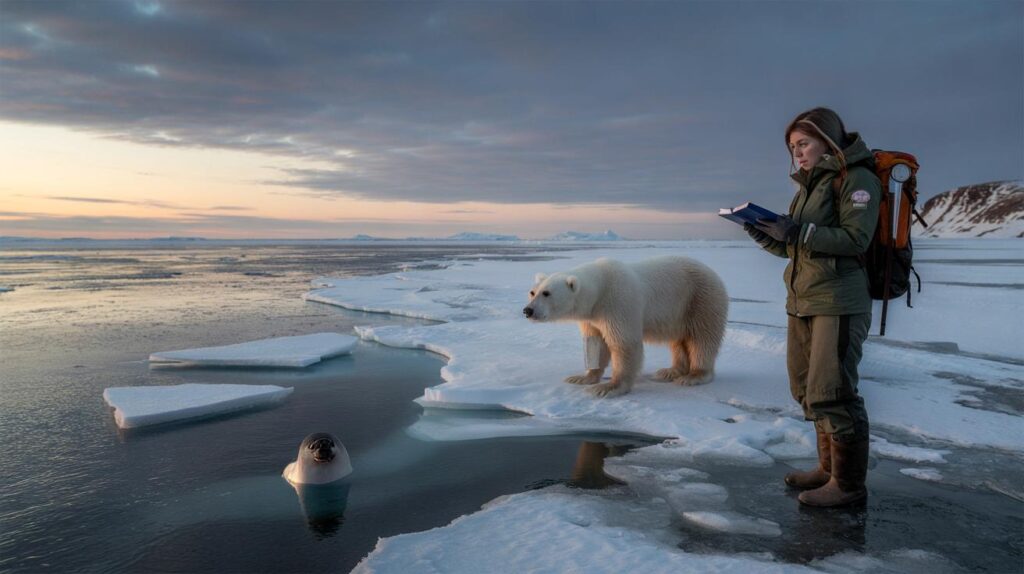
Across the Arctic and sub-Arctic, scenes like this are unfolding in early February 2026. Rivers thaw, then flash-freeze. Lemmings breed, then starve. Bears stumble out of dens, then are hit by a new wave of snow. Meteorologists call it a chain of “Arctic anomalies.”
 Everyone throws it in the trash, but for your plants, it’s pure gold and nobody cares about it
Ecologists are starting to use a different word.
 If you feel responsible for other people’s emotions, psychology explains where it comes from
Early February feels like April at the top of the world
In the first days of February, satellite maps usually show the Arctic as a solid crown of deep blue cold. This year, the color palette looks bruised. Patches of red and orange — zones up to 20°C above the seasonal norm — are leaking across Siberia, Greenland, and northern Canada. On the ground, that translates into rain on snow, half-frozen rivers and ice so thin that snowmobiles, and sometimes caribou, crash through.

Meteorologists from Europe to Alaska have been trading the same stunned screenshots. Sea ice that should be thickening has stalled. Some fjords never fully froze. On Svalbard, where polar night only just lifted, weather stations hit temperatures that locals say they’ve only seen in late April.
In Norway’s Finnmark region, reindeer herder Nils Isaksen says this winter has felt “inside out.” In late January, a warm pulse from the Atlantic sent rain pouring over his grazing grounds, glazing the snow into a concrete crust. The animals could smell the lichens below but couldn’t dig through. Within days, he was hauling emergency fodder in the dark, fighting wind gusts that felt more like autumn storms than midwinter polar air.
Across the Arctic, similar “rain-on-snow” events are being logged with worrying regularity. Canadian researchers tracking musk oxen have documented mass starvation after such episodes. One widely cited study found that in some regions, these icy-rain winters have doubled in frequency over the past 30 years. On paper, they’re weather anomalies. On the tundra, they’re life-or-death roll-of-the-dice moments for entire herds.
Climate scientists are clear about the backdrop. The Arctic is warming about four times faster than the global average, a phenomenon now called Arctic amplification. Warm ocean surfaces and thin ice release more heat into the atmosphere, which in turn destabilizes the polar jet stream. That wavy jet stream can suddenly yank mild Atlantic or Pacific air deep into the high latitudes in February, producing the jolting temperature spikes now being recorded.
These are not just weird warm days. They scramble the internal calendars of plants, insects, fish, and mammals that evolved around stable seasons. When warm spells hit, some animals wake, breed, or migrate too early, only to be slammed by a “normal” Arctic cold snap that still follows. It’s the biological equivalent of pulling the rug out mid-step.
The silent countdown inside Arctic ecosystems
Biologists talk a lot these days about phenology — the timing of natural events like flowering, egg-laying, migration. In early February, Arctic phenology used to be simple: deep winter, mostly on pause. Now, sensors and field notes show a strange double life. Soil microbes activate under brief thaws, insects begin to stir inside tree bark, some plants even start moving nutrients upward, as if spring had already announced itself, then everything is slammed back into freeze mode.
Those stutter steps aren’t harmless. Repeated freeze–thaw cycles damage roots, reduce seed survival and weaken shrubs that hold tundra soils together. Insect larvae that wake, then refreeze, may die in large numbers, changing how much food is available later for birds that fly thousands of kilometers to feed on them.
On the island of Hokkaido, at the southern fringe of the sub-Arctic, ornithologist Mari Tanaka has been counting migratory ducks for 18 winters. This February, she noticed something she used to only see in late March: dragonflies and midges dancing over patches of open water. The birds arrived early too, drawn north by the warmth, but they hit a trap. A new cold surge dropped in, freezing the surface again. Many ducks were forced to move back south, burning precious fat reserves they needed for breeding.
Researchers call this “trophic mismatch” — when predators and prey fall out of sync. In Alaska, shorebirds have been arriving to find that the insect boom they rely on peaked days earlier. In parts of Scandinavia, lemming cycles are shifting, which ripples into the fortunes of snowy owls, foxes and even vegetation they no longer graze the same way. One change nudges the next, like a long row of dominoes that no one quite knows where it ends.
 Psychologists share the sentence that lets you decline any offer politely and still look confident
The phrase scientists are using more freely this year is **“tipping point.”** Not because the Arctic will suddenly flip in one dramatic moment, but because systems have thresholds after which they reorganize fast. Think of sea ice: once it thins past a certain level, summer melt races ahead, exposing dark ocean that absorbs far more heat. Or permafrost: once enough of it softens, microbes feast and burp out methane, a powerful greenhouse gas.
Animal ecosystems have similar thresholds. If repeated February anomalies keep killing early-hatched chicks or starving herd animals every few years, populations can cross a line where recovery becomes unlikely. *That’s when a familiar landscape can still look the same from your plane window, but quietly function like a different ecosystem.* The fear among Arctic biologists is that early February 2026 is not a one-off spike, but part of a step-change toward that state.
What can actually be done from thousands of kilometers away?
When news breaks about “Arctic anomalies,” the first instinct is often a shrug. The region feels remote, abstract, a distant white blur on the map. But the actions that influence Arctic weather patterns are very much taken in cities, on motorways, in offices and homes far from the tundra. That starts with the obvious: cutting the fossil fuel use that’s supercharging polar warming. Less oil and gas burned in February in Europe or North America means slightly less heat trapped above the Arctic Ocean in the years ahead.
There’s also a quieter, more immediate lever: consumption choices that reduce industrial pressure on Arctic-linked supply chains. From farmed salmon fed on Arctic fish meal to shipping lanes being opened through thinning sea ice, every product tied to high-latitude extraction adds another nudge to stressed ecosystems. No one fixes that alone, but collective shifts in demand do move boardroom decisions.
Of course, most of us don’t rebuild our lifestyles because of one worrying winter report. Let’s be honest: nobody really does this every single day. The emotional distance is real. So one practical step is to narrow that gap. Following Arctic communities, scientists and Indigenous voices on social platforms turns the region from a blur into a set of neighbors with names and faces. That changes how climate news feels, not just how it reads.
Another common trap is falling into all-or-nothing thinking. If you can’t become zero‑carbon tomorrow, you assume your behavior doesn’t count. Yet when cities cut traffic pollution, or households curb peak-hour electricity demand, there’s a measurable cooling effect on regional air masses. Small actions don’t “save the Arctic” in a neat Hollywood arc, but they buy time — and time is what migrating birds, starving reindeer and thawing permafrost most desperately need.
“From a purely scientific perspective, we’re ringing the alarm on an Arctic biological tipping point,” says marine ecologist Dr. Lena Sørensen. “From a human perspective, we’re asking people to care about a place they may never see, because the stability of that place is quietly woven into the stability of their own lives.”
- Choose two or three high-impact climate actions you can stick with for 12 months, not 12 days.
- Support organizations working on Arctic conservation, wildlife corridors, and Indigenous land rights — even small recurring donations help planning.
- Share concrete stories, not just scary graphs, when you talk about Arctic change with friends or children.
- Watch your news diet: mix alarming headlines with reporting on solutions and adaptation projects.
- If you vote, treat Arctic policies — shipping, drilling, climate targets — as pocketbook issues, not distant moral add-ons.
A distant storm that bends back toward us
For most people, early February is about school runs in the dark, a slogging commute, maybe a faint hope that spring is somewhere on the horizon. On the same calendar days, above 60 degrees north, rivers are deciding whether to freeze or flow, bears and seals are timing their births, plankton are sensing the lengthening light. When warm air surges into that delicate choreography, it doesn’t just make for strange headlines. It rewrites the life scripts of thousands of species at once.
There’s a plain truth here: the Arctic is not a separate planet. The same warped jet stream that is pumping freak warmth into the polar night can later buckle south, bringing cold snaps, floods or heat waves to cities that never see ice floes. The health of Arctic ecosystems is entangled with food prices, migration patterns, even insurance premiums, whether we like it or not.
We’ve all been there, that moment when a news alert about “record-breaking Arctic heat” flashes up between emails and you flick it away, promising yourself you’ll read it later. That gap — between knowing and feeling, between caring and acting — might be the most fragile tipping point of all. The question hanging over this strange February is not only how close reindeer, seabirds or polar bears are to their biological limits. It’s how we respond, while the anomalies are still warnings and not the new definition of normal.
| Key point | Detail | Value for the reader |
|---|---|---|
| Arctic anomalies are accelerating | February temperatures up to 20°C above normal, more rain-on-snow events, stalled sea-ice growth | Helps you grasp why scientists talk about a looming biological tipping point |
| Ecosystems are falling out of sync | Earlier migrations, disrupted breeding, “trophic mismatches” between predators and prey | Makes the crisis concrete, beyond abstract climate graphs |
| Everyday choices still buy time | Energy use, consumption patterns, political pressure all influence Arctic stress | Shows where your actions genuinely intersect with a distant but decisive region |
FAQ:
- Question 1What exactly do meteorologists mean by “early February Arctic anomalies”?They’re referring to unusual patterns like extreme warm spells, rain instead of snow, stalled sea-ice growth and repeated freeze–thaw cycles happening weeks earlier or more intensely than historical records suggest.
- Question 2How do these anomalies push ecosystems toward a tipping point?By repeatedly disrupting breeding, migration and food availability, they weaken populations over time. Once enough species are stressed, the whole food web can reorganize quickly into a new, poorer state that’s hard to reverse.
- Question 3Is this just natural Arctic variability?Natural swings do occur, but the frequency and intensity of today’s anomalies strongly track rising greenhouse gas levels and rapid Arctic warming seen in long-term datasets and satellite records.
- Question 4Does what I do in a mid-latitude city really affect the Arctic?Yes. Fossil fuel use, air pollution, demand for Arctic resources and political choices about climate policy all influence how fast the region warms and how much pressure its ecosystems face.
- Question 5What’s one realistic step I can take this year?Pick a single high-impact change — like cutting flight frequency, switching to a greener energy plan, or backing an Arctic-focused conservation group — and commit to it for a full year so it becomes part of your normal life, not just a passing reaction to a headline.
