
The first time neurologist Catherine Rollins read the new data, she had to stand up from her desk. On her screen: a graph showing how one common virus seemed to shadow almost every case of multiple sclerosis. It wasn’t a subtle hint or a weak statistical wobble. It was a cliff, a before-and-after that made her quietly swear under her breath.
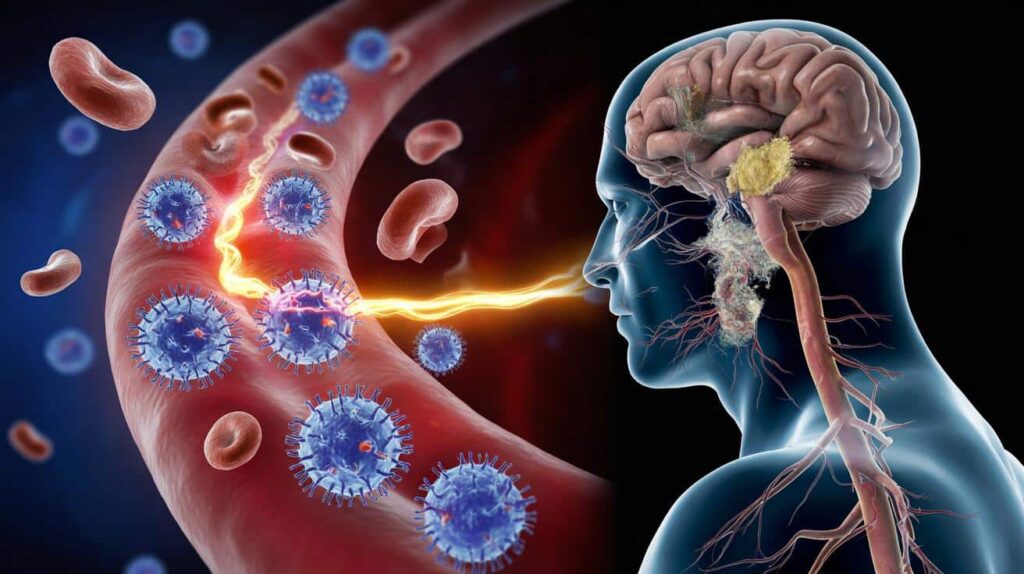
Outside her hospital window, people walked past with coffee cups and backpacks, unaware that a tiny, almost universal virus might be silently rewriting the odds of who develops MS. Most of them had already caught it in their teens and never thought twice.

The question isn’t “Does Epstein–Barr virus matter?” anymore.

It’s “What do we do with a link this strong?”

When a “harmless” virus stops looking harmless
Epstein–Barr virus is the party crasher of human life. Around 90 to 95% of adults carry it, often picked up in adolescence as “the kissing disease,” or a vague flu you barely remember. It hides in our B cells, a kind of immune cell, and usually keeps quiet for the rest of our lives.
For decades, doctors suspected a connection between this virus and multiple sclerosis, a chronic disease that attacks the brain and spinal cord. It was a rumor in medical textbooks, a suspicion shared in conference corridors.
Now the rumor has teeth.
A turning point came from a massive study of US military personnel. Researchers followed more than 10 million soldiers over years, regularly testing their blood. Some of those people later developed MS.
When scientists went back and checked, they saw a pattern so sharp it almost looked staged. Out of 801 MS cases, all but one had evidence of prior Epstein–Barr infection. The risk of developing MS after catching EBV wasn’t slightly elevated. It was multiplied by about 32.
That’s not a gentle nudge. That’s a flashing red sign.
So what’s going on inside the body? EBV seems to change the immune system in a way that can go off the rails. In some genetically vulnerable people, the virus may “train” the immune system badly, nudging it to misfire against the brain’s myelin sheath, the protective coating around nerves.
Imagine your body’s defense soldiers learning from the wrong instructor. They walk away thinking that parts of you are the enemy. Over years, this can trigger the attacks that define multiple sclerosis: blurred vision, numbness, fatigue, trouble walking.
*The virus doesn’t guarantee MS, but it appears to be a loaded dice in a very specific game.*
What this means for everyday lives, not just lab slides
So, what can a person actually do with this kind of information? You can’t rewind time and “uncatch” a virus you probably picked up at 16. There’s no simple blood cleanse, no reset button.
The real opportunity sits one step earlier: preventing that first Epstein–Barr infection or blocking its worst effects. Researchers are now racing to develop EBV vaccines, some modeled on the same mRNA technology used in COVID-19 shots. The idea is simple on paper: stop EBV before it slips into your B cells, and you might sharply cut the number of future MS cases.
A vaccine wouldn’t just be about avoiding a sore throat. It could be about protecting future brains.
For those already living with MS, this link changes the emotional landscape. It’s no longer just a mysterious lightning strike of bad luck. There’s a story, a sequence, a before and after: first EBV, then, years later, the first numb leg or tingling hand.
Some patients describe it as both comforting and infuriating. Comforting because their illness finally has a clearer villain. Infuriating because the villain is almost universal and invisible. One woman told her doctor, “So I got a teenage virus and now I’m paying the price at 35?” That’s a raw sentence, but it captures the quiet anger behind a lot of consultations right now.
Let’s be honest: nobody really reads a line about a 32-fold increased risk and just shrugs.
 Goodbye balayage: “melting,” the new coloring technique that makes gray hair almost unnoticeable
For doctors, the new evidence is starting to reshape conversations in the exam room. They’re watching more closely for early MS symptoms in people with a history of severe EBV illness, like mononucleosis. Some clinics are adding more detailed questions about past infections to their intake forms.
At the research level, labs are studying how EBV hides in B cells and how MS treatments that target these cells might also be indirectly targeting the virus. The logic is subtle but powerful: if a disease is partly fueled by a virus living in a specific type of immune cell, therapies that calm or reduce those cells might not just slow MS.
They might be tugging on the virus–MS connection itself.
Living with the knowledge, without drowning in it
On a very practical level, the EBV–MS link is pushing people to think differently about long-term immunity. No one can live inside a bubble, but some habits can stack the odds a little more in your favor. That means taking infections seriously, resting properly through viral illnesses, and not brushing off prolonged fatigue or neurological oddities as “just stress.”
If you had a rough bout of mono in your teens or early adulthood, it can be worth mentioning it explicitly to your doctor, especially if you notice recurring numbness, vision issues, or unusual weakness. A 30-second sentence during a checkup can be the seed of much earlier investigation. Early MS treatment often slows disease progression, which is a quiet form of power.
Knowing your past can sharpen how you watch your present.
Many people will read about EBV and MS and spiral into “What if?” territory. What if I caught EBV when I was 14? What if that week of swollen glands was the start of something bigger? This anxiety is understandable. The science is heavy, and the headlines don’t always show the nuance.
Here’s the tricky truth: most people infected with EBV will never develop multiple sclerosis. Genetics, environment, other infections, vitamin D levels, smoking history — they all weave into the final picture. Blaming everything on a single virus is tempting, but life doesn’t follow single-cause storylines for long.
We’ve all been there, that moment when one piece of news suddenly colors years of health memories.
Researchers are trying to keep the message grounded. They’re saying: this is a big clue, a strong link, a door that finally opened. Not a destiny, not a curse.
“Epstein–Barr virus looks less like a bystander and more like a trigger,” says one MS researcher, “but a trigger only fires in a gun that’s already been built by genetics and environment.”
To navigate all this as a non-specialist, it helps to hold on to a few simple anchors:
- **EBV is extremely common** — almost everyone carries it by adulthood.
- **MS remains relatively rare** — most people with EBV will never develop it.
- Current MS treatments already help many patients maintain work, family life, and autonomy.
- EBV vaccines and antiviral strategies are under active development.
- Talking openly with your doctor about your infection history can only help.
A new chapter, still being written in real time
Medicine doesn’t often get moments this clear. For years, the connection between Epstein–Barr virus and multiple sclerosis was like a half-heard conversation in the next room. Now the door is open, the voices are loud, and the numbers are on the table. A nearly universal virus appears to be one of the strongest known risk factors for a disease that can reshape a life before 40.
This doesn’t fix anything overnight. It doesn’t erase wheelchairs, missed careers, or the slow, stubborn fatigue that MS patients describe as “walking through wet sand.” What it does is hand us a sharper map: one that starts long before the first MRI, back in childhood infections and viral footprints in the blood.
The coming years may bring EBV vaccines, more targeted therapies, and new ways to predict who is most at risk. Until then, the story is still unfolding in clinics, labs, and living rooms. People are quietly connecting the dots between a teenage illness they barely recall and the neurologist appointments crowding their calendar.
Some scientific links change only textbooks. This one might change futures.
| Key point | Detail | Value for the reader |
|---|---|---|
| EBV strongly linked to MS | Large studies show a ~32-fold higher MS risk after EBV infection | Helps readers grasp why this research is making headlines |
| Most EBV carriers won’t get MS | MS still affects a small fraction of those infected, with genetics and environment also involved | Reduces unnecessary panic and keeps the risk in perspective |
| New prevention paths | EBV vaccines and targeted therapies are in development | Offers a sense of progress and hope for future patients and families |
FAQ:
- Is Epstein–Barr virus the direct cause of multiple sclerosis?Current research suggests EBV is a major trigger, but not the sole cause. Genetics, environment, vitamin D, and lifestyle factors also shape who actually develops MS.
- If I had mono, will I develop MS later?No, most people who had mononucleosis never develop MS. Your personal risk is higher than someone never infected, but the absolute risk remains relatively low.
- Can I get tested for EBV to know my MS risk?Blood tests can show if you’ve had EBV, but since almost all adults are positive, it doesn’t give a clear personal prediction. Doctors look at symptoms, MRI scans, and other markers to assess MS risk.
- Are there vaccines against Epstein–Barr virus yet?Several EBV vaccines are being studied, including mRNA-based ones, but none are widely available yet. Trials over the next few years will show how effective they are at preventing infection and possibly MS.
- What should I do if I have MS and just learned about the EBV link?You don’t need to change treatment solely based on this news. Talk with your neurologist about how this research fits your situation. Existing MS therapies can still work well, regardless of when you caught EBV.
