
On a grey morning in Paris, as tourists lined up under the drizzle at Les Invalides, a very different kind of tension hummed behind the thick walls of the Ministry of the Armed Forces. Phones were on silent, eyes glued to secure messaging apps, half-drunk coffees forgotten. For months, teams from Dassault Aviation, diplomats and military officers had inched toward a glittering prize: a €3.2 billion Rafale fighter jet contract abroad, the kind of deal that keeps entire industrial regions breathing.
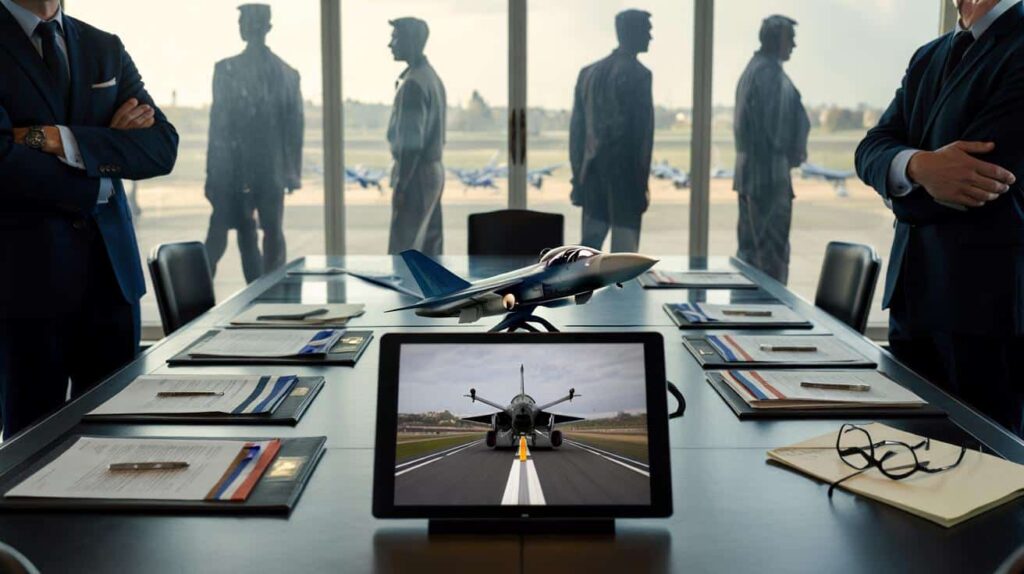
Then, almost overnight, the smiles froze. A last-minute political shift in Paris, a discreet call from a rival capital, and the mood in those corridors turned leaden.

People stopped talking in full sentences.

When politics walks into the negotiation room
The Rafale story always starts with images of sleek grey jets slicing through the sky, but the real drama usually unfolds far from any runway. In this case, it happened across a string of discreet hotel lobbies and closed-door offices, where French envoys had been quietly nurturing a €3.2 billion sale with a friendly foreign air force. Months of technical briefings, offset agreements, and patient lobbying had pushed the deal to the edge of signature.

Then politics walked in, uninvited. A last-minute French decision — part domestic calculation, part diplomatic gamble — changed the tone of the talks. The buyer felt slighted. In defense diplomacy, bruised ego is sometimes more explosive than TNT.
The pattern is painfully familiar to those who work in this world. Think back to 2021, when Paris woke up to the AUKUS submarine shock: an Australian deal worth tens of billions slipping away overnight, with a terse communiqué and some carefully rehearsed “strategic” justifications. For those close to the Rafale file, the current fallout feels like a smaller, but eerily similar earthquake.
Behind the scenes, negotiators describe a chilling déjà vu. One diplomat recalls how the partner country quietly postponed a key signing ceremony, then downgraded a planned ministerial visit. A defense attaché talks about suddenly “unavailable” counterparts. On paper, the €3.2 billion Rafale package is still alive. On WhatsApp, it already looks like a ghost.
What actually happened? According to several industry and political sources, Paris tried to juggle too many priorities at once. Domestic optics on arms exports. Pressure from European partners. The need not to offend a rival regional power. All this filtered into a single late decision that, from the buyer’s perspective, looked like hesitation — or worse, a lack of respect.
In the high-stakes game of fighter jet diplomacy, hesitation kills. These customers are courted by Washington, London and sometimes Moscow. They watch every signal, every delay, every unsmiling photo. When Paris wobbles, they don’t just shrug and wait. They call someone else.
The fine line between sovereign choice and self-sabotage
Inside the French state, there’s a kind of unwritten choreography when a big arms deal is on the table. The Élysée Palace weighs the geopolitical cost. The foreign ministry reads the mood in the target capital. The defense ministry stresses operational ties. And industrial champions like Dassault submit quietly desperate memos about jobs, skills and export credibility.
This time, that choreography slipped out of rhythm. A political signal meant for a domestic audience — a degree of caution on sensitive exports, framed for TV talk shows and parliamentary questions — crossed wires with ultra-sensitive negotiations abroad. The buyer read it as a warning: “Paris might back off under pressure.” For a country about to retool its air force for decades, that’s the kind of ambiguity that sends chills down the chain of command.
We’ve all been there, that moment when a last-minute change of heart in a meeting wrecks weeks of patient work. In the world of fighter sales, the stakes are just multiplied by a few billion. One industry insider describes how technical teams had already aligned on radar configurations, training pipelines and local maintenance hubs. Local officers had visited French air bases, posed proudly in front of Rafale cockpits, sent photos back home.
Then came the political U-turn vibes. Not a formal “no,” but a sense that Paris might tighten conditions, slow approvals, or link the deal to a broader diplomatic package. The buyer’s defense council, already under pressure from opposition figures and rival foreign lobbies, saw an opening to walk away gracefully. They started talking “evaluation delays” and “alternative options.” The temperature dropped a few degrees with each email.
 Sorry, the Matrix doesn’t exist: new mathematical proofs suggest the universe cannot be a simulation
Behind the emotion and the bruised pride, there’s a cold logic at work. Defense purchases are not one-off shopping trips, they are marriages. Once you buy Rafales, you are tied to French training, spare parts, software updates, political moods. So the buyer asks a simple question: can we trust this partner for 30, 40 years?
When domestic French politics suddenly interferes with a near-final deal, that trust takes a hit. *Strategic reliability isn’t about shiny brochures, it’s about consistency in the messy, uncomfortable moments.* This episode will quietly land in the mental archive of procurement chiefs around the world, filed under: “France — modern, capable, but politically exposed.”
How France could stop torpedoing its own flagship
There is a way out of this spiral, and it doesn’t only rest on louder speeches or glossier air shows. The first method is brutally simple: lock in political red lines early, and stick to them. Before negotiators fly out to pitch Rafales, the Élysée and key ministries need a shared map of what’s non-negotiable — human rights conditions, regional balances, parliamentary constraints — and what can be flexed.
Then, keep that map away from the electoral noise. Once a major deal crosses a certain threshold of maturity, Paris has to treat it like a strategic promise, not a variable of the weekly political weather. Quiet, unequivocal messaging to the buyer — “we’re committed, here are the exact conditions, they will not change unless X” — can save billions. It also lowers the risk of last-minute “surprises” that feel like betrayal abroad.
The other habit to rethink is the temptation to play several games at once. French leaders love nuance, strategic ambiguity, balancing acts between rivals. That’s part of the country’s diplomatic DNA. But when you’re selling cutting-edge jets, trying to please both the buyer and their regional opponent is a recipe for suspicion. Let’s be honest: nobody really does this every single day.
A more grounded approach would be to accept short-term criticism at home — “why are we selling arms there?” — in order to defend long-term credibility abroad. Or, if a deal genuinely crosses a political red line, say “no” early and clearly, before hopes and headlines build up. That clarity might frustrate industry in the short term, yet it avoids the much deeper resentment that comes from feeling dropped at the last minute.
“Customers don’t walk away only because of price or technology,” sighs a senior European defense negotiator. “They walk away when they sense you’re not fully in, or that you could change your mind the moment the wind shifts in your parliament or your TV studios.”
- Define export red lines in writing, shared across all ministries from day one.
- Assign a single political anchor — often the president — as final guarantor of the deal’s continuity.
- Communicate privately, but unambiguously, with the buyer on timing and conditions.
- Shield ongoing negotiations from short-term media storms and opposition theatrics.
- Debrief lost deals publicly, at least partially, so the same mistakes don’t stay hidden and repeated.
A €3.2 billion warning shot to the whole defense ecosystem
What looks, on paper, like “just another” complicated export case is already echoing far beyond this single €3.2 billion Rafale package. For thousands of engineers in Mérignac, suppliers in small French towns, pilots in partner air forces and analysts in rival capitals, this aborted or at least frozen deal is a signal. A warning that French political life is bleeding more directly into long-term strategic commitments.
It raises uncomfortable questions. How many future buyers will quietly lean toward the United States or another supplier, not because they doubt French technology, but because they worry about French politics? How will this shape the next generation of joint European projects, when teammates wonder whether Paris might blink under pressure at the eleventh hour? And on the domestic front, how long can political leaders promise a strong industrial base while sending such jittery signals to export partners?
The bitter irony is that the Rafale, technically, has never been so attractive. Combat-proven, constantly upgraded, wrapped in a web of training and cooperation. Yet the jet now risks being shadowed by something much less aerodynamic: the perception that French politics might pull the plug when it hurts most. That’s the kind of story that spreads quietly at defense fairs, in the bars of air bases, and across those smoky, late-night hotel lounges where the next big contracts are already being whispered into existence.
| Key point | Detail | Value for the reader |
|---|---|---|
| Political signals matter as much as technology | Last-minute shifts in Paris can be read as unreliability by foreign buyers | Helps decode why seemingly solid mega-deals suddenly collapse |
| Export red lines need to be fixed early | Clear internal rules avoid U-turns when negotiations are almost complete | Shows how strategic industries can be protected from political turbulence |
| Lost deals reshape global balance | Each failed Rafale sale opens space for US, UK or other competitors | Gives context on how one decision affects jobs, alliances and long-term security |
FAQ:
- Question 1Did French politics directly kill the €3.2 billion Rafale deal?
- Answer 1Not with a single clear “no,” but through a late political shift that created doubt on the buyer’s side, slowing momentum and pushing them to actively explore alternatives.
- Question 2Which country was involved in this Rafale negotiation?
- Answer 2Several countries have been in advanced talks with France, and sources close to the file are deliberately vague; the key takeaway is the pattern, not just the flag on the tail.
- Question 3Is the Rafale itself losing competitiveness?
- Answer 3Technically, no — the aircraft remains highly capable and combat-proven; the fragile element is not the jet, but the political reliability attached to it.
- Question 4Can France restore trust with potential buyers?
- Answer 4Yes, if it stabilizes its export decision process, sets clearer red lines, and avoids sending mixed signals once negotiations reach the final stretch.
- Question 5Why should ordinary readers care about a failed fighter jet deal?
- Answer 5Because such deals support jobs, shape alliances, and quietly influence whether your country faces the world as a credible partner or a hesitant player in moments that really count.
