
The first time you see the new images of interstellar comet 3I ATLAS, it feels a bit like catching a stranger’s gaze on a crowded train. You know they don’t belong here. The background stars are our regulars, the usual cast. And then there’s this faint, ragged smear of light slipping across the frame, carrying the cold memory of another star system entirely.
On a screen in a dim control room, astronomers quietly argue over tiny details: a blur here, a notch there, a suspiciously lopsided tail. Someone zooms in one more time. Someone else mutters that the numbers don’t add up.

The data looks ordinary. The feeling in the room does not.

The comet that didn’t grow up here
When 3I ATLAS was first flagged in 2024, it didn’t roar into the headlines like ʻOumuamua once did. It slipped in quietly, a faint, fast-moving intruder on survey images, tagged as another icy wanderer. Then the orbital calculations came back. Its path was too open, its speed too high, its trajectory absolutely wrong for something born in our Solar System.

Astronomers had seen this story only once before: **an interstellar visitor** cutting across our celestial backyard, unbound to the Sun. This one, though, looked more like a “real” comet than ʻOumuamua’s weird cigar-shaped rock. Or so people thought at first glance.
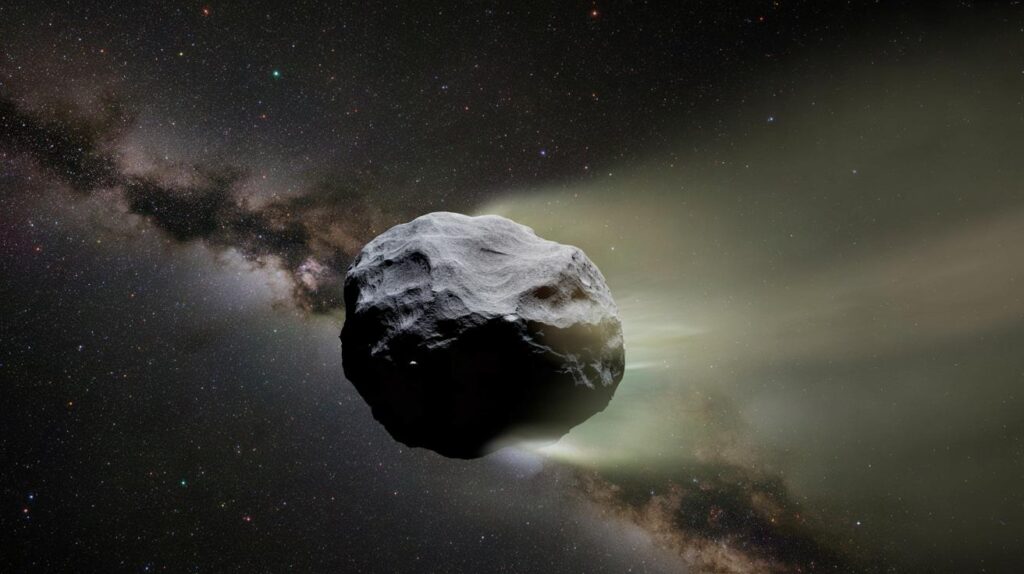
The sharper the images got, the stranger 3I ATLAS began to look. With the European Southern Observatory’s Very Large Telescope and a swarm of ground-based telescopes, teams pulled out a nucleus only a few kilometers wide, wrapped in a ghostly coma that seemed to breathe on and off.
One group measured its brightness over several nights and found a nervous flicker, as if the comet was tumbling, exposing fresh pockets of ice to harsh starlight. Another group tracked the tail and noticed it wasn’t cleanly aligned with the solar wind like a neat physics diagram. It kinked. It forked. It looked almost bruised.
On astronomy Slack channels and late-night Zoom calls, the tone shifted from “cool new comet” to “wait, what exactly are we looking at?”
The core of the debate sits in a deceptively simple question: what actually drifts between the stars? Textbooks tend to talk about “interstellar space” as an almost empty void, salted with thin gas and dust. But 3I ATLAS, like ʻOumuamua and 2I/Borisov before it, is forcing scientists to confront a less tidy picture.
The comet’s composition hints at chemistry more extreme than we see around our Sun, with a possible overabundance of carbon-bearing molecules and fragile ices that shouldn’t have survived a long exile in hard vacuum. Some models say this object may be a fragment tossed out of a violent young system, where giant planets flung debris like shrapnel into interstellar night.
Others argue the odd non-gravitational nudges in its motion hint at exotic ices or ultra-porous structure. A few, quietly, wonder if we’re still underestimating how wild the space between stars really is.
Peeling back the layers of an interstellar stranger
Studying a visitor like 3I ATLAS is a bit like trying to analyze a snowflake that’s already landing on a hot stove. It’s racing through the inner Solar System at tens of kilometers per second, brightening, fading, shedding material all the time. The only way to get a sharp look is to layer technique on technique, and be ready to adapt fast.
Teams use time-series imaging to track subtle changes night by night, spectroscopy to break its light into chemical fingerprints, and high-contrast processing to suppress the glare and reveal structure in the tail. One practical “trick”: stack dozens of short exposures aligned on the comet, letting the background stars turn into trailing lines. The result is a sharpened, almost intimate look at a visitor that will never come back.
We’ve all been there, that moment when you zoom in on a photo and see more than you were ready for. Astronomers got their version of that when they started comparing independent analyses of 3I ATLAS’s shape and motion.
One group’s model suggested a fairly standard, rounded nucleus, just dusty and active. Another saw evidence for a highly elongated body, more like a splinter than a snowball. The non-gravitational accelerations, those tiny pushes from outgassing jets, didn’t quite agree from paper to paper. Some fits demanded ridiculously light, fluffy material, almost like aerogel. Others implied patchy outbursts from buried pockets of volatile ice.
The statistics were fine. The interpretations were not. And every time new data landed, old theories creaked.
Behind the technical debate sits a quieter, more human tension: how far are we willing to stretch our picture of the cosmos before it snaps? Astronomers aren’t blind to the public fascination with “interstellar visitors”. Talk of alien probes and artificial objects lurks in the background of every press release.

Let’s be honest: nobody really reads a 30-page orbital dynamics paper before jumping to the wild stuff. Scientists know that, and they feel the pressure. Many are careful to stress that 3I ATLAS behaves, on the whole, like a natural comet. Gas emissions match known species. Dust scattering looks familiar. Its coma responds to sunlight in recognizable ways.
At the same time, the object’s sheer improbability — flung from some unknown nursery light-years away, wandering for eons, then crossing our narrow observing window — gnaws at the edges of that caution. *There’s only so many times you can call something “unlikely” before you start to doubt what “likely” even means in a galaxy this big.*
Why this matters far beyond one pale smear of light
If you strip the romance away for a second, 3I ATLAS is raw data about how planetary systems live and die. Each molecule in its tail is a receipt from someone else’s cosmic grocery run: water, carbon monoxide, organic compounds, silicate grains. By comparing those spectra to our own comets, scientists test ideas about how common Earth-like chemistry might be across the galaxy.
The “precise method” behind the poetic headlines is brutal patience. You watch the comet over weeks. You separate its light into colors, then into more colors, hunting for faint dips and spikes that shout “methane here” or whisper “complex organics there”. You fit models, throw them away, fit them again. Out of all that grind comes one quiet payoff: a slightly less vague answer to the question, **are we chemically ordinary or not?**
For people following from the sidelines, the messiness can feel frustrating. One day the comet looks “normal”. The next, a new preprint says its composition is way off the charts. Then a revised distance estimate adjusts everything, and yesterday’s hot take quietly ages out of the news cycle.
That’s not a sign of confusion so much as a real-time view of how science actually moves. There are common mistakes we all make when watching stories like this unfold. We treat early numbers as final. We cling to the first explanation that makes intuitive sense. We get attached to drama — the rogue shard from a shattered super-Earth, the frozen messenger from a crowded star cluster — and forget that nature rarely cares about our need for a tidy plot.
An empathetic way to follow along is to let your opinion stay soft around the edges. Expect updates. Allow for revisions. That’s how the field stays honest.
“Interstellar comets like 3I ATLAS are not just visitors,” says one planetary scientist involved in the observations. “They’re samples delivered straight from somebody else’s backyard, and we’re still learning how to read the labels.”
- What it is: An interstellar comet, officially designated 3I ATLAS, on a hyperbolic path that proves it’s not bound to the Sun.
- Why it’s special: Its coma, tail structure, and chemistry don’t line up neatly with most comets we know, sparking fresh debate.
- What’s being argued: How fluffy, how active, and how chemically exotic it really is — and what that says about other planetary systems.
- What it could change: Models of how often planetary systems eject debris, and how “normal” our Solar System is in the wider galaxy.
- Why you should care: Every one of these visitors tightens or loosens the case for life-friendly worlds being common, not rare.
The quiet shift in how we think about the space between stars
Seen from a city sidewalk, the night sky suggests a simple story: bright points, dark in-between, and us, stuck under it all. But with every interstellar object we catch — from ʻOumuamua’s eerie shard to Borisov’s chaotic fuzzball and now 3I ATLAS’s bruised-looking halo — that story gets harder to tell with a straight face.
The space between stars no longer feels like a blank gulf. It’s starting to look like a slow river, carrying fragments of a hundred thousand failed worlds, frozen experiments, half-finished planets and never-were moons. Some break apart quietly in eternal dark. A few drift into someone else’s system and catch a brief flash of light as they pass a foreign sun. Once in a blue century, that sun is ours.
You can feel that mental shift in the way astronomers talk now. They speak less about “rare events” and more about “limited detection windows”. Surveys are getting sharper, faster, hungrier. New projects are being designed explicitly to hunt these hyperbolic ghosts. Each one adds a data point to a growing, imperfect map of what’s really crossing the gulfs between stars.
There’s also a more personal side. If comets like 3I ATLAS are flying through interstellar space all the time, then our Solar System is not an isolated island. It’s part of a slow, silent exchange of material that’s been running since before Earth had oceans. Some researchers quietly wonder if building blocks for biology might have hopped systems this way. Others roll their eyes at that leap — not yet, not with this data. But the question now lives in the room.
So when you scroll past a blurry white smudge labeled “3I ATLAS” on your phone, you’re not just seeing a distant snowball. You’re looking at the physical trace of another star’s story, scribbled across our sky for a brief moment, then gone forever into deep night.
What drifts between the stars is no longer just theory or poetry. It’s measurable, debatable, sometimes infuriatingly ambiguous. It’s dust, ice, rock, maybe more complex chemistry than we’re ready to admit.
Whether you lean toward the cautious camp or the “galaxy is wilder than we think” crowd, this much is plain truth: the empty parts of the universe are getting harder to call empty with a straight face. And we’ve only just begun catching what’s been passing us by all along.
| Key point | Detail | Value for the reader |
|---|---|---|
| Interstellar origin | 3I ATLAS follows a hyperbolic path and moves too fast to be bound by the Sun. | Clarifies why this comet genuinely comes from beyond our Solar System. |
| Unusual behavior | Its brightness, coma structure, and tail show subtle but persistent oddities. | Helps you see what scientists are arguing about, beyond hype or rumors. |
| Big-picture stakes | Each object like this refines models of planetary systems and interstellar space. | Connects a distant comet to questions about how common Earth-like worlds may be. |
FAQ:
- Question 1What exactly is 3I ATLAS?
- Answer 1It’s the third confirmed interstellar object ever detected, and the second interstellar comet, identified by its hyperbolic orbit and high speed that show it came from outside our Solar System.
- Question 2How do astronomers know it’s not from our Solar System?
- Answer 2By tracking its position over time, they calculate an orbit with an eccentricity greater than 1, meaning it’s not bound to the Sun. Its incoming speed is too high for any known Solar System process to have launched it.
- Question 3What makes 3I ATLAS different from ʻOumuamua and Borisov?
- Answer 3ʻOumuamua looked like a dry, oddly shaped object with no obvious coma, while 2I/Borisov behaved like a very active comet. 3I ATLAS sits in between: comet-like, but with puzzling tail structure and activity patterns.
- Question 4Is there any serious chance it’s artificial?
- Answer 4Most researchers say no. Its spectrum, dust, and gas release all look natural. The debate is about what kind of natural object it is, not whether it’s a machine.
- Question 5Why should non-specialists care about this comet?
- Answer 5Because objects like 3I ATLAS are physical samples from other planetary systems. They tell us whether the ingredients that built Earth — water, organics, rock — are common across the galaxy or rare lucky accidents.
