
The hairstylist snapped the cape around Anne’s neck and sighed softly. “We can take ten years off with the right cut,” he said, comb in hand, eyes scanning her silver bob. Around them, the salon buzzed with women of every age, but there was a particular energy at the chairs where women over 60 sat. Half were asking for “something fresh, something younger.” The other half were saying, almost defiantly, “I’m keeping the gray. I earned it.”
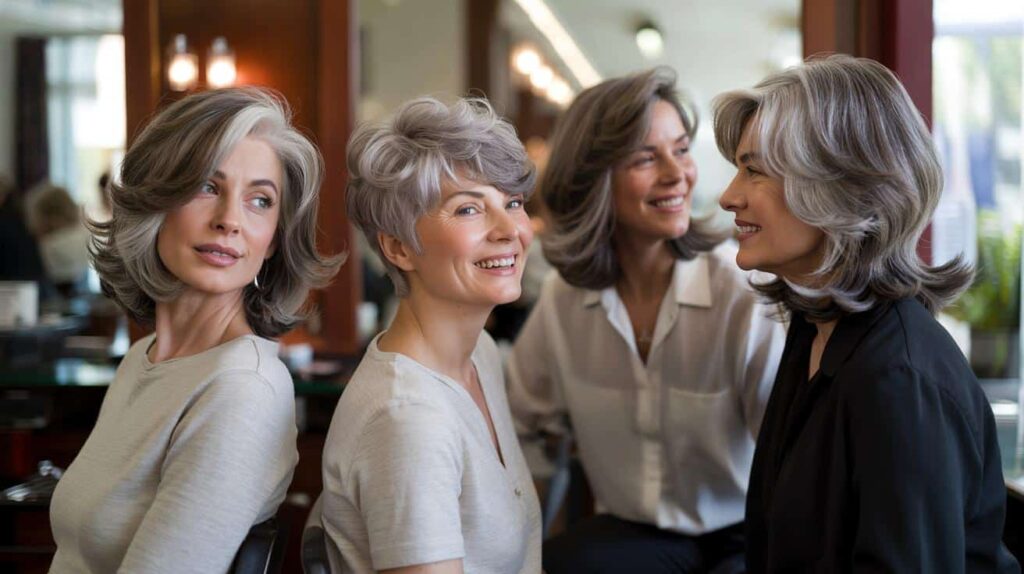
You could feel the split even in the mirrors.

One woman left with a sharp layered crop and a huge smile, looking energised and lighter. Another left with her natural white waves intact, just trimmed, walking out with a sort of quiet pride.

Between those two exits sits a very modern tension.

The four “anti-aging” haircuts everyone asks for after 60
Talk to any busy stylist and they’ll tell you the same thing: four cuts keep coming back, like a playlist on repeat. The softly layered bob. The pixie with volume on top. The shoulder-length shag. The grown-out fringe with face-framing layers.
These are the **“anti-aging” greatest hits**.
They’re flattering, easy to style, and they do the one thing so many women quietly hope for after 60: they pull the eye up and away from the lines and the sagging we all eventually get. Shorter lengths reveal necks and cheekbones. Layers add movement where hair has started to sit flat. You catch your reflection and see light instead of tiredness.
That little jolt of recognition can feel addictive.
Take Mary, 67, retired teacher, who walked into a central London salon with hair halfway down her back. It was thinning at the ends, yellowed from old highlights, always tied in the same loose bun. “I want my old self back,” she told the stylist, then laughed, “Or maybe a new one.”
Two hours later, the bun was gone. In its place: a chin-length layered bob, grazing the jaw, with a side part that opened her face. The gray was still there, but softened, blended with a few cool-toned lowlights. She stepped off the chair and actually gasped.
Her daughter texted later that day: “Mum, you look ten years younger.” Mary screenshot that message. She still shows it to friends.
These four haircuts work for simple, practical reasons. Shorter and mid-length cuts remove the heaviest, weakest part of aging hair, so what’s left looks thicker and bouncier. Layers add air between strands, so light can pass through and reflect, which the eye reads as “youthful.” Strategic volume at the crown subtly corrects the way the face changes with time, balancing softer jawlines and falling cheeks.
“When hair thins, we lose structure,” one Paris stylist explained to me. “So I cut like an architect, not like a painter.”
There’s also a psychological shift: a fresh shape signals “I’m still evolving.” Even a tiny change in silhouette can shake off that invisible label society likes to stick on older women.
When “anti-aging” stops feeling honest
There’s another scene, quieter, but just as real. A woman sits down in front of her mirror at home, runs her fingers through her thinning, wiry hair, and whispers, “I can’t keep fighting this.” Instead of booking a “rejuvenating makeover,” she trims her ends herself, uses a gentle styling cream, and lets the white and silver stand. No filters. No promises. Just what is.
This is where some experts are pushing back.
Dermatologists and trichologists are increasingly blunt: thinning and graying are not failures, they’re biology. Trying to erase every sign of age with cut, color, and volume can slide into a sort of denial that leaves women more anxious, not less. For them, the most radical, modern choice over 60 isn’t another clever bob. It’s saying, *this is my real hair, and I’m not apologising for it.*
We’ve all been there, that moment when you stare at a clump of hair in the shower drain and feel something sink in your chest. You start scrolling “youthful hairstyles for older women” and the algorithm doesn’t help: endless thumbnails of “60 but looks 40!” side by side with dramatic before-and-afters.
Online, the four anti-aging cuts are presented like magic tricks: sagging jowls, then suddenly lifted; dull hair, suddenly glossy; tired eyes, suddenly bright. The not-so-hidden message is that your natural hair is a “before picture” waiting to be fixed.

For some, that’s fun, empowering even. For others, it lands like a quiet insult. You start to wonder: if I don’t choose the “lifting” cut, am I choosing to “let myself go”?
Strip away the marketing and you see the plain conflict. On one hand, a flattering haircut can genuinely change how you feel when you look in the mirror. Confidence isn’t fake; it shows in how you walk into a room, whether you apply for a job, whether you say yes to a date. On the other, experts who work with aging hair daily know you can’t cut your way out of reality.
Let’s be honest: nobody really does this every single day. The round-brush blowout, the root touch-ups every three weeks, the constant styling to “keep the lift” going.
So they argue for a middle ground. A cut you can live with, not just pose with. A shape that respects what your hair is actually doing at 60, 70, 80, instead of pretending it’s still 35.
How to choose a cut that respects both your age and your story
The most useful question isn’t “Which haircut will make me look younger?”. It’s “How do I want to feel when I see my reflection?”. Start from that feeling, then work backwards.
If you want lightness and energy, those four classic shapes can be tweaked to fit your real hair, not the model’s. A bob that stops at the collarbone instead of the jaw. A pixie with slightly longer sides for softness. A shag that keeps most of the weight at the bottom if your hair is very fine.
Ask your stylist to show you how the cut behaves when it’s just air-dried, no salon magic. If you still like it then, you’re on the right track.
The biggest mistake many women over 60 mention isn’t cutting their hair short. It’s cutting it short for the wrong reasons. Choosing a pixie because “women my age should” or clinging to long hair because “my partner likes it” rarely ends well. Hair grows, yes, but the sting of not recognising yourself can linger.
There’s also the trap of chasing the last haircut that made you feel beautiful… from 15 years ago. Styles that worked with denser, darker hair can look harsh or stringy once texture and color change. Stylists see this every day: the stubborn fringe that now emphasizes forehead lines, the long layers that expose a widening part.
Being gentle with yourself doesn’t mean giving up. It means allowing today’s face and today’s hair to have a say.
“Anti-aging is the wrong word,” says Berlin-based hairdresser Lena R., who works almost exclusively with clients over 55. “What we really do is harmony. If the cut argues with the person’s age, you feel it immediately. My best work is when people leave and say, ‘That looks like me… just rested.’”
- Soft layered bob
A classic that lifts the jawline slightly, removes weak ends, and adds swing without demanding daily blowouts. - Textured pixie
Works with thinning hair by embracing shortness, creating the illusion of density at the crown, and drawing attention to the eyes. - Modern shag at the shoulders
Ideal for wavy or curly hair, it lets natural texture shine while avoiding the drag of long, heavy lengths. - Longer cut with face-framing layers
For those not ready to go short, this keeps length but brightens the face, especially when paired with subtle gray blending.
Between “ten years younger” and “this is me now”
There’s a quiet revolution taking place in salons and bathrooms around the world. Some women are asking for the illusion of youth: lift, volume, movement, disguise. Others are asking for the opposite: truth, ease, dignity, the right to walk around with thin, silver hair and still be seen as fully alive.
Most live somewhere between those two poles. A soft bob that respects the gray rather than hiding it completely. A pixie that owns the thinning crown instead of fighting it. A decision to keep dyeing, but less often, or to let the white grow in with patience and a scarf on bad days.
None of the experts I spoke to believe there’s a “correct” choice. What worries them is when women feel cornered, pressured to pick a side: anti-aging or authentic, cropped or long, colored or natural. Real life is messier. One season you might want the drama of a big chop, the next you might grow it out and let the silver win.
Hair carries history: grief, illness, reinvention, love affairs, grandchildren’s sticky fingers. The four anti-aging haircuts are just tools. They can help you highlight what you love about your face, or they can mask what you’re not ready to accept yet. Only you can decide whether that masking feels like self-care or self-erasure.
The mirror is waiting either way.
| Key point | Detail | Value for the reader |
|---|---|---|
| Four popular “anti-aging” cuts | Soft bob, textured pixie, modern shag, long cut with face-framing layers | Gives concrete ideas to discuss with a stylist |
| Expert criticism | Some specialists say chasing youth can deny the reality of gray and thinning hair | Helps readers reflect on emotional impact, not just aesthetics |
| Middle-ground approach | Adapting cuts to current texture, density, and lifestyle rather than copying trends | Supports more honest, sustainable hair choices over 60 |
FAQ:
- Question 1What haircut really suits women over 60 with thinning hair?Layered, shorter or mid-length cuts usually work best, as they remove weak ends and create volume at the crown without needing heavy styling.
- Question 2Does going gray automatically make you look older?No; harsh lines, flat color, and neglected cuts age the face more than the gray itself, while well-shaped silver hair can look fresh and modern.
- Question 3Is a pixie cut always the most flattering after 60?Not always; a pixie suits some face shapes and personalities, but others feel more like themselves with a bob or soft shoulder-length style.
- Question 4How often should I cut my hair at this age?Every 6–10 weeks keeps shape and ends healthy, with finer or shorter hair often needing slightly more frequent trims.
- Question 5Can I keep my long hair even if it’s thinning?Yes, as long as the length still looks full enough; subtle layers and a strong perimeter line can help long, fine hair look more intentional than straggly.
