
New research from Spanish scientists now suggests that image may have been seriously over‑cranked, with mammoths and many dinosaurs moving at a far more measured pace than popular culture has led us to believe.
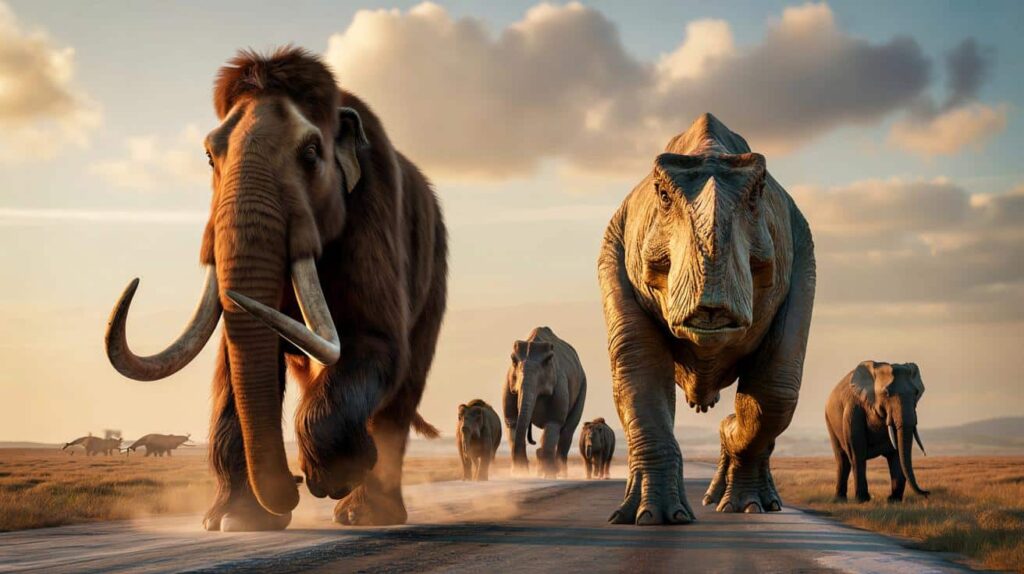
Prehistoric giants with more shuffle than sprint
The new study, led by teams at the University of Granada and the Complutense University of Madrid and published in Scientific Reports, reassesses how fast very large land animals could realistically move. The researchers focused on mammoths and big dinosaurs, two classic icons of prehistoric power and speed.

Instead of treating them as oversized versions of modern fast animals, the team asked a simple question: what happens to legs, muscles and bones when body mass becomes extreme?

The study concludes that the maximum speed of very large dinosaurs and mammoths was substantially lower than many earlier estimates suggested.

Past work often relied on fossil trackways or broad equations applied across all land animals, from dogs to ostriches to elephants. The Spanish-led group took a different approach. They built specific models for so‑called “graviportal” animals — species built like pillars, with thick, weight-bearing limbs rather than springy, gazelle‑style legs.
Modern elephants provided the key comparison. They are the closest living analogue to mammoths and some of the giant dinosaurs in terms of weight, limb shape and style of movement.
Why bigger did not mean faster
When animals get heavier, their muscles get stronger, but their skeletons also face far greater loads. The models developed in the study show a clear threshold: beyond roughly 100 kilograms of body mass, top speed stops increasing with size. Past that point, speed begins to decline.
Beyond a certain body mass, trying to run faster would push bones and joints close to their mechanical breaking point.
The team analysed how forces travel through legs during walking, fast walking and running. At higher speeds, every stride sends a stronger shock through the limbs. For an animal weighing several tonnes, that shock becomes enormous.
Evolution seems to have responded by favouring thick, column-like legs in giants such as mammoths and large sauropod or theropod dinosaurs. Those limbs are great for stability and for carrying weight over long distances, but they are poorly suited to sprinting.
Elephants as a window into mammoth speed
Modern elephants do not truly “run” in the classic sense. They can move quickly, reaching around 20–25 km/h, but they keep at least one foot on the ground at all times and never achieve a full aerial phase like a galloping horse.
The Spanish researchers used detailed data from elephant locomotion — including force plate measurements and high‑speed video — to calibrate their models. When they applied those models to mammoths of comparable size, the results lined up: mammoths probably moved with moderate top speeds, broadly similar to elephants.
Mammoths were likely capable of brisk, ground‑covering walks and short bursts of speed, but not long chases across the tundra.
That picture clashes with older, more cinematic portrayals of mammoth herds charging at full tilt. Instead, they appear as endurance specialists, built to travel steadily, conserve energy and avoid catastrophic leg injuries.
What this means for dinosaur behaviour
The implications are even more striking for large dinosaurs. The study suggests that many of the heaviest species — including some famous long‑necked herbivores and big meat‑eaters — could not sustain true running. Their safest option was a fast walk or a kind of “power stride”, enough to reposition or escape danger over short distances, but not to stage long, high‑speed pursuits.
Iconic predators like large theropods were probably not marathon sprinters, but ambush hunters relying on timing, terrain and a short final dash.

This shifts how scientists picture ancient ecosystems. If both predators and prey were slower, their interactions would have looked different from many museum murals and blockbuster films. Stalking, patience and surprise attacks make more sense than endless chases across open plains.
Rewriting familiar dinosaur chase scenes
The new speed estimates challenge some long‑standing assumptions used in films, video games and even educational material. Scenes of a massive carnivorous dinosaur racing a jeep, or an enormous herbivore fleeing at racehorse speed, look less plausible in light of the new data.
Instead, researchers suggest a landscape filled with:
- Large herbivores moving in steady, energy‑saving herds
- Predators relying on cover, waterholes or tight spaces to get close
- Short, decisive rushes rather than drawn‑out chases
- Strong selection for robust skeletons rather than flexible, springy limbs
For children and adults raised on high‑speed dinosaur dramas, the revised picture might seem less glamorous, but it matches more closely with the physics imposed by sheer size.
Biomechanics: when bones call the shots
The core of the study lies in biomechanics — how forces act on structures. When an animal accelerates, ground reaction forces surge. If those forces get too high, bones can crack, joints can fail and tendons can tear.
In small animals, like cats or antelopes, bones have a comfortable safety margin. They can handle speeds much higher than their everyday walking pace. For giant animals, the safety margin shrinks dramatically once they try to run.
| Approximate body mass | Locomotion strategy | Speed potential |
|---|---|---|
| Up to 100 kg | Light limbs, more spring | Speed increases with size |
| 100–1000 kg | Transition zone | Speed levels off |
| Over 1000 kg | Graviportal, pillar‑like legs | Maximum speed declines |
The researchers argue that natural selection, over millions of years, tuned giants like mammoths and large dinosaurs to stay within safe mechanical limits. They traded peak speed for durability, stability and a lower energy cost per kilometre walked.
Energy budgets and survival strategies
Speed is only one part of survival. For huge herbivores, finding enough food and water each day can be a bigger challenge than outrunning predators. Moving efficiently at moderate speed helps them cover ground without burning through their reserves.
Predators, facing similar mechanical constraints, likely adapted their hunting strategies around these limits. They may have targeted young, old or injured individuals, or chosen locations where prey movements were restricted, such as river crossings or forest edges.
Seen through this lens, the heavy, deliberate build of many dinosaurs becomes a feature rather than a flaw. Their sheer mass, combined with herd behaviour and defensive anatomy, could offset their lack of sprinting ability.
Putting “top speed” in perspective
Fans of prehistoric life often ask how fast a particular dinosaur or mammoth could run, as if that number alone defines its prowess. The Spanish study suggests we should treat speed more cautiously and in context.
A lower top speed does not mean these animals were weak or clumsy. It means they were specialists in a different direction: stability, endurance and structural safety.
For readers less familiar with the technical language, “graviportal” is worth unpacking. The term refers to animals whose limbs are shaped like load‑bearing columns, with thick bones and relatively straight joints. Elephants, hippos and rhinos fit this pattern today. Many large dinosaurs and mammoths did too. That design spreads weight evenly, protects joints and keeps the centre of mass steady — all useful traits when you weigh several tonnes.
One useful way to picture the study’s findings is to imagine two running tracks. On one, you have a cheetah, built for explosive speed: long, flexible spine, slender limbs, small body. On the other, a multi‑tonne dinosaur with pillar‑like legs. Even if both push themselves as hard as their bodies can manage, the cheetah’s anatomy favours speed, while the giant’s design caps it. The dinosaur’s primary win condition was never outrunning a cheetah; it was surviving for decades, growing huge and raising offspring in a slow, steady life strategy.
