
The plan sounds like science fiction: a 91‑kilometre tunnel, super‑cold magnets and beams of particles smashing together at unimaginable energies. What has stunned many observers is not just the scale of the project, but the latest twist in its funding story: a group of tech and industry billionaires has pledged hundreds of millions of euros for pure, curiosity‑driven science.
The billionaire bet on pure knowledge
Most mega‑donations from wealthy tech figures chase obvious returns: vaccines, AI labs, climate tech, elite universities. The new pledge for CERN’s Future Circular Collider (FCC) sits in a very different category. It offers no equity, no patents and no exclusive licences. Just data, equations and, if things go well, a deeper grasp of how reality works.

About €850–860 million in private money has been promised for a collider that aims to answer questions with no direct commercial payoff.

The pledge comes from a coalition of philanthropic heavyweights, including the Breakthrough Prize Foundation, former Google CEO Eric Schmidt and Wendy Schmidt, industrialist John Elkann of Stellantis, and French telecoms entrepreneur Xavier Niel. All are backing a machine that might never generate a product, but could rewrite physics textbooks.

The moment matters for another reason: high‑energy physics has traditionally lived almost entirely on public budgets. For decades, the logo on the door at CERN has been that of European governments and partner states, not wealthy donors. This move signals that private fortunes now see fundamental physics as part of their long‑term legacy portfolios.
What is the Future Circular Collider?
A ring larger than a capital city
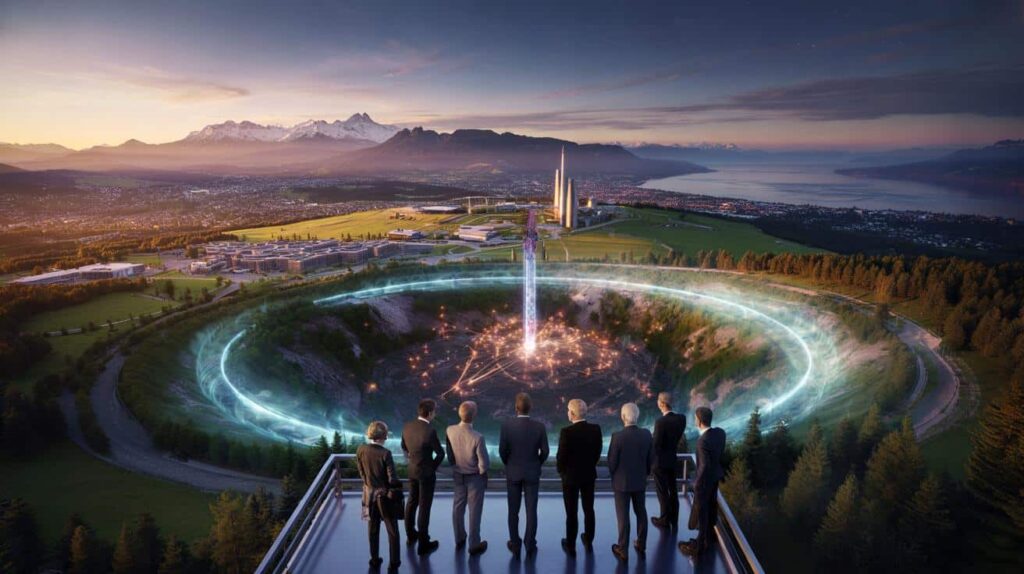
The FCC is conceived as the successor to the Large Hadron Collider (LHC), the 27‑kilometre ring that delivered the Higgs boson in 2012. While the LHC already counts as a giant, the FCC would dwarf it.
- Planned circumference: about 91 km
- Location: deep under the Geneva basin, crossing the French‑Swiss border
- Scale comparison: roughly three times the length of the Paris ring road
- Estimated cost: around €20 billion over several decades
The idea is brutally simple and technically brutal: accelerate particles such as electrons or protons to energies far beyond what the LHC can reach, then collide them and sift through the debris. Each collision is a miniature laboratory, recreating conditions that existed fractions of a second after the Big Bang.
The collider would act as a time machine for physics, recreating energies that nature has not seen locally since the universe was extremely young.
The Higgs under a microscope
The headline goal in the early phase of the FCC is relentless, high‑precision study of the Higgs boson. This particle, confirmed at CERN in 2012, is linked to the mechanism that gives mass to other fundamental particles.
Physicists want to know:
- Does the Higgs interact with itself exactly as current theory predicts?
- Are there tiny deviations suggesting hidden particles or forces?
- Can precise Higgs measurements hint at dark matter or new symmetries in nature?
Any mismatch between measurements and the so‑called Standard Model of particle physics would be a crack in our current framework. Through that crack could come explanations for dark matter, hints about quantum gravity, or clues to whether multiple universes are mathematically plausible.
CERN’s long game: why Europe keeps building colliders
From postwar peace project to physics powerhouse
CERN began in 1954 as a kind of peace treaty disguised as a lab. Twelve European nations, still recovering from the Second World War, agreed to pool resources for basic research rather than weapons programmes. That original club has grown into 23 member states and collaborations with scientists from more than 110 countries.
| CERN key figures | Value |
|---|---|
| Founded | 1954 |
| Member states | 23 |
| Scientists involved | ~17,000 |
| Current main collider (LHC) | 27 km ring |
| Scientific papers per year | 3,000+ |
| Annual budget | ~€1.35 billion |
Along the way, CERN has not only confirmed major pieces of the Standard Model, but also driven technologies that seeped quietly into everyday life: advances in superconducting magnets, data‑crunching methods for huge datasets and, famously, the invention of the World Wide Web in 1989 to share physics data more easily.
The FCC is pitched as the next step in that lineage: a European “moonshot” for the late 2020s and 2030s. The European Strategy for Particle Physics is expected to decide around 2028 whether to green‑light construction. If approved, digging and assembly are likely to span at least a decade.
How private money fits into a €20 billion puzzle
The pledged €850–860 million will cover only a slice of total costs, perhaps 4–5%. The bulk would still come from public funds and international contributions. Yet symbolism matters here.
Private funding at this scale sends a signal that curiosity‑driven research is no longer seen as a luxury reserved for state budgets.
CERN director Fabiola Gianotti has framed the pledge as recognition that fundamental physics shapes society in indirect ways: from cancer scanners and better medical imaging to secure communications and new materials. For donors, the bet is that even if no new particle pops out immediately, the required technology will push software, hardware and engineering into new territory.

Eric Schmidt, who steered Google through its hyper‑growth years, has emphasized areas such as advanced computing and predictive modelling as likely spin‑offs. Running the FCC will mean simulating, storing and analysing truly massive datasets. That pressure tends to yield new algorithms and chip designs that later show up in everything from weather forecasting to finance.
Why build another collider at all?
What the LHC has already found
For critics, the obvious question is: “The LHC exists, so why another giant machine?” The answer lies in both energy and precision. The LHC has scored major hits, but it is already straining against its limits.
| Year | Result at CERN | Scientific impact |
|---|---|---|
| 1973 | Neutral currents | Key support for the Standard Model |
| 1983 | W and Z bosons | Confirmed the electroweak theory |
| 1995 | Antihydrogen creation | Opened detailed antimatter studies |
| 2010 | Trapped antihydrogen | Allowed precise comparisons of matter and antimatter |
| 2012 | Higgs boson | Nobel Prize in 2013, Standard Model confirmed |
| 2021 | Hints of anomalies in particle decays | Possible cracks in current theory |
Some measurements hint that the Standard Model might be incomplete, but the statistics are not yet strong enough. Reaching firmer ground demands both higher collision energies and cleaner, more controlled collisions. That is exactly what FCC designers are targeting.
In practice, the FCC would likely operate in stages: first as an electron‑positron machine, acting as a Higgs “factory” with exceptionally clean data, then potentially as a proton‑proton collider at much higher energies than the LHC.
Timeline, risks and environmental questions
A very long‑term project
Even optimistic planners admit the FCC will not switch on this decade. The process looks roughly like this:
- Until around 2028: design work, political negotiations, environmental and geological studies
- Late 2020s–early 2030s: possible approval and start of tunnel excavation
- Next 10+ years: construction, installation of magnets, detectors and infrastructure
- First physics runs: likely the late 2030s or 2040s
Such timescales raise obvious risks: political mood swings, budget pressure, shifts in global priorities, or competing projects in Asia or the US. The technology itself must also keep pace; superconducting magnets and power systems may need breakthroughs to make the collider truly efficient.
Managing the footprint underground
Building a 91‑kilometre tunnel under a populated region is not just a physics challenge. Geologists, civil engineers and environmental planners are already studying rock stability, earthquake risks and groundwater behaviour.
One key task is finding productive uses for roughly 9 million cubic metres of excavated rock and soil.
Ideas under discussion range from reusing materials in local construction to creating new landscape features or reservoirs. Energy use is another pressure point. Modern collider design now bakes in energy‑recovery schemes, more efficient magnets and smarter scheduling so that the grid impact stays manageable. None of this removes the footprint, but it can reduce it compared with earlier generations of accelerators.
Why this matters beyond physics departments
Spinoffs you can actually picture
Colliders sound abstract, but their side effects show up in tangible ways. Three areas often highlighted by researchers are:
- Medical imaging and therapy: technologies developed for particle detectors feed into PET scans, more precise radiotherapy and new approaches to targeting tumours.
- Computing and cybersecurity: handling petabytes of collider data has driven advances in distributed computing and data security methods that later spread into commercial cloud services.
- Materials and cryogenics: pushing magnets close to absolute zero leads to better superconducting materials, which can benefit power grids, MRI machines and experimental fusion devices.
For philanthropists, this combination of deep questions and practical offshoots is part of the appeal. The FCC forces progress in engineering, software and cooling technology simply to exist. Those advances rarely stay confined to one lab.
Jargon check: dark matter, moonshots and more
Several key terms around the FCC debate can sound opaque. A few are worth unpacking:
- Dark matter: an unseen form of matter inferred from its gravitational pull on galaxies. It does not emit light, but seems to outweigh normal matter several times over. The FCC could hunt for particles that might make it up.
- Standard Model: the current set of equations that describes known particles and three of the four fundamental forces. It works extremely well, but leaves out gravity and dark matter.
- Moonshot: in EU jargon, a high‑risk, high‑ambition project seen as transformative, echoing the Apollo missions. The FCC appears on the list of such flagship ideas for the 2028–2034 period.
Thinking in scenarios helps. One path is that the FCC confirms the Standard Model everywhere it looks, forcing theorists to rethink where new physics might hide. Another is that it spots even a single robust deviation in Higgs behaviour or particle decays. That one anomaly could steer decades of theoretical work, just as a small mismatch in Mercury’s orbit once nudged Einstein toward general relativity.
For now, the pledged billions do not guarantee that giant tunnel will be dug. They do something subtler: they keep the option alive, and they show that some of the people who made fortunes on software, cars and telecoms are willing to stake serious money on a machine whose main output is understanding.
