
The girl at the café barely touches the pen.
Her latte cools beside a blank paper form, the kind that used to be filled in with looping blue letters. She sighs, taps her phone twice, and starts taking a photo instead of writing her details by hand. The waiter watches, a bit confused, then shrugs.
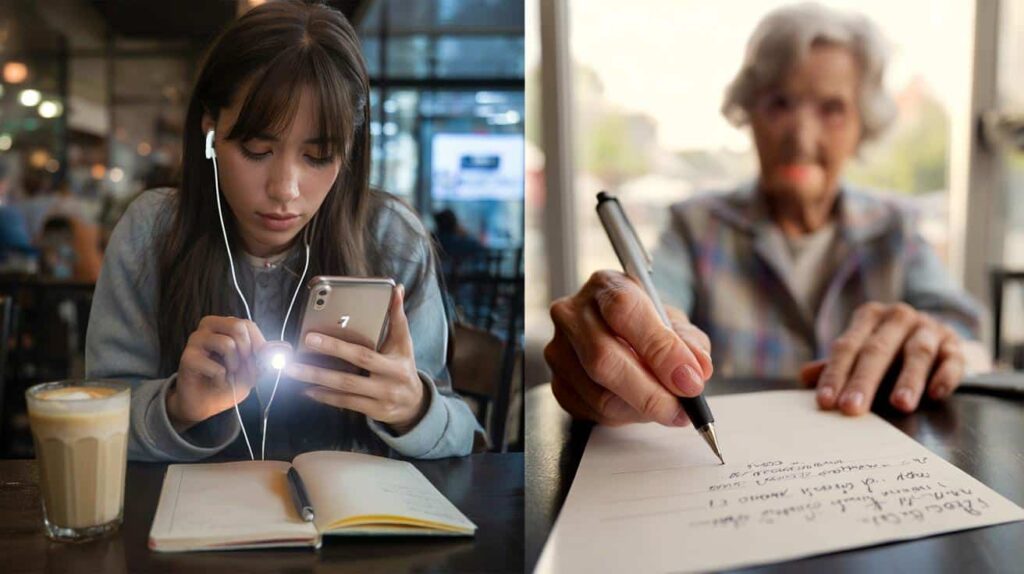
At the next table, a grandmother is writing a postcard to her grandson in slow, careful script. She pauses on his name, as if drawing it were a small act of love.
 Decathlon’s ‘car’ is the size of a Renault Clio but seats six thanks to 2CV-inspired chairs
Two generations. Two ways of putting words into the world.
One, sliding across glass.
The other, scratching ink into fibers.

Somewhere between them, a 5,500‑year‑old human skill is quietly slipping away.

Gen Z can type at lightning speed – but the pen is falling silent
Scroll through a college lecture today and you’ll see a glow of screens instead of a forest of pens. Fingers move fast, words rain into Google Docs, and autocorrect politely fixes the spelling you never really learned. Handwriting, once a default reflex, now looks almost optional.
A recent UK survey found that around 40% of young adults say they “rarely” write anything by hand beyond a quick signature or a sticky note. Some admit they haven’t filled a full page in years. Their notebooks are spotless. Their Notes apps are chaos.
For a generation raised on voice notes and DMs, pen and paper feel slow, almost old‑fashioned. And old‑fashioned rarely wins against a battery‑powered life.
Ask teachers and you hear the same story, told with a weary half‑smile. One high‑school English teacher in Ohio describes juniors who hold pens “like they’re chopsticks for the first time”. After ten minutes of writing, their hands cramp. Their letters shrink, wobble, vanish into half‑formed glyphs.
Standardized tests that require handwriting are becoming a quiet nightmare. Students who can argue brilliantly on a keyboard struggle to get their thoughts out on paper in legible form. Some universities now accept typed exam answers, not just for accessibility needs but because the unreadable blue scribble is becoming a norm.
Meanwhile, in daily life, landlords, banks, even doctors’ offices increasingly switch to tablets. There’s always a screen somewhere, offering a way out of ink.
The decline isn’t just nostalgia; it’s structural. Workflows, schools, communication platforms are all engineered for speed and searchability. Notes in the cloud feel safer than notebooks in a backpack. PDFs beat folders stuffed with photocopies.
Cognitive scientists still keep pointing to the same thing: handwriting activates more areas of the brain linked to memory, spatial processing, and language. When you write by hand, your mind is editing as your wrist moves, compressing, prioritizing, actually thinking. Typing, especially at high speed, can turn into pure transcription.
And then there’s the social shift. DMs, emojis, and short replies have compressed our interactions. *When your thumb can say “K” in half a second, full sentences on paper start to feel like a luxury item.*
Handwriting is more than pretty letters – it’s a way of thinking and connecting
If you ask neuroscientists why handwriting matters, they rarely talk about calligraphy. They talk about the loop. Eye to hand, hand to brain, brain back to eye. Every letter you form is a tiny choreography of muscles and attention. That loop slows you down just enough to filter your thoughts.
One simple method that keeps coming back in research is the handwritten “thinking page”. Take three minutes, one sheet, one pen. No bullet points, no formatting. Just write a messy stream of what you’re trying to understand: a problem at work, a breakup, an idea for a side hustle.
Most people are surprised that by the bottom of the page, their question has changed shape. The act of handwriting didn’t just record their thoughts. It helped rearrange them into something sharper.
The loss shows up most brutally in deeper communication. When a 22‑year‑old sends “u good?” to a friend in crisis, they’re not being cruel. That’s the speed and tone they’ve breathed since childhood. Long, reflective messages feel risky, almost cringe.
Yet therapists tell a very different story. They still use written exercises with Gen Z clients: letter‑writing to their future selves, unsent apologies, lists of things they actually feel but never post. On paper, far from the screen that judges and remembers, young people often surprise themselves. The words are slower, more raw, less performative.
We’ve all been there, that moment when you try to say something serious in a chat and watch it sink under memes and notifications. That’s not a failure of empathy. It’s a platform problem.

There’s also a simple social truth: people treat a handwritten note differently. A roommate who barely answers your texts might keep a small sticky note on their fridge for months. A partner who struggles with emotional talks may later read and reread a letter you left on their pillow.
Digital messages are infinite and disposable. Handwritten ones are finite and physical. You can’t endlessly edit them, you can’t unsend them, you can’t search them. That vulnerability is exactly what gives them weight.
Let’s be honest: nobody really writes in a journal every single day. But the rare times you do, those pages often chart the real turning points of your life. The breakups, the moves, the decisions that didn’t fit into a caption box.
Small, realistic ways to bring the pen – and deeper words – back
The good news: nobody is asking Gen Z to go full Victorian letter‑writer. No one has time for three‑page cursive essays about the weather. The shift can be tiny and still powerful.
One simple gesture is to create a “pen‑only” moment once a day. Not an hour. Two minutes. During a commute, before you open TikTok at night, when the kettle boils. One postcard‑sized card, one thought: something you learned, something that hurt, something that was funny.
Over a month, you don’t just stack paper. You quietly rebuild the muscle of turning vague feelings into shaped words. Your handwriting might stay ugly. Your thinking usually won’t.
Another practical step is to reconnect handwriting with people, not just with productivity. Instead of another “HBD!!” on someone’s Instagram story, write a short note on real paper and take a photo of it to send… then slip the original into their bag or mailbox when you can.
The main mistake is going too hard, too fast. Buying a fancy journal, promising yourself three pages a day, then dropping the whole habit by Thursday. Go micro instead. One line on a sticky note. One quote you liked, copied by hand. One list of three things you actually want this month, beyond surviving.
If your hand cramps, that’s not failure. That’s proof the skill is rusty, not gone.
“Handwriting is like a fingerprint of the mind,” says a French educational psychologist I interviewed. “When students stop writing, they don’t just lose a motor skill. They lose one of the ways they recognize themselves.”
- Micro‑journal once a day:
Write two sentences by hand about something that happened. Not your whole life story. Just a snapshot. - Keep one “analogue friend”:
Choose one person and decide that, once a month, you’ll write them a physical note, however short. A postcard, a scrap of paper, a page torn from a notebook. - Use handwriting for big decisions:
Whenever you face a major choice – job, move, relationship – write the pros and cons on paper. The slowness often reveals what’s actually at stake.
What else disappears when handwriting fades?
The debate around Gen Z and handwriting often gets stuck at aesthetics. Is cursive “dying”? Will future kids even be able to read their grandparents’ letters? Those are real questions, but they’re not the only ones.
Behind the pen is a deeper issue: how we think, and how we open up to each other. If every thought is typed at speed, archived and tracked, we naturally become more careful, more brand‑safe. When words cost more effort, like they do on a page, they tend to carry more of what we truly mean.
This isn’t about rejecting screens or romanticizing ink blots. It’s about noticing what quietly vanishes when our thumbs do all the talking. Memory changes. Conflict changes. Even grief changes.
Writing on a phone feels reversible, airy, easy to forget. Writing with a pen feels like pinning a moment to the wall. That difference affects how we remember our own lives. Ten years from now, will you be scrolling through old chats trying to find the day everything shifted? Or will there be a physical trace – a page, a note, a letter – that brings back the sound of who you were?
No one can roll back the clock on 5,500 years of writing and say, “We’re done, we’ll just voice‑note from now on,” without losing something human. The question isn’t whether Gen Z types. They do, brilliantly. The question is whether the ancient gesture of hand to page survives as a quiet, stubborn act of depth in a world of instant send.
That answer, oddly enough, may depend on what you do with the next blank piece of paper in front of you.
| Key point | Detail | Value for the reader |
|---|---|---|
| Handwriting is declining fast in Gen Z | Around 40% say they rarely write by hand beyond signatures and quick notes | Helps readers see they’re part of a wider cultural shift, not personally “broken” |
| Writing by hand strengthens thinking and memory | Engages more brain areas and slows thoughts just enough to clarify them | Motivates readers to reintroduce pen and paper for studying, decisions, and self‑reflection |
| Small, realistic habits can revive the skill | Micro‑journals, occasional handwritten notes, paper for big decisions | Gives concrete, manageable ways to reconnect with deeper communication |
FAQ:
- Question 1Is Gen Z really losing the ability to write by hand, or is this exaggerated?
- Question 2Does handwriting truly help with learning, or can typing do the same job?
- Question 3My handwriting is messy and slow. Is there any point in working on it?
- Question 4How can parents or teachers encourage handwriting without fighting against technology?
- Question 5What’s one small habit I can start this week to reconnect with deeper, more honest communication?
