
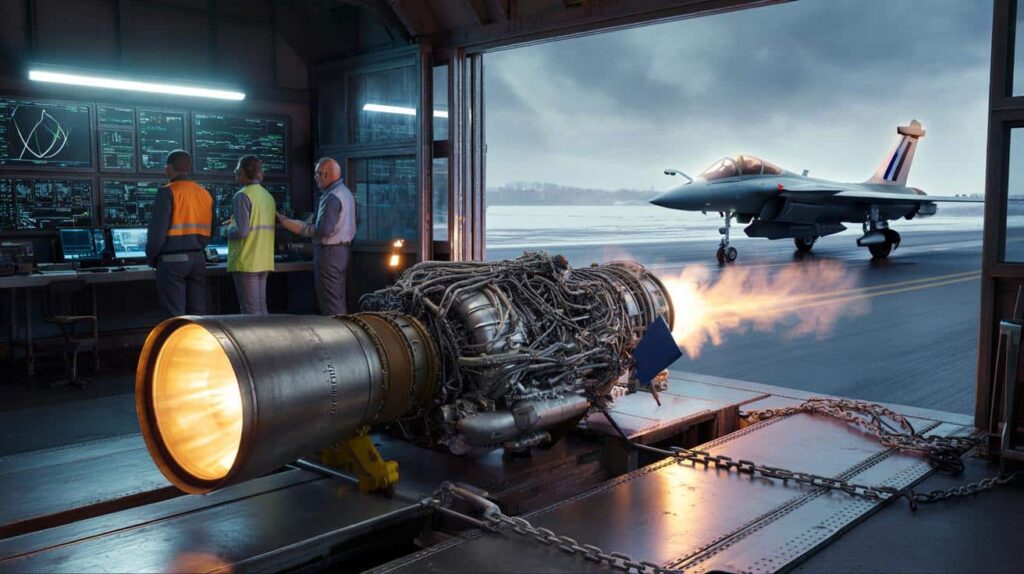
On a gray winter morning at the DGA engine test center in Saclay, the air shudders long before the sound reaches you. Behind a thick glass pane, a Rafale fighter engine roars, chained to the ground, spitting invisible heat. Technicians in worn sneakers and fluorescent vests watch a forest of screens, each tiny vibration translated into colored curves. One of them wipes coffee off a keyboard without even looking up. Outside, nothing moves. Inside, France is rehearsing a kind of controlled thunder.
Most people think fighter jets are all about wings and flashy maneuvers. The real secret sits here, in this humming bunker, measured down to the micrometer.

There’s a quiet truth hidden behind the noise.
 Decathlon’s ‘car’ is the size of a Renault Clio but seats six thanks to 2CV-inspired chairs
How France ended up guarding one of Europe’s rarest industrial secrets
France doesn’t shout about it on billboards, but behind the elegant silhouette of the Rafale lies a rare fact: **no other European country is as autonomous in building fighter jet engines**. Germany, Italy, the UK – each has impressive aerospace industries. Yet when it comes to designing, testing and certifying a complete military jet engine family on its own soil, with its own state labs and its own industrial ecosystem, France stands almost alone.

At the heart of that ecosystem sits a somewhat discreet player: the DGA, the Direction générale de l’armement. On paper, it’s just an administration. On the ground, it’s a strange hybrid of referee, coach and mad scientist laboratory.
Walk through the DGA’s testing facilities and you quickly sense what’s at stake. In a cavernous hall, a Safran M88 engine — the heart of the Rafale — is fixed to a massive metal frame. Sensors cling to it like barnacles. A test engineer, not even 30, casually explains that they’re pushing the engine beyond what any pilot will ever dare do in flight. Sudden throttle jumps, brutal temperature swings, simulated sand ingestion.
Every data spike means someone in another building will recheck a weld, a blade angle, a software line. Sometimes a test runs all night, watched by three people, a pot of stale coffee and a blinking alarm no one wants to hear. That’s how you learn to trust a jet engine at Mach 1.8.
There’s a simple reason France still holds this niche: it never let go of the full chain. From materials science to aerodynamics, from digital control systems to test benches, the DGA has kept a hand on everything. The UK chose to lean more on big private players. Germany spread skills across consortia. France built an odd triangle: DGA for the state brain, Safran for industrial muscle, and the Air and Space Force for raw operational feedback.
This trio takes time. It costs money. It creates friction. Yet this is what gives France the precision few others have: the ability to tune every turbine blade and every line of code to a national standard, without waiting for anyone’s permission.
The hidden choreography between DGA and industry that keeps the Rafale so sharp
Behind each “French miracle engine” story, there is a very unglamorous routine. The DGA’s strength lies in its method: imagine a permanent technical arm-wrestling contest with Safran, Thales and other partners, where everyone secretly wants the other side to win. The DGA writes obsessive specifications. Industry teams push back with real-world constraints: cost, weight, deadlines. Then begins the dance.
On a whiteboard, a DGA engineer might circle one single parameter: vibration at a certain frequency. That tiny circle can delay an entire program by months. Yet that’s how you avoid catastrophic in-flight failures ten years later.
The hardest part for industrial teams is accepting that DGA’s obsession with detail isn’t theoretical. Take the Rafale engine upgrades. When pilots asked for better acceleration during dogfights, Safran proposed digital tweaks. The DGA replied with a list of “what if” scenarios that sounded almost paranoid: bird strikes, hot-and-high bases, sudden pilot error. Each scenario triggered fresh bench tests and simulations.
For a year, nothing spectacular happened. No big announcements. Just incremental changes to fuel-flow curves, blade cooling, and software protections. Then pilots started noticing something simple: “The jet reacts like it’s reading my mind.” That feeling, again and again, is partly stamped “DGA”.
We’ve all been there, that moment when you think, “Why are they so picky?” A lot of young engineers arriving at DGA admit they’re shocked by how slowly decisions move. Some leave. The ones who stay learn another rhythm. They discover that a one-degree change in turbine entry temperature can shift an engine’s lifespan by hundreds of hours. That a poorly anticipated resonance can cost a billion euros ten years later.
*Precision at this level isn’t elegance, it’s survival.*
Let’s be honest: nobody really reads a 400-page certification report from start to finish every single day. Yet those unread pages are what allows a French fighter jet to take off from a dusty Sahel airstrip, night after night, without fanfare.

What this “French way” of building engines quietly teaches the rest of us
On paper, the DGA’s methods look very far from everyday life. Yet their habits say a lot about how to reach extreme precision in any field. First, they isolate critical points. Instead of trying to make the “perfect” engine, they identify a handful of parameters that truly decide life or death: turbine temperature margins, stress on certain blades, software reaction times. The rest is negotiable.
Then they test these points until boredom sets in. Different environments, worst-case scenarios, strange combinations that “should never happen”. Perfection, here, isn’t a heroic burst. It’s a very stubborn routine.
One thing DGA veterans repeat to junior staff is that pride can be deadly. The classic mistake: falling in love with a beautiful design and refusing to see its weak spots. When a bench test goes wrong, the reflex in some teams is to blame the sensor, the setup, anything but the engine itself. The DGA tries to flip that mindset. A red flag is not an insult, it’s an early gift.
For many of us, whether we’re coding, building a product, or just running a project, the temptation is the same: rush to the shiny demo, skip the boring checks, trust that “it will be fine”. The French engine world quietly repeats the opposite: the boring part is the job.
At DGA’s engine division, one engineer summed it up over a plastic tray at the canteen:
“We’re not here to build the fastest engine. We’re here to build the engine that still behaves on the worst day of its life.”
That sentence could be written on almost every lab door.
To get there, they lean on a few stubborn habits:
- They document everything, even the “stupid” tests.
- They welcome bad news early, instead of burying it.
- They keep one person responsible for each critical parameter.
- They run long, repetitive trials when everyone else wants to move on.
- They keep political pressure out of the test bench as much as they can.
Behind the national pride and sleek promotional videos, **this is the real daily grind of French engine supremacy**.
What remains when the noise fades: a fragile, fiercely guarded edge
Step outside the test hall and the roar drops to a dull echo. You hear doors closing, a forklift reversing somewhere, the scrape of a chair. From the road, this could be any anonymous industrial site on the outskirts of Paris. Yet inside these walls, France is holding onto something that’s quietly slipping away in much of Europe: the ability to design, test and certify the beating heart of a combat aircraft without asking anyone else for permission.
This edge is fragile. It depends on public money that could move somewhere flashier, on young engineers who hesitate between aerospace and a better-paid job in big tech, on a political will that treats long-term sovereignty as more than a slogan.
When we talk about “strategic autonomy”, the conversation usually jumps to headlines: nuclear deterrence, aircraft carriers, big contracts. The reality is less glamorous. It’s a thin line of expertise, passed from one retiring specialist to a slightly overwhelmed newcomer, on a Tuesday morning in a fluorescent-lit office. It’s the DGA still maintaining full-scale test benches, when others outsource or dismantle theirs.
There is something almost stubbornly old-school in this choice. Yet in a world where supply chains fray and alliances shift, having your own hand on the engine throttle becomes more than a technical curiosity. It becomes a quiet, strategic form of freedom.
| Key point | Detail | Value for the reader |
|---|---|---|
| French uniqueness in fighter engines | France, via DGA and Safran, masters the full cycle of combat jet engine design, testing and certification on its own soil | Helps understand why French aerospace has a special weight in Europe |
| DGA’s obsessive test culture | Extreme focus on critical parameters, worst-case scenarios and long bench trials | Offers a concrete model for precision and reliability in any demanding field |
| Sovereignty through technology | Engine know‑how anchors strategic autonomy beyond political slogans | Invites reflection on the hidden infrastructures that keep a country independent |
FAQ:
- Why is France considered unique in Europe for fighter jet engines?Because France keeps on its territory the full chain: design, testing, qualification and production of a complete modern fighter engine family, largely through DGA and Safran, without relying on foreign partners for critical technologies.
- What exactly does the DGA do for Rafale engines?DGA defines technical requirements, oversees and conducts tests, validates safety margins, and delivers the certifications that allow the M88 engines to fly in operation. It also pushes upgrades based on feedback from the Air and Space Force.
- How is this different from civilian aircraft engines?Civil engines aim for fuel economy and long, predictable missions. Fighter engines must handle sudden power changes, combat maneuvers, and harsher environments, all with strong military confidentiality constraints and national security stakes.
- Is France really alone? What about the UK or Germany?The UK has Rolls-Royce and a strong heritage, Germany and Italy participate in European programs, but the combination of full-state testing capability, national industrial prime and full engine sovereignty for a current frontline fighter is today especially concentrated in France.
- Why should non-specialists care about this topic?Because this kind of hidden, high-precision know‑how shapes a country’s strategic freedom, its industrial jobs, and its ability to decide in crises without depending entirely on others for key military technologies.
