
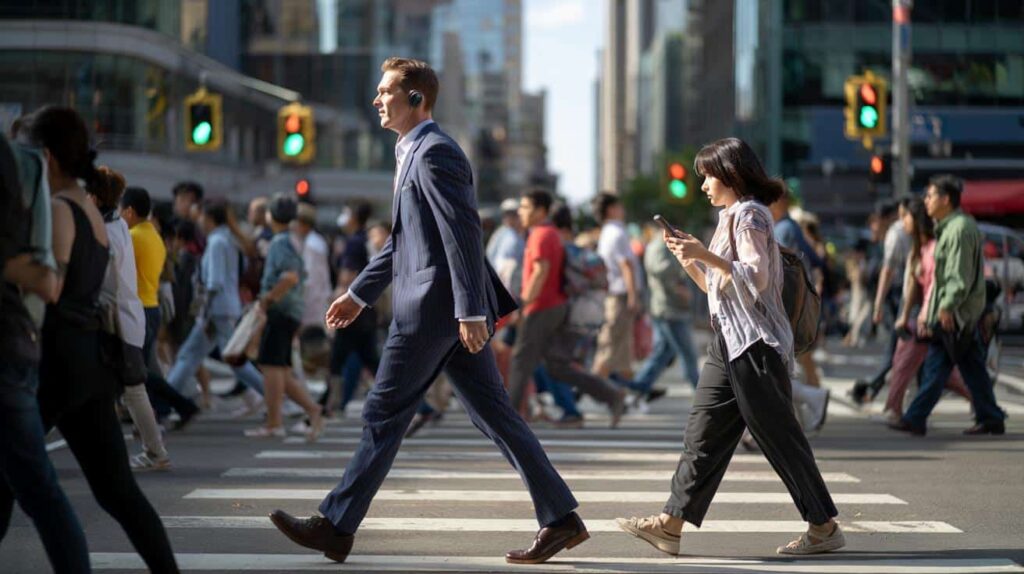
The crosswalk light turns green and the crowd surges forward. One guy in a dark coat slices through the flow like he’s late for a flight, headphones in, eyes locked on some invisible destination. Next to him, a woman strolls, scrolling on her phone, letting everyone pass. Two worlds, same sidewalk. You’ve probably felt it: that weird tension between people who move fast and those who seem to float in slow motion.
On the surface, it’s just walking. Legs, pavement, traffic lights.

But behavioral scientists are increasingly saying this small, everyday detail reveals far more about our brains, our ambitions, even our future health.

The way you walk might be telling a story you don’t realize you’re broadcasting.

Why scientists pay attention to your walking speed
Walk through any busy city and you’ll quickly notice a pattern: the people walking with purpose tend to look like they have somewhere to be, something to do, someone waiting. Their steps are brisk, almost rhythmic. They dodge obstacles without really seeing them, as if their body already did the math.
Slow walkers, on the other hand, often give off a softer signal. They pause more. They hesitate at crossings. They wander, not always sure where they’re heading, even when they technically know the address.
Behavioral scientists aren’t judging them. They’re measuring something deeper.
Several large studies have dug into this. One famous project from Duke University followed people from childhood into midlife and found a strange predictor: by age 45, those with slower walking speeds tended to score lower on cognitive tests and show more signs of brain aging. Same age, same city, different tempo.
In London, researchers timed over 400,000 volunteers and found that people who naturally walked faster often had lower risks of heart disease and early death. No stopwatch training, no Olympic ambition. Just their normal, everyday pace.
One behavioral expert described walking speed as a “moving summary” of your brain, body, and motivation.
The logic isn’t mystical. Fast walking usually means your brain and body are in sync. You estimate distance, read social cues, absorb traffic signals, adjust your path, and keep a steady rhythm without really thinking about it. That requires processing speed and a decent amount of executive function.
There’s also a psychological layer. People with a stronger sense of purpose or clear goals tend to move more quickly between points A and B. The pace becomes a reflection of inner momentum.
*Slow walking doesn’t mean someone is lazy or less intelligent, but repeated studies keep finding that, on average, pace is tied to cognitive health, discipline, and long-term success markers.*

Can you “train” yourself to walk like a fast thinker?
One simple method used by some behavioral coaches starts with a silly task: pick a familiar route, turn on your phone’s stopwatch, and walk it at your normal pace. Don’t rush, don’t act. Just you, the sidewalk, and the clock.
Next day, do the same route and shave 15–20% off the time. Not a sprint, not a workout. Just a slightly more determined pace, chest open, gaze forward, phone away.
Repeat this for a week and you start noticing something odd. Your thoughts line up quicker. Decisions feel a bit sharper. Your body “remembers” the new baseline.
Of course, this is where many people get stuck. They try to speed up everything overnight and end up exhausted. Or they walk fast for two days and then sink back into old habits because life, work, kids, traffic, groceries.
We’ve all been there, that moment when your calendar says “new routine” and your energy says “absolutely not today”.
Let’s be honest: nobody really does this every single day. What counts is not perfection but pattern. A slightly faster default pace, repeated often enough, starts sending a new signal to your own brain: “I move with intention. I know where I’m going.”
Behavioral psychologist Dr. Grace Lordan puts it this way: “Your walking speed reflects how you value your own time. When people walk with purpose, they’re usually more organized, more decisive, and more likely to follow through on their plans.”
Walk coaches and occupational therapists often share a simple toolkit to “upgrade” your pace without turning your life into a military drill:
- Start with one route you use daily (station, office, school run) and set a modest time goal.
- Walk with your head up and arms swinging naturally, not stiff like you’re on a mission from a movie.
- Use music with a slightly faster beat than your current pace to gently pull you forward.
- Drop the phone from your hand; pocket or bag only, so your body can move freely.
- Notice how you feel after 5 minutes: more awake, slightly warmer, a bit more focused.
Fast walkers, slow walkers, and what your pace really says about you
All this raises a tricky question: if fast walkers seem to be, on average, healthier and cognitively sharper, does that automatically mean slow walkers are doomed or “less successful”? Not quite. Real life refuses to be that simple. Some slow walkers are deep thinkers who’ve chosen to live against the clock. Some fast walkers are anxious, constantly rushing without knowing why.
The emotional frame behind your pace often matters as much as the speed itself. Are you moving quickly because you’re focused and engaged, or because you’re running away from your own thoughts? Are you walking slowly because your body needs it, or because you’ve quietly stopped caring where you’re heading?
| Key point | Detail | Value for the reader |
|---|---|---|
| Walking speed mirrors brain health | Studies link faster walking with better cognitive function and lower brain aging markers | Helps you see your daily pace as a subtle early-warning or early-opportunity signal |
| Purpose shapes your pace | People with clear goals and stronger time awareness tend to move more quickly between tasks and places | Encourages you to connect your physical tempo with your priorities and long-term ambitions |
| Pace is trainable | Small changes on familiar routes can gradually reset your default walking speed | Gives you a low-effort habit to boost focus, energy, and the feeling of being “switched on” |
FAQ:
- Does walking faster really mean I’m smarter?On an individual level, no single behavior defines intelligence. Research shows a statistical link between faster walking and better cognitive performance on average, but personality, education, health, and environment all play big roles too.
- What if I walk slowly because of a health condition?Then these findings don’t “judge” you at all. Many studies exclude people with mobility issues. Your value and intelligence are not defined by your speed, and your priority is comfort and safety, not pace.
- Can speeding up my walk actually make me more successful?Speed alone won’t magically change your career. Yet walking with more intention can sharpen focus, improve fitness, and subtly reinforce a more proactive mindset, which often supports better results over time.
- Is there an ideal walking speed?Researchers often talk about around 1.3–1.4 meters per second as a “brisk” pace for adults, but the ideal speed is the one that feels slightly challenging without leaving you breathless or in pain.
- How can I test my walking pace?Measure a known distance (for example, 100 meters or a block), time yourself walking it at your normal pace, then divide distance by time. Repeat a few days in a row to get a realistic average instead of a one-off number.
