
The sun is setting over the scrubland outside Midland, Texas, and the pumpjacks still move like iron grasshoppers against a violet sky. A few hundred meters away, a row of new solar panels glints on the horizon, swallowing the last light of the day. Trucks loaded with drilling equipment rumble past workers in neon vests who are quietly rolling up extension cords on the solar site. Same boots. Different future.
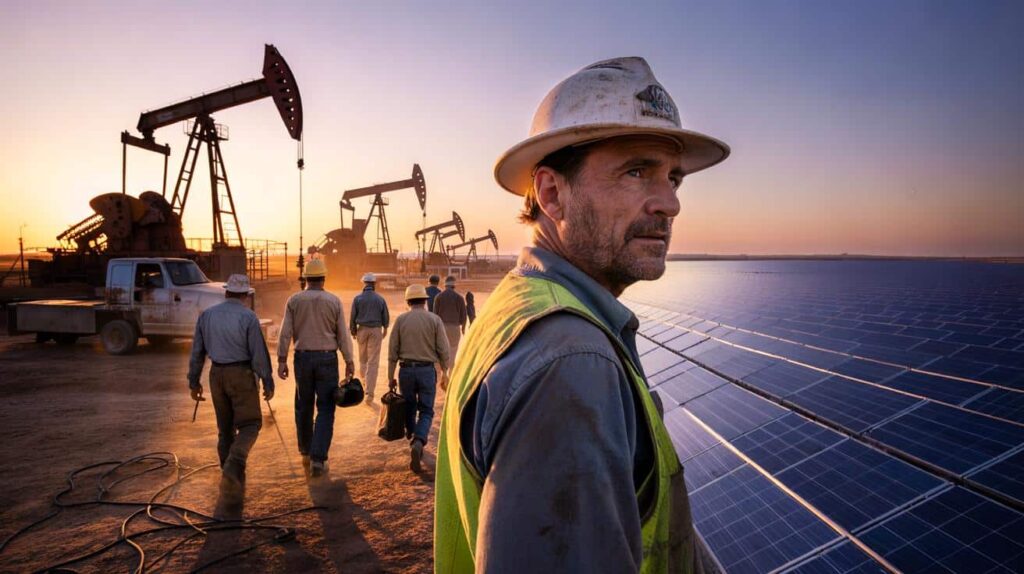
A foreman in his fifties, cap pulled low, squints at the panels and mutters to no one in particular: “Guess that’s what’s left for us, huh.” His crew laughs, but nobody really finds it funny.

The global conversation has moved on. For many experts, the debate isn’t whether we should go solar, but how fast we’re willing to break things on the way there.
 Meteorologists warn early February may trigger an Arctic shift that rewrites climate expectations
And who we’re willing to break.

Why solar is no longer a side character in the energy story
Walk into any serious climate or energy conference today and you’ll notice it right away. Fossil fuels aren’t the main event anymore, they’re the awkward relative everyone knows they need to phase out. On the big screens, it’s solar graphs, solar cost curves, solar gigafactories.
The new storyline is blunt. If we want a livable planet, solar can’t just be a “big piece of the mix”. It has to become the backbone, the default, the thing we turn on and forget about. For some researchers, the wording is even harsher: fossil fuels must be “squeezed out” until there’s no economic oxygen left for them.
Behind the technical slides, there’s a very human silence about what that actually means for the people still earning their living from oil, gas, and coal.
Take Germany’s Ruhr region, once a black-and-white photo of coal dust and steel. Mines closed, smokestacks went cold, and today the area is dotted with solar parks, tech hubs, and modern campuses. Politicians hold it up as proof that transitions work. The numbers kind of back them up: coal jobs collapsed, green jobs grew, unemployment fell over time.
But inside that shiny statistic there are real people who never made the jump. Men who were 52 when the mine shut and 59 when their retraining applications were politely rejected. Towns where the bar stayed open but the supermarket did not. Families who learned the hard way that “we’re investing in the future” doesn’t pay this month’s rent.
When experts calmly say fossil fuel workers are “collateral damage”, they’re talking about lives like these — just in a colder, cleaner vocabulary.
On paper, the logic looks ruthless but tidy. Solar is now the cheapest electricity in history in many regions. Panels are faster to install than pipelines, and they don’t blow up geopolitically every time there’s a war or a shipping crisis. Climate deadlines are closing in, and every new gas field or coal plant locks us into decades of emissions we can’t afford.
From that lens, the equation is simple. Phase out fossils as quickly as grids can handle it, pour subsidies into solar and storage, and accept that some industries, regions, and jobs will be sacrificed. The language of war creeps in: “frontline”, “total mobilization”, “stranded assets”.
The moral nuance gets flattened. *If the goal is survival, the casualties become numbers on a transition slide.*
The new “necessary war” and how to live inside it
Energy economists say we’re already in a quiet resource war, only this time the battlefield is policy, capital, and public opinion. The winners are whoever can build solar, batteries, and grids faster than everyone else. The losers are those stuck with fossil infrastructure nobody wants to buy from in ten years.
For workers caught in the middle, the first practical move is painfully simple: read the map, not the press release. Is your refinery already talking about “asset optimization”? Is your company quietly selling fields or delaying maintenance? Those are early warning flares.
Shifting skills early, even modestly, matters more than waiting for a perfect transition program that may arrive five years too late. A basic certification in electrical work, high-voltage safety, or project logistics can be the tiny hinge that swings your whole career toward solar.
The public speeches often sound upbeat: “No one will be left behind”, “Just transition for all”. Talk to workers leaving a shuttered coal plant in South Africa or a downsizing offshore platform in the North Sea and you hear a different tune. Retraining funds are slow. Courses are far away. Childcare doesn’t magically appear when a 45-year-old roustabout is told to become a coder.
We’ve all been there, that moment when you realize the policy headline is three steps ahead of your actual life. The emotional whiplash is real: one day you’re powering the economy, the next day you’re framed as a problem to be solved.
 Bad news for homeowners: starting February 15, a new rule bans lawn mowing between noon and 4 p.m.
Let’s be honest: nobody really reads a government transition brochure and thinks, “Yes, that will take care of my mortgage.” The gap between narrative and paycheck is where distrust grows.
The harsher experts don’t sugarcoat it anymore.
“Any serious climate pathway implies deliberate destruction of fossil fuel value,” says one climate economist. “That means stranded assets and stranded workers. We can soften it, but we can’t fully avoid it.”
Inside that tough statement, there’s still room for choices. Not about whether solar will dominate — that ship has sailed — but about how we treat the humans on the losing side of the curve.
Policy researchers point to a handful of very concrete levers that change the story:
- Redirect fossil subsidies to wage guarantees for transitioning workers.
- Fund retraining that starts before closures, not after.
- Tie solar tax breaks to local hiring and apprenticeships.
- Support small towns with direct budget transfers, not just “innovation hubs”.
- Give workers a real say in closure timelines and retraining design.
None of that erases the pain. It does turn “collateral damage” into something closer to a hard, negotiated trade-off — with names and faces attached, not just job counts on a chart.
What happens when the sun really becomes the only power source?
Imagine, for a moment, what experts are actually talking about when they say solar should be the only power source on Earth. They don’t mean a cartoon world where coal and gas plants vanish overnight and every rooftop glows blue. They mean a system where almost all new investment goes into solar, backed by batteries, smarter grids, and a bit of wind or hydro to steady the rhythm.
Oil demand tumbles not because we suddenly become saints, but because electric cars undercut diesel, heat pumps quietly replace gas, and factories shift to electric processes powered by sprawling solar deserts. The fossil fuel economy shrinks the way landline phones did: still there, but fading into the background, unprofitable, unloved.
In that world, a 20-year-old today probably never works on a rig. A 45-year-old driller might never work again in his trade.
The open question is not whether we head toward that solar-heavy reality, but how honestly we talk about what we’re breaking to get there. Communities that built their identity on black gold or “clean gas” now hear experts framing them as obstacles to a planetary emergency response. Some will fight back with lawsuits and pipelines chained to politics. Others will try to ride the wave and negotiate better terms for their own unwinding.
On social media, the debate turns brutal: climate activists calling for “end fossil now”, industry defenders calling them naive about jobs and poverty. In between stand millions of people who just want to keep the lights on, breathe air that doesn’t hurt, and not wake up unemployed because a global model flipped a color from red to green.
The conversation about solar dominance is missing that middle, human voice. That’s where the next battles will be fought.
If there’s a thread worth holding onto, it’s this: the energy war is real, but it doesn’t have to be waged only in spreadsheets and sound bites. Citizens can ask harder questions when a new solar mega-project is announced: Who gets hired? Who gets left behind? What money flows back into the towns that powered the old era?
Workers can resist being framed as casualties and organize as negotiators instead, demanding that “just transition” stops being a slogan and starts being a contract. Investors who love to talk about climate risk can include social risk in the same sentence, not as an afterthought.
The sun will keep rising whether we plan this well or badly. The real story is how we treat each other while we race to capture its light.
| Key point | Detail | Value for the reader |
|---|---|---|
| Solar is set to dominate | Experts see solar as the future backbone of global power, with fossil fuels rapidly losing economic ground. | Helps you understand why the shift feels sudden and non‑negotiable. |
| Workers are on the front line | Fossil fuel communities face job loss and identity shocks as their industries shrink. | Gives context for the human cost behind climate headlines. |
| Transitions can be shaped | Policies like wage guarantees, early retraining, and local hiring can soften the damage. | Shows where pressure and action can still change outcomes. |
FAQ:
- Is it realistic for solar to become the “only” power source?In practice, experts expect solar to carry most of the load, backed by batteries, wind, hydro, and smarter grids. “Only” is a shorthand for “dominant”, not literally the single technology everywhere.
- Why are fossil fuel workers called “collateral damage”?Because many climate and energy plans accept job losses and community decline as unavoidable side effects of a rapid phase‑out, focusing on emissions targets more than individual lives.
- Can fossil fuel skills really transfer to solar jobs?Often yes: experience with heavy equipment, safety protocols, and project logistics is valuable. The gap is usually in formal certifications, location, and timing, not in basic capability.
- Who should pay for a “just transition”?There’s growing pressure on governments, fossil fuel companies, and big investors to share the bill, through taxes, levies, and conditions attached to clean‑energy subsidies.
- What can an ordinary reader do about any of this?You can vote for policies that protect workers as well as the climate, support local training initiatives, and ask tough questions when new energy projects are sold as painless miracles.
