
The courier is already sweating before he steps into the tower.
Outside, Beijing’s winter air bites his cheeks. Inside, the lobby is a glass-and-marble climate bubble, with a giant digital clock counting seconds above the turnstiles.
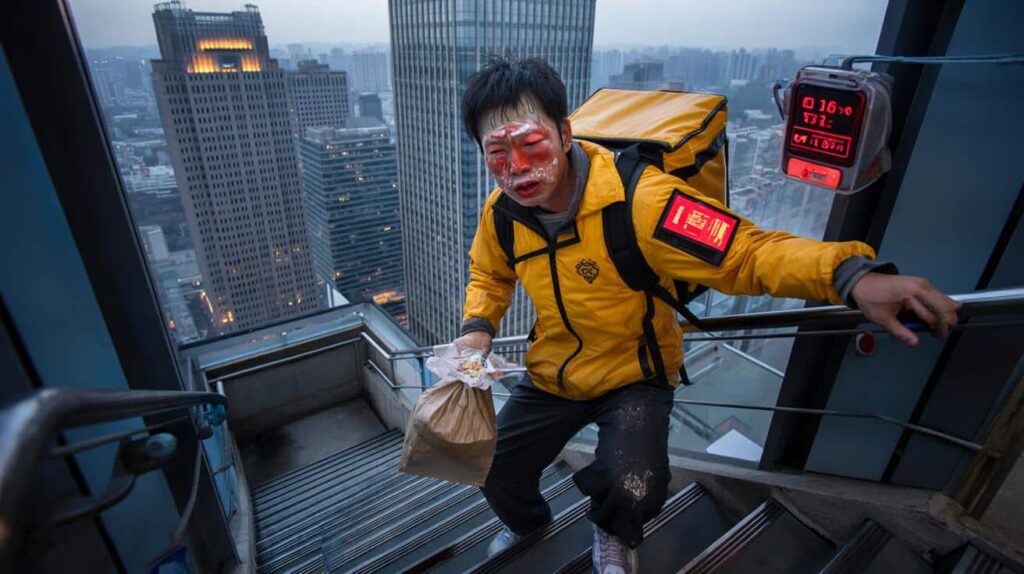
He tightens the straps on his yellow delivery bag, checks the order again on his cracked screen: 47th floor, 6 minutes left. The elevator line snakes across the hall, office workers scrolling on their phones, coffees in hand. No one looks up when he peels away toward the concrete fire stairs.
His watch counts his heartbeat. The app counts his seconds.
Somewhere far above, another office worker taps “urge delivery” on their phone.
 Meteorologists warn early February may trigger an Arctic shift that rewrites climate expectations
Inside the vertical treadmill of China’s food delivery boom
On paper, the whole thing looks like a miracle of modern convenience.
China’s food delivery apps promise hot meals in under 30 minutes to almost any desk in almost any tower, no matter how high. Screens flash, scooters swarm the streets, and office workers brag about lunches that appear like magic.
But climb inside this system for one morning and the magic feels more like a trap.
The higher the buildings go, the tighter the deadlines get. The people connecting those two worlds are not executives or engineers.
They’re the ones panting in the stairwells.
In Shenzhen’s Nanshan tech district, a 23-year-old courier named Liu told a local reporter he can deliver to 60 or 70 customers on a “good” day.
His day starts before 7 a.m. and often stretches well past 10 p.m., his legs burning from stair runs that don’t even show up in the navigation app.
The tower where he dreads orders most has 52 floors and elevator security gates that slow him down every time.
He described sprinting up 18 floors once because the elevator line was packed with workers returning from lunch. The app timer went from green to yellow to angry red.
When he arrived, breathless and dripping, the customer frowned and asked why the soup wasn’t hotter.
China’s skyline is rising faster than its delivery system can adapt.
Office towers are tightly controlled, with access cards, security checkpoints, elevator algorithms, and lunch rushes that turn vertical travel into a daily traffic jam.
For platforms obsessed with speed, the stairwell becomes the obvious “solution”. Couriers lose precious minutes in elevators, so the algorithm quietly rewards those who run instead. Time penalties pile up for late orders, orders mean ratings, ratings mean survival.
The result is a strange new layer of urban life.
From the street, these glass towers look smooth and silent. Inside their concrete cores, people in cheap sneakers are racing the clock, unseen.
The small trade‑offs that turn into a brutal daily grind
Most of this system runs on tiny, almost invisible trade-offs.
A security guard waves a courier away from a crowded elevator “for safety reasons”, but also because tenants complain about “clutter”. A manager in a glossy office insists staff “stay focused” at their desks, so lunch breaks shrink and delivery becomes ritual.
Nobody wakes up planning to exhaust a stranger.
Yet every time someone taps “send reminder” on an app because their noodles are 3 minutes late, the pressure at the bottom of the chain rises.
*This is how a thousand small gestures add up to one man gasping on the 23rd floor landing, clutching a paper bag of bubble tea.*
There’s a quiet choreography in these towers that most people never notice.
At 11:45 a.m., smartphones light up across open-plan offices from Shanghai to Chengdu. One person orders Sichuan hotpot, another milk tea “extra ice, less sugar”, someone else a vegan bowl that will arrive wrapped in three layers of plastic.
Fifteen minutes later, the flood begins. Couriers pile into lobbies, juggling bags marked with QR codes and apartment numbers. Some buildings ban them from going past the first floor.
In those places, couriers cluster around temporary pickup tables, watching the minutes bleed away. Office workers come down in waves, choosing the fastest, not the first. The ones on higher floors often write “please deliver to my desk”, adding ten more flights of stairs to a day that already feels endless.
Behind the scenes, the algorithms that power this convenience compress time like a vice.
Delivery windows shrink because competition is fierce and platforms sell speed as a brand identity. “30 minutes or less” becomes “25 minutes or less”, then “20 minutes in your hand or a coupon if we fail”.
Human bodies can’t be updated at the same pace as software. Yet every “optimization” at the app level turns into urgency at the street level.
Let’s be honest: nobody really imagines the person doing that last kilometre on foot.
They picture a scooter, a logo, a countdown timer. Not the staircase.

What could change in the race between speed and dignity
There are small levers that could change the daily reality inside these towers.
Some buildings have started to reserve one elevator during peak lunch hours just for deliveries, cutting the temptation for stair sprints. Others set up designated shelves on certain floors so couriers don’t have to navigate dense office layouts, badge systems, and awkward conversations.
A simple, powerful gesture would be this: give couriers a name and a voice inside the building.
Not just “外卖” (waimai) shouted across a lobby, but a visible contact person in each company who helps them reach staff without losing 10 minutes to security checks.
When the route is predictable and the rules are clear, the race loses a few of its sharpest edges.
From the customer’s side, tiny shifts in habit can ripple outward.
Ordering five minutes earlier. Switching off the “urge” button unless there’s a real emergency. Choosing pickup from the lobby when your schedule allows, instead of “to my desk, please, 41st floor”.
We’ve all been there, that moment when hunger and stress make us impatient with anyone standing between us and food.
But the person holding that paper bag probably hasn’t had a proper meal break in hours.
The most common mistake is pretending that because you paid a delivery fee, you bought someone’s time down to the last second. You bought a service, not a body.
Sometimes couriers put it more bluntly than any policy report ever could.
“People think we’re late because we’re lazy,” one rider in Guangzhou told a local blogger. “They don’t see that we’re climbing while they’re sitting.”
Inside this harsh simplicity is the whole emotional core of the story.
There are a few concrete ideas that come up again and again when you talk to riders, office workers, and building managers:
- Extend delivery windows during peak hours so riders don’t risk falls in stairwells.
- Allow mixed-use elevators or dedicated courier access in office towers.
- Encourage companies to set an internal norm: staff pick up from lobby when possible.
- Display basic guidelines in apps reminding users what “urge” means on the ground.
- Offer micro-breaks and rest spots near major towers for riders between runs.
These aren’t heroic solutions.
They’re the kind that quietly turn a daily ordeal into something closer to a job.
A new skyline, and the hidden cost of not waiting five minutes
Walk through any Chinese megacity at night and the view is breathtaking.
Glass towers glow like vertical circuits, every lit window a tiny square of human activity. Food, parcels, medicine, flowers, midnight snacks — almost anything can be summoned by tapping a screen.
From a distance, it looks seamless. Up close, the seams are everywhere.
In the chipped helmets leaned against lobby walls. In the swollen knees under cheap black pants. In the breathless phone calls: “I’m almost there, please don’t cancel.”
This is the disturbing new reality behind the race to the sky.
Not a sci‑fi dystopia with drones and robots, but a present tense where real people climb real stairs so someone else doesn’t have to walk 30 metres to the elevator.
The question is not whether China’s cities will keep growing upward. They will.
The question is what kind of moral architecture we build inside these vertical worlds.
Right now, the system prizes productivity minutes at the top of the tower more than physical minutes at the bottom. Office workers don’t “waste time” queuing for food, so couriers burn theirs in bulk, along with their knees and lungs.
A different balance is possible.
Not anti-tech, not anti-delivery, just a quieter type of ambition: a skyline that is smart not only in sensors and software, but in how it treats the people who tie the whole thing together.
Stories of collapsed couriers on stair landings surface on social media every few months.
For a day or two, comments fill with outrage, sympathy, promises to “be more patient next time”. Then the feed scrolls on, the apps stay installed, the orders keep coming.
Change rarely arrives as a grand gesture. It usually starts with one building adjusting its rules, one company giving five more minutes for lunch, one user thinking twice before tapping that little red “urge” button.
Somewhere between the street and the 47th floor, there’s room for a different deal.
Not a slower city, just a slightly more human one.
| Key point | Detail | Value for the reader |
|---|---|---|
| Vertical pressure | High-rise office culture and tight delivery timers push couriers into stairwells instead of elevators | Helps readers see the hidden human cost behind “instant” convenience |
| Everyday choices matter | Small actions like ordering earlier or picking up from the lobby can ease the strain | Gives concrete ways to keep convenience without fueling burnout |
| Room for new norms | Building policies, app design, and office habits can all be tweaked | Shows that the situation is not fixed; collective pressure can shift standards |
FAQ:
- Why do couriers in China often use stairs instead of elevators?Because elevator lines in big office towers get jammed during peak hours and security rules can slow riders down, many feel forced to sprint up stairs to meet strict app deadlines and avoid penalties.
- Are delivery platforms doing anything to protect riders?Some large platforms have publicly promised “no forced speeding” and slightly adjusted algorithms, but riders and labor researchers say time pressure on the ground is still intense, especially in dense business districts.
- Do office workers really expect door‑to‑desk delivery on high floors?Yes, desk delivery is widely normalized in major cities, and many app interfaces encourage it by default, which quietly shifts the physical burden of moving through towers onto couriers.
- What can individual users change without giving up convenience?Ordering a bit earlier, avoiding unnecessary “urge” reminders, choosing lobby pickup when possible, and being more patient with minor delays all reduce pressure without ending delivery.
- Is this issue unique to China?China’s density and speed make it especially visible there, but similar patterns exist in high-rise districts from Seoul to New York, wherever algorithmic delivery meets tall buildings and impatient office cultures.
