
The tray hit the sink with a dull clang, like it knew it had done something wrong. A sheet of roasted vegetables that started out golden and wholesome had left behind a crust of black, welded-on caramel. Overnight “soaking” turned into a 24-hour silent standoff. By the next morning, the water was cold, the grease had formed a rainbow film, and the pan still looked like a lost cause.
You stare at it, calculating how much of your weekend you’re willing to sacrifice to scrub duty. Your eyes drift to the bottle of harsh oven cleaner under the sink, then to the soft box of baking soda in the pantry, then to that half-forgotten jar of vinegar on the top shelf. There’s a strange little thought that appears: what if the answer is already here, hiding between the pasta and the flour?
The quiet magic is in that pantry. You just have to wake it up.
The burnt tray problem nobody really talks about
There’s burnt… and then there’s “how is this not part of the metal now?” burnt. Anyone who roasts, bakes, or “just quickly throws something in the oven” has met that second category. The baking tray that seemed to cross a point of no return somewhere between 180°C and “I’ll take it out in a minute”.
You soak it. You scrape it with the edge of a spatula. You attack it with the rough side of the sponge until your forearm protests. The black patch laughs back. Suddenly, your trusty tray looks like something that lives at the back of a restaurant kitchen, not in a home you’re trying to keep vaguely decent.
One home cook I spoke to described her worst tray as “a geological site”. Layers of lasagne spillover, baked-on chicken fat, and the ghost of a Christmas roast were stacked in different shades of brown and black. She was convinced nothing short of sandblasting would fix it.
Out of frustration, she tried a trick her grandmother swore by: a slurry of two kitchen staples, left to sit while she scrolled on her phone. Twenty minutes later, she claims the crust “slid off like old stickers in hot water”. She didn’t believe it either until she saw the original silver shine of the metal for the first time in years.
There’s a simple reason this kind of pantry mix works so well. Those dark, stubborn patches are essentially carbonized sugars and fats, clinging to tiny invisible scratches in the metal. Strong chemicals try to dissolve them aggressively, often attacking the tray’s surface at the same time. Mild pantry ingredients play a different game. One softens and lifts, the other gently abrades. Together, they turn scrubbing from an arm workout into a light finish step. *That’s the quiet chemistry going on in your sink while you answer a few messages.*
The pantry mixture that does the heavy lifting for you
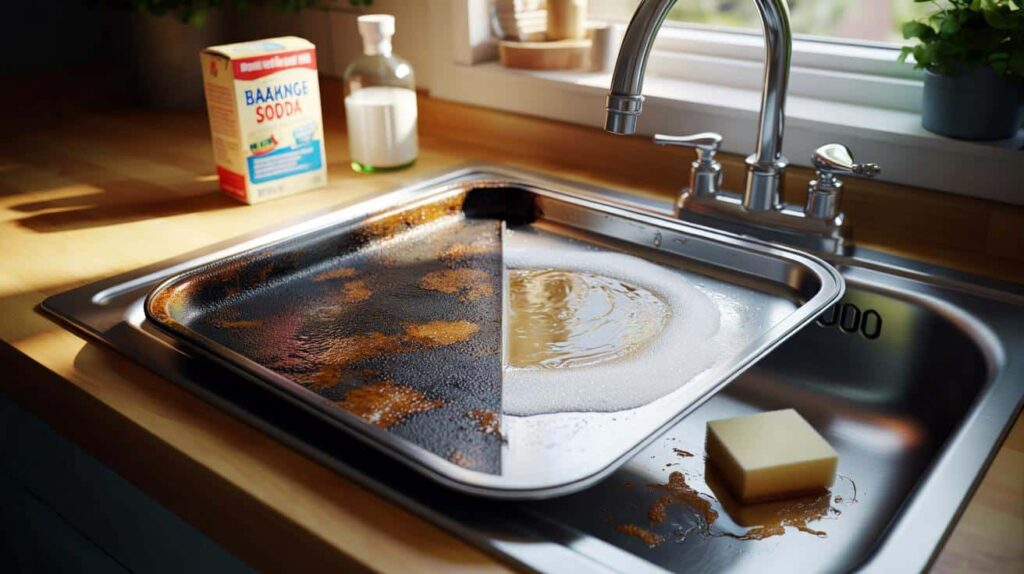
Here’s the method many seasoned home bakers quietly swear by. Start with a dry, cool tray. Sprinkle a generous, snowy layer of baking soda over every burnt and sticky patch. Don’t be shy: this is your cleaning “powder”, not a decoration. Then drizzle white vinegar slowly across the surface, watching it fizz and foam like a tiny science project gone right.
That foam is your signal. The reaction is loosening the bond between the burnt crust and the metal underneath. Let it sit for 15–30 minutes, depending on how bad the damage is. While it rests, you can wipe down the counters or just sit with a coffee, pretending you’re “letting the chemistry work”.
When the time’s up, come back with a soft sponge or a non-scratch pad. Start nudging the burnt patches. On a good day, they’ll move like mud after rain rather than dry cement. You’ll still have to scrub, but it’s more like wiping away crumbs than scraping a road. This is where many people go wrong: they either don’t wait long enough, or they attack with steel wool from the start and scar the tray forever.
The mixture was working. It just needed a little patience, not brute force.
There’s a quiet comfort in using ingredients that also live in your food cupboard. You’re not holding your breath over choking fumes, worrying about splashes on your skin. You’re using products whose names you can actually pronounce.
“Once I switched to the baking soda and vinegar trick, I stopped postponing cleaning my trays,” says Elise, a busy mum of three who bakes once or twice a week. “It doesn’t feel like a punishment anymore. I sprinkle, I pour, I walk away. By the time I come back, most of the hard work is done.”
- Baking soda: gentle abrasive that loosens and lifts burnt residue
- White vinegar: acidic boost that softens grease and baked-on sugars
- Waiting time: gives the mix space to work before you even touch a sponge
- Soft sponge or brush: finishes the job without scratching your tray
- Warm rinse: carries away the loosened grime and any lingering odour
From dreaded chore to quiet little ritual
There’s something oddly satisfying about watching a tray you had mentally written off come back to life. The dull grey turns reflective again. Corners you thought were permanently stained finally show bare metal. You almost feel a bit guilty for all the times you considered throwing it out.
We’ve all been there, that moment when you quietly slide a stained tray back into the oven drawer, hoping guests won’t notice if you use baking paper as camouflage. This small pantry ritual rewrites that scene. Suddenly, cleaning feels less like punishment for cooking and more like part of the rhythm of it.
Let’s be honest: nobody really does this every single day. Life happens, dinners run late, and trays get shoved into the sink “to deal with tomorrow”. That’s normal. The pantry mix is less about becoming the sort of person who always cleans immediately, and more about having a forgiving plan for when you don’t.
You might start experimenting too. A sprinkle of coarse salt for extra grit on really stubborn corners. A drop of dish soap added to the mix when there’s a lot of visible grease. A hotter soak at the end to finish it off. These tiny adjustments become your own version of a family recipe, passed on without ceremony.
Soon, that dreaded clang of a burnt tray hitting the sink doesn’t trigger the same sigh. You know that between the pasta and the flour lives a low-cost, low-effort fix that doesn’t ask you to suit up like a lab technician. Just baking soda, vinegar, a little time, and a few lazy circles of a sponge.
The next time you open the oven to find dinner welded to metal, you might still roll your eyes. But you won’t feel defeated. You’ll walk to the pantry, reach for that familiar box and bottle, and quietly reclaim a small corner of your kitchen from the myth that only harsh chemicals can do the real work.
| Key point | Detail | Value for the reader |
|---|---|---|
| Pantry ingredients work | Baking soda and vinegar soften and lift burnt-on grime | Less scrubbing, fewer harsh products in the home |
| Time does the heavy lifting | Letting the mixture sit 15–30 minutes replaces brute force | Saves effort and protects trays from aggressive scraping |
| Gentle tools matter | Soft sponges and non-scratch pads preserve the tray’s surface | Extends the life of baking trays and keeps them looking new |
FAQ:
- Question 1Can I use this baking soda and vinegar mix on non-stick trays?Yes, as long as you stick to a soft sponge or cloth. Avoid metal scrapers or very abrasive pads, which can damage the non-stick coating.
- Question 2How often should I deep-clean my baking trays this way?Whenever you notice a build-up that regular dishwashing isn’t removing. For frequent bakers, that might be every couple of weeks; for occasional use, once a month is often enough.
- Question 3Will this mixture remove rust spots on metal trays?It can help with light surface rust, but deeper rust usually needs a dedicated rust remover or very fine steel wool, followed by thoroughly drying the tray after each wash.
- Question 4Does the vinegar smell linger on the tray or in the oven?No, the smell fades quickly, especially once you rinse the tray with warm water. Any faint trace disappears completely with the next regular wash or bake.
- Question 5Can I swap white vinegar for another type, like apple cider vinegar?You can, but white vinegar is usually cheaper, clearer, and slightly more neutral. Other vinegars may leave a faint colour or scent, though they still work on the grime.