
Albert Einstein discovered something remarkable about time: it doesn’t flow at the same speed everywhere. His theory of relativity shows that gravity and motion affect how fast time moves. When gravity is stronger time passes more slowly. When gravity is weaker time speeds up. Although motion plays a role gravity has the biggest effect on planets and stars. This changes how we think about the universe. Mars has less gravity than Earth. A clock on Mars runs at a different speed than a clock on Earth. Even when both are highly accurate atomic clocks they gradually show different times. This idea started as theory but space agencies now use these calculations when navigating spacecraft.
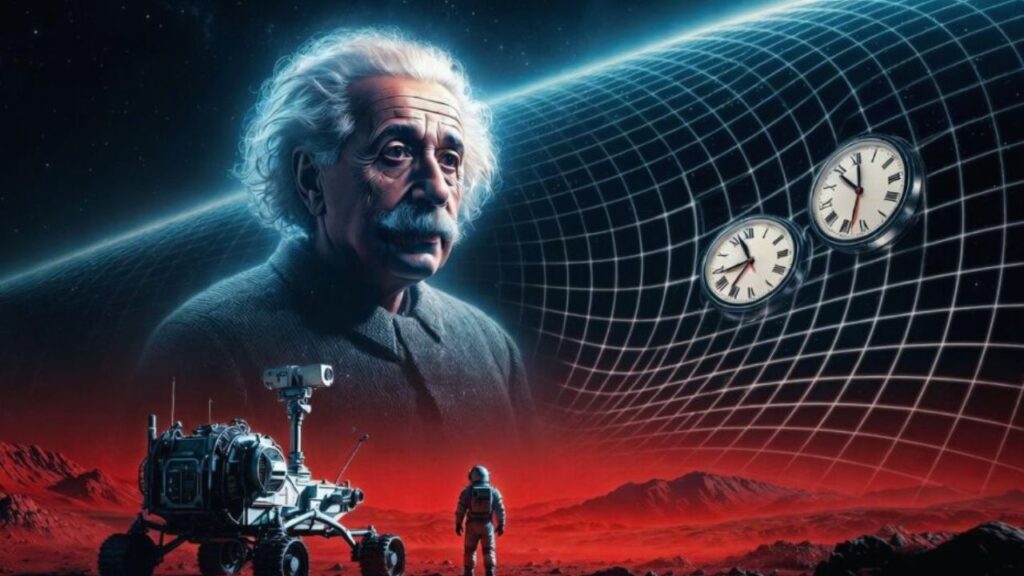
How Much Faster Time Moves On Mars
Recent scientific calculations show that time on Mars runs faster than on Earth by about 477 microseconds per Earth day. A microsecond is one millionth of a second so the difference is tiny but it adds up over time. The difference is not constant throughout the year. Mars follows a more elliptical orbit around the Sun so its distance from the Sun changes more than Earth’s distance does. Because gravity from the Sun also affects time the daily difference can change by as much as 226 microseconds per day over a Martian year. Depending on where Mars is in its orbit clocks on Mars may run ahead by roughly 364 to 590 microseconds per Earth day. Over months & years this becomes significant for mission planning & coordination.
 A Lost World Beneath Antarctica: Scientists Uncover 34-Million-Year-Old Landscape Under Ice
Why Microseconds Matter In Space
Spacecraft navigation relies heavily on precise timekeeping. When signals move between Earth and Mars or between spacecraft they travel at light speed. Even a tiny timing mistake of one microsecond creates a position error of roughly 300 meters. Mars clocks gain approximately 477 microseconds each day compared to Earth time. If mission controllers ignore this difference, navigation mistakes could exceed 140 kilometers daily. Such large errors make successful landings impossible and ruin orbital adjustments or coordination between multiple spacecraft. Future Mars missions need to include time correction systems from the start to avoid these problems.

Mars Has Two Different Time Challenges
Many people confuse relativistic time differences with Mars having a longer day. A Martian day is called a sol & lasts about 24 hours & 39 minutes & 35 seconds. This makes it roughly 39 minutes longer than an Earth day. NASA handles this difference by scheduling rover activities in sols rather than Earth days. Relativity creates an additional complication beyond just the longer day. Each second on Mars is slightly shorter because time moves faster there compared to Earth. During extended missions both of these time effects need to be managed at the same time.

Key Facts And Figures
| Topic | Mars Value | Why It Matters |
|---|---|---|
| Average clock speed difference | +477 microseconds per Earth day | Mars time runs faster |
| Orbital variation | Up to 226 microseconds per day | Changes during the Martian year |
| Typical daily range | 364–590 microseconds | Depends on Mars’s position |
| Length of one sol | 24:39:35 | Longer operational day |
| Martian year length | About 687 Earth days | Different seasonal timing |
How Future Missions Will Adapt
Mars Time: A New Reality for Space Exploration As we expand our presence on Mars upcoming missions will need to adopt timekeeping systems designed specifically for the planet. Rather than depending solely on Earth time, spacecraft & ground operations will use Mars-calibrated clocks that naturally compensate for relativistic differences. This method will become critical for crewed missions, orbital satellite systems, robotic explorers and communication networks. Precise time measurement will rank alongside fuel reserves, navigation programs and environmental control systems in importance. Einstein theorized that time would flow differently under varying gravitational forces, and Mars has now demonstrated this principle in measurable ways. With time advancing faster on the Red Planet by several hundred microseconds daily future missions must adjust or face significant positioning problems. Concepts that once belonged to theoretical physics have become practical engineering challenges. On Mars, even the passage of time operates under different conditions—and space programs must account for them.