
For about 4.5 billion years the Moon has circled Earth in its regular orbit. But this relationship between the two bodies is not fixed or unchanging. New research shows that the Moon is slowly moving farther away from our planet. This process happens gradually but it creates real effects on both objects in space. How does this change what we know about the connection between Earth & the Moon? The Moon moves away from Earth at a rate of roughly 3.8 centimeters each year. Scientists measure this distance using laser reflectors that astronauts placed on the lunar surface during the Apollo missions. These instruments allow researchers to calculate the exact distance between Earth and the Moon with remarkable precision.
Why the Moon Is Gradually Drifting Away From Earth
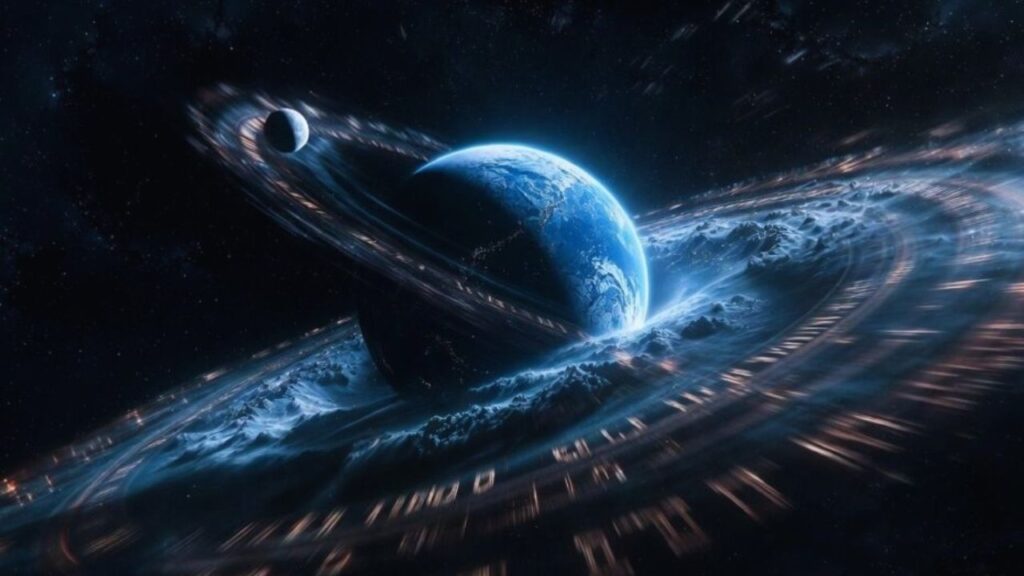
The Moon moves away from Earth because of the gravitational pull between them that creates tidal forces.

The Moon’s gravity affects Earth’s oceans and makes tidal bulges form.

Earth spins faster than the Moon travels around it so these bulges get pulled forward past the Moon’s position.

This transfer of energy from Earth’s spinning motion pushes the Moon into a wider orbit. At the same time Earth’s rotation becomes slower.
Scientists call this process tidal acceleration and it has continued without stopping for billions of years.
Right now the Moon drifts away from Earth at about 3.8 centimeters each year.
How the Moon’s Movement Is Slowly Lengthening Our Days
Earth’s rotation is gradually slowing down because it transfers energy to the Moon. This process makes each day a little bit longer over time. Right now a day on Earth gets longer by roughly 0.002 seconds every hundred years.
This might seem like nothing but it adds up over geological timescales. Scientists have found evidence in ancient rocks and fossils that shows Earth used to spin much faster.
About 600 million years ago a complete day only took around 21 to 22 hours instead of our current 24 hours.
The change happens so slowly that humans cannot notice it in their lifetimes.
However when you look at millions of years of planetary history the effect becomes clear & meaningful.
If this trend keeps going then days on Earth will eventually become much longer than they are now.
In the distant future our planet will take significantly more time to complete one full rotation.
Why Ocean Tides Are Losing Strength Over Time
The Moon is the primary driver of Earth’s tides. Its gravitational pull causes ocean water to rise and fall each day.
Earth’s rotation is gradually slowing down because it transfers energy to the Moon. This process makes each day a little bit longer over time.
Right now a day on Earth gets longer by roughly 0.002 seconds every hundred years. This might seem like nothing but it adds up over geological timescales.
Scientists have found evidence in ancient rocks and fossils that shows Earth used to spin much faster. About 600 million years ago a complete day only took around 21 to 22 hours instead of our current 24 hours.
The change happens so slowly that humans cannot notice it in their lifetimes. However when you look at millions of years of planetary history the effect becomes clear and meaningful.
If this trend keeps going then days on Earth will eventually become much longer than they are now. In the distant future our planet will take significantly more time to complete one full rotation.
What the Moon’s Drift Means for Earth’s Distant Future
Earth’s rotation is getting slower because it transfers energy to the Moon. This makes each day slightly longer as time passes. Currently a day on Earth increases by about 0.002 seconds every hundred years. This seems insignificant but it accumulates over geological timescales. Scientists have discovered evidence in ancient rocks and fossils showing that Earth once spun much faster. Around 600 million years ago a full day lasted only about 21 to 22 hours compared to our current 24 hours. The change occurs so gradually that humans cannot detect it during their lifetimes. But when examining millions of years of planetary history the effect becomes significant & noticeable. If this pattern continues then days on Earth will eventually grow much longer than they are today. In the far future our planet will need considerably more time to finish one complete rotation.
Essential Facts You Should Know About the Moon’s Recession
| Category | Key Information |
|---|---|
| Moon’s Drift Speed | Approximately 3.8 cm farther from Earth each year |
| Change in Earth’s Day Length | Increases by about 0.002 seconds every century |
| Length of Days in the Distant Past | Roughly 2 hours shorter around 600 million years ago |
| Present Earth–Moon Distance | Nearly 384,000 kilometers |
| Primary Reason for Recession | Tidal friction and transfer of angular momentum |
| Impact on Ocean Tides | Gradual weakening of tidal forces over time |
