
The first fat flakes started falling just after school pickup, drifting lazily past the supermarket windows while people rushed for last‑minute groceries. By 5 p.m., parking lots were full of carts loaded with bottled water, chips, and “just in case” bread, as if the world might close for a week, not a night. Over the loudspeaker, a manager reminded customers the store would “remain open as usual tomorrow,” almost talking over the weather alert chiming on everyone’s phones. Out on the road, taillights glowed a nervous red as parents, nurses, delivery drivers all raced the storm home. The snow didn’t care who had a shift, a deadline, or a quarterly target.
Somewhere between safety warnings and sales targets, the night ahead began to feel like a test.
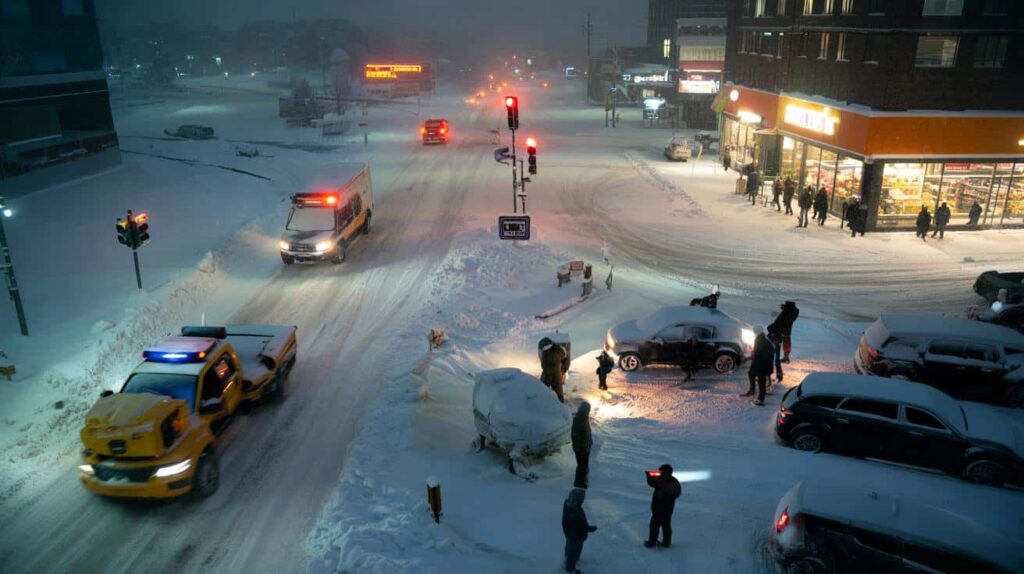
Snowstorm warnings meet business-as-usual pressure
By early evening, the forecast turned from “significant snowfall” to “dangerous travel” in a matter of minutes. Local authorities held a brief press conference, urging residents to cancel nonessential trips and keep cars off the road after dark. Plows and salt trucks were already lining up at the depot, engines humming, as officials spoke about black ice, whiteouts, and the real risk of blocked highways. On social media, the city’s emergency accounts repeated the same blunt message: stay home tonight if you can.
At almost the same moment, company group chats lit up with a different tone.

In a midtown office park, one logistics manager described getting two emails in ten minutes. The first, from the city, warned that “travel will be extremely hazardous or impossible overnight.” The second, from corporate headquarters hundreds of miles away, reminded staff that “all operations are expected to continue as scheduled.” She looked out at the swirling snow and thought of her team’s long commutes on winding side roads. “I can’t just tell people to drive through that,” she said quietly, “but I also know what happens if we fall behind on orders.”
That tug-of-war is playing out tonight in restaurants, warehouses, hospitals, and call centers all over the region.

Public officials are locked into a simple duty: protect lives and keep roads clear enough for ambulances, plows, and utility crews. Business leaders, especially in retail and logistics, are locked into something else: keeping revenue flowing and customers served, even when nature slams on the brakes. The clash feels sharper now that so many industries learned to work remotely during the pandemic. When city alerts say “stay home” and a supervisor says “see you at 8 a.m.,” the mixed signals land directly on the shoulders of the person holding the car keys.
That’s where the real stress lives tonight, in that gap between policy and reality.

How to navigate tonight if you’re expected to work
If your boss still expects you on site tomorrow morning, the most practical thing you can do tonight is treat your commute like a small expedition, not a routine drive. Check the hour‑by‑hour forecast, but also the live traffic cameras and your local transportation agency’s feed. Charge your phone fully and toss a portable charger and old blanket in the back seat, even if your trip is usually just fifteen minutes. Top up your gas tank now, not at dawn in a snow‑clogged station line.
A simple rule helps: if you’d pack it for a winter road trip, it deserves a spot in your car before this storm.
The emotional part is trickier than the logistics. Calling in, asking to work remotely, or telling a manager you don’t feel safe driving can feel like breaking an unwritten workplace code. Many people still hear that little voice saying, “Everyone else is going, don’t be dramatic.” *That’s how a lot of bad decisions start.* If you’re nervous, say so clearly, and offer a practical compromise, like arriving later, leaving earlier, or taking on remote tasks.
Let’s be honest: nobody really reads every line of the employee safety handbook, but tonight is when those dusty policies actually matter.
When roads and responsibilities collide, a lot of workers end up quietly improvising. One warehouse supervisor I spoke with put it this way:
“Corporate says we’re open. The city says stay home. My job is to look my people in the eye and decide who I’m willing to see out on that highway. That’s not a line in my job description, but it’s real.”
# Making the Right Choice for Your Kitchen
Some readers face this same choice at home when planning their kitchen setup. A few basic questions can help you decide:
When you sit down to think about your kitchen you need to consider what matters most to you. Think about how you use your space every day. Ask yourself what problems you currently face & what would make cooking easier. Consider your budget first. Know how much you can spend before you start looking at options. This keeps you focused on realistic choices that fit your financial situation. Think about your cooking habits. Do you cook elaborate meals or do you prefer quick and simple dishes? Your answer affects what equipment and layout will work best for you. Look at your available space. Measure your kitchen area carefully. Some solutions work great in large kitchens but feel cramped in smaller ones. Make sure any changes you plan will actually fit. Consider who uses the kitchen. If multiple people cook at the same time you need a different setup than if only one person prepares meals. Think about height differences and accessibility needs too. Ask yourself how long you plan to stay in your home. Permanent solutions make sense if you will be there for years. Temporary or flexible options work better if you might move soon. Think about maintenance requirements. Some choices need regular upkeep while others require minimal attention. Be honest about how much time you want to spend on maintenance. These straightforward questions help you see what really matters for your situation. They cut through marketing messages & trendy ideas to focus on your actual needs.
- Is your role truly **essential** tonight, or simply convenient for your employer?
- Do you know your rights if you refuse unsafe work in your state or country?
- Can you propose a **specific alternative** instead of just saying “I can’t”?
- Did your company send any written guidance about weather emergencies this season?
- Are you relying on someone else’s risky drive, like a rideshare or carpool?
Under heavy snow, those quiet details turn into loud consequences.

➡️ Short haircut for fine hair the truth no one tells you about these 4 viral volume cuts that can make your hairline look even thinner
➡️ “Extremely flattering”: forget short cuts, this rejuvenating hairstyle is ideal after 50 according to a hairstylist
# No Planning Tools or Memory Tricks Needed for Remembering Errands
When it comes to keeping track of daily tasks and errands most people rely heavily on planning tools or memory techniques. However there is another approach that works just as well without requiring any special systems or mental gymnastics. The traditional method involves writing everything down in planners or using smartphone apps to create detailed to-do lists. Some people swear by memory palaces or mnemonic devices to help them recall what needs to be done. While these methods can be effective they also require consistent effort and discipline to maintain. The alternative is to build habits and routines that naturally incorporate your regular errands into your daily life. When you always do certain tasks on specific days or at particular times you eliminate the need to actively remember them. Your body and mind simply know what comes next. For example if you always stop at the grocery store on your way home from work on Thursdays you don’t need to write it down or create a mental reminder. The routine becomes automatic. The same principle applies to other regular tasks like picking up prescriptions or dropping off dry cleaning. This approach works because it takes advantage of how our brains naturally form patterns. Once something becomes part of your regular routine it requires much less mental energy to execute. You free up cognitive resources for other things while still getting everything done. The key is to establish consistent patterns rather than trying to remember individual tasks. Instead of memorizing a list of errands you create a lifestyle where those errands fit naturally into your schedule. This reduces stress and makes daily life feel more manageable without any special tools or techniques required.
➡️ Do you often have moisture on your windows? Here’s the most effective way to remove it and protect your health
➡️ Harvard brain scientist recommends six daily habits to slow ageing
➡️ Fisherman lands once in a lifetime electric blue lobster that scientists say is ‘one in 200 million’ and must decide whether to eat it or set it free
➡️ Car experts share the winter tire-pressure rule most drivers forget
Snow warnings are getting more serious as weather experts confirm that up to 30 centimeters of snow will fall. They have released detailed hourly forecasts so each area knows exactly when to prepare. Meteorologists are tracking a major winter storm that will bring heavy snowfall across multiple regions. The weather service has issued updated alerts with specific timing for when the snow will arrive in different locations. Forecasters say the storm will move through gradually over the next day. Some areas will see snow beginning in the early morning hours while others will not experience the heaviest accumulation until later in the afternoon or evening. The predictions show that certain regions could receive the full 30 centimeters of snow while neighboring areas might see significantly less. Local conditions & elevation will play important roles in determining final snow totals. Officials are urging residents to check the hourly breakdown for their specific location. This information will help people plan their travel & make necessary preparations before conditions deteriorate. The detailed timeline shows when snow will start falling in each area and when it will reach its peak intensity. This allows residents to know the best windows for completing outdoor tasks or making essential trips. Weather services recommend that people stock up on supplies and avoid unnecessary travel during the heaviest snowfall periods. Road conditions are expected to become hazardous quickly once the snow begins accumulating. The storm system is large and will affect a wide geographic area. Communities should prepare for potential power outages & have emergency supplies ready in case conditions become severe. Meteorologists will continue monitoring the storm and updating forecasts as new information becomes available. Residents should stay informed through official weather channels and follow any instructions from local emergency management officials.
Between staying safe and staying employed
Tonight’s storm puts something uncomfortable under a bright white spotlight: who actually carries the risk when the weather turns ugly but the doors stay open. For frontline staff, the choice is almost never framed as “life or death,” even when road conditions creep close to that line. It’s framed as “dependable or difficult,” “team player or troublemaker.” That’s a tough weight to balance against a mortgage, a student loan, a kid’s daycare bill. Yet deep down, most people know the answer they’d give a friend: if the roads scare you, don’t drive.
The gap between what we’d advise others and what we demand of ourselves is where a lot of harm is born.
| Key point | Detail | Value for the reader |
|---|---|---|
| Weather warnings vs. work demands | Authorities urge people to stay home while some businesses insist on normal operations | Helps you name the mixed signals you’re feeling tonight |
| Practical storm prep for workers | Emergency car kit, updated route info, and clear communication with managers | Gives you concrete steps to protect yourself without quitting your job |
| Personal risk judgment | Learning to weigh “essential” work against dangerous conditions | Supports more confident decisions when safety and income feel at odds |
FAQ:
- Question 1What should I do if my boss insists I come in despite the travel warning?
- Question 2Can I be fired for refusing to drive in heavy snow?
- Question 3I have to go in. What’s the safest way to handle the commute?
- Question 4My company says it supports safety, but stays open in every storm. Is that normal?
- Question 5How can businesses balance staying open with keeping workers safe during storms?
