
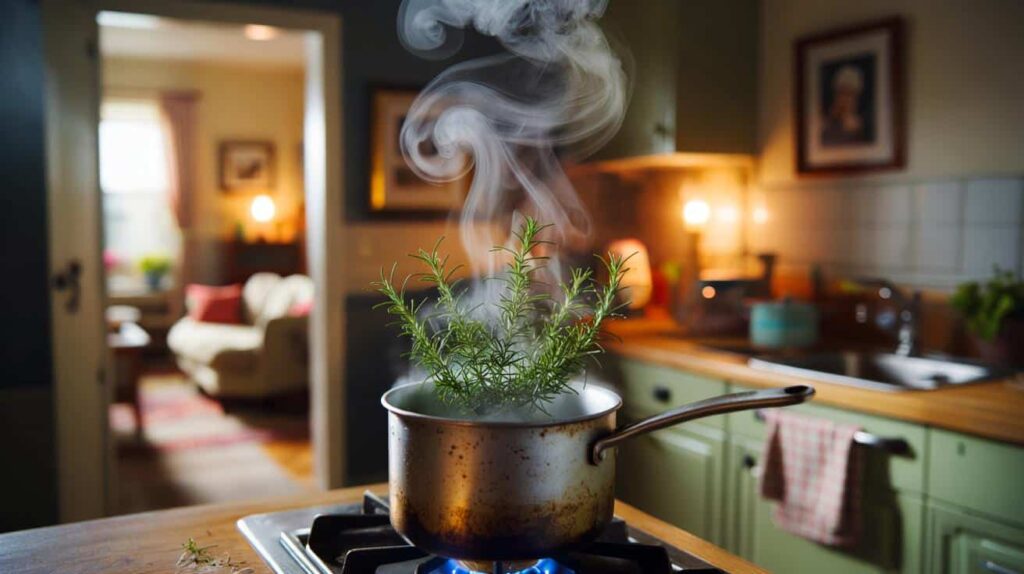
The first time I saw my grandmother boiling rosemary, I thought she’d lost the plot. The whole kitchen smelled like a forest after the rain, and there she was, standing over a steaming pot, eyes half-closed, as if she were listening to something I couldn’t hear. No fancy diffuser, no expensive candle, no plug-in gadget. Just a battered saucepan, some tap water, and a bunch of green sprigs she’d picked from the garden.
I was a teenager who felt impatient as I scrolled on my phone and rolled my eyes at her strange rituals. She simply smiled at me & said to wait ten minutes before taking a breath. When those ten minutes passed the house felt different to me. The air felt softer and lighter around me. Everything seemed less noisy even though nothing had actually changed in the room.

Years later I lived in a small city apartment that smelled like food from other units & long exhausting days. That was when I finally grasped what she had been trying to teach me.

Why a simple pot of rosemary can change the whole atmosphere
There is a specific type of tiredness that exists in the atmosphere of a house. You recognize it when you enter after a long day and everything seems heavy. The space is not dirty or messy but feels emotionally thick. Screens are buzzing and laundry baskets are full while the smell of last night’s dinner mixes with today’s coffee. You open a window and it helps briefly. Then the same stale feeling returns and settles back into the room.

That’s when my grandmother’s voice comes back to me: “Put a pot on.” So I grab a handful of rosemary, toss it into boiling water, and let the steam rise slowly into the room. It doesn’t shout like a chemical spray. It seeps in gently, almost shy at first, then firm, then grounding.
One winter evening I put it to the test in the harshest way possible right after a heated family fight. The tension in the room was thick and nobody wanted to say a word to each other. Everyone just grabbed their phones and tablets to escape. I decided to do something different and walked into the kitchen. I grabbed a pot and filled it with water. Then I tossed in some rosemary & turned the stove on. I did not give any speeches or try to have some deep conversation about feelings. It was just a small simple ritual.
Within fifteen minutes, something softened. People drifted out of their rooms, “What’s that smell?” someone asked. Another person leaned against the counter, then another. We didn’t fix everything, of course. But voices were lower, shoulders dropped a bit, breathing slowed. The room felt less like a battlefield and more like a neutral zone.
I’ve since tried the same thing after cooking fish, after hosting friends, after a marathon workday at home. Each time, I notice the same small but real shift: the house seems to exhale.
There’s a simple explanation behind this little “magic trick.” Rosemary is packed with aromatic compounds that release when heated in water. They bind to smells lingering in the room and, little by little, nudge them out of the way. Unlike synthetic fragrances that just layer on top, the herbal steam mixes with humidity and travels into corners candles never reach.
Boiling rosemary creates a psychological shift that matters. When you boil rosemary you have to slow down for a few minutes and focus on one simple task for your home. You stand at the stove watching small bubbles form while breathing more deeply without realizing it. This sensory moment tells your brain that something is changing. You move from rushing to resting & from constant doing to simply being. That small shift can transform your home’s atmosphere better than any store-bought spray.
➡️ “One chance in 200 million”: US fisherman hauls in electric-blue lobster with breathtaking colour
# Health insurers want to cut fees for psychotherapists – what’s at stake for patients in Germany? Health insurance companies in Germany are pushing to reduce the payments they make to psychotherapists. This move has sparked serious concerns about what it could mean for people seeking mental health treatment across the country. The dispute centers on how much therapists should be paid for their services. Insurance providers argue that current rates are too high & need adjustment. However mental health professionals warn that lower fees could make the situation worse for patients who already face long waiting times & limited access to care. Germany has been struggling with a shortage of available therapy spots for years. Many people wait months to get an appointment with a psychotherapist. The professional associations representing therapists say that cutting their income will only drive more practitioners out of the field or force them to reduce the number of patients they accept through public insurance. Therapists point out that their work requires extensive training & ongoing education. They also handle complex cases that demand significant time and emotional energy. If insurance payments drop below a sustainable level fewer people will choose this career path & existing therapists may shift toward private patients who pay higher rates. For patients this could mean even longer waiting lists. Those who rely on public health insurance might find it increasingly difficult to access mental health services when they need them most. Some experts worry that vulnerable groups including people with severe mental illness or those from lower income backgrounds will be hit hardest by these changes. The negotiations between insurance companies & therapist representatives will determine the future landscape of mental health care in Germany. Both sides need to find a balance that ensures therapists can maintain their practices while keeping treatment accessible & affordable for everyone who needs it.
A major engineering project has started construction on an underwater rail line that will connect entire continents through a deep-sea tunnel. The ambitious infrastructure development represents one of the largest transportation projects ever attempted. Engineers & construction teams have begun work on the massive undertaking that will link landmasses separated by ocean waters. The underwater railway system will run through a tunnel built beneath the seabed. This connection aims to provide a direct transportation route between continents that currently rely on air travel or shipping for movement of people & goods. Project planners have designed the rail line to handle passenger and freight traffic. The tunnel will be constructed deep enough to avoid interference with maritime activities while maintaining structural integrity under ocean pressure. Construction teams are using advanced tunneling technology to excavate and reinforce the underwater passage. The project requires specialized equipment capable of working in challenging subsea conditions. Transportation experts believe the completed rail link will reduce travel times significantly compared to current options. The direct route will eliminate the need for transfers and provide a reliable alternative to weather-dependent transportation methods. The engineering challenge involves managing water pressure and ensuring long-term stability of the tunnel structure. Construction crews must also account for seismic activity & ocean floor conditions during the building process. Once operational the underwater rail system will mark a significant achievement in global infrastructure development. The project demonstrates how modern engineering capabilities can overcome geographical barriers that have historically separated populations.
➡️ Due to high mercury levels, eight French cities remove tuna from school canteens

➡️ Many people don’t know this, but cauliflower, broccoli and cabbage are all varieties of the same plant
➡️ If you want a happier life after 60 be honest with yourself and erase these 6 habits
➡️ New analysis of Hadrian’s Wall latrines reveals Roman soldiers lived with widespread and disruptive gut parasites 1,800 years ago
➡️ Day will turn to night as the longest solar eclipse of the century triggers backlash against tourism plans locals accuse authorities of cashing in on fear
How to boil rosemary like my grandmother (and actually enjoy it)
The method is simple and straightforward. Take a medium pot or saucepan & fill it about two-thirds of the way with water. Heat the water until it boils and then reduce the heat to maintain a gentle simmer. Toss in a generous amount of fresh rosemary sprigs or use two tablespoons of the dried version if fresh isn’t available. There are no complicated recipes or precise measurements required. Just be generous with the rosemary rather than using too little.
Let the rosemary simmer uncovered for 15 to 30 minutes. The longer it stays on, the more the scent blooms. If you live in a small apartment, 15 minutes is often enough. For larger homes, you can go longer and even move the pot carefully to another room, placing it on a trivet so the steam continues to rise. My grandmother used to do this in winter, walking through the hallway like a quiet priestess with her steaming “cauldron.”
There are a few traps we often fall into when we try these kinds of home tips. Either we expect a miracle in five seconds, or we turn it into a complicated project. You don’t need to scrub the whole house before you earn the right to boil a pot of rosemary. Start with the pot. Let the ritual lead the rest. Let’s be honest: nobody really does this every single day.
Another common mistake is adding too many other things. A bit of lemon peel or a cinnamon stick can be lovely, but if you throw your entire spice cabinet in there, you’ll just create confusion, not calm. Go simple at first. Smell how plain rosemary feels. Then slowly adjust. If the scent feels too strong, just turn off the heat and open the kitchen window a crack. The steam will still travel.
My grandmother used to say that my house does not feel clean unless it smells alive. She believed that soap cleans the surfaces while plants clean the mood. She kept small pots of herbs on every windowsill in her home. Basil grew in the kitchen near the sink. Mint filled the bathroom with its fresh scent. Rosemary sat on the living room table where sunlight came through in the afternoon. I never understood what she meant until I moved into my first apartment. The space felt empty and cold even after I scrubbed every corner. The walls were white & the floors were clean but something was missing. I bought a small lavender plant from the market and placed it near my bed. Within days the room felt different. The air seemed softer & I slept better at night. Plants do something that cleaning products cannot do. They add life to a space. They change the way air moves through a room. They create a sense of calm that no amount of scrubbing can achieve. My grandmother knew this without reading studies or articles about it. She simply felt it. Now I keep plants throughout my home just like she did. They require attention & care but they give back more than they take. Every time I water them or trim their leaves I think about her words. A clean house needs more than soap and water. It needs something living and growing to make it feel complete.
- Use fresh sprigs when you can
Fresh rosemary releases a deeper, greener scent than dried, and the steam feels more vibrant. - Simmer, don’t aggressively boil
A gentle simmer keeps the aroma round and pleasant, while a rolling boil can make it evaporate too fast. - Turn it into a tiny ritual
While the pot simmers, do one small thing: wash two dishes, fold five clothes, or simply sit and breathe. - Open interior doors
Let the steam wander into the hallway, the living room, even the bedroom. It works quietly in the background. - Reuse the water once cooled
You can pour the cooled rosemary water into a spray bottle and lightly mist fabrics or the bathroom for a softer scent.
When a pot of rosemary becomes a way of caring for your space
What stays with me today isn’t just the smell of rosemary. It’s the idea that atmosphere is something we can tend to, like a plant or a relationship. We’re quick to clean visible dirt and hide clutter in drawers, but the emotional climate of our home usually comes last. A simple pot on a stove says the opposite. It says: I see you, house. I see what you hold for me. I’m going to lighten your load a little.
This small act doesn’t fix loneliness, stress, or the fact that life is sometimes too much. Yet it anchors you in something real, warm, and honest. You hear the water, you see the steam, you smell the herb. Your senses remind you that you’re not just a head full of tabs, you’re also a body in a living space. And from that point, lots of other good decisions get easier: drinking a glass of water, going to bed earlier, calling someone back.
We’ve all been there, that moment when the house feels like an extension of our anxiety. Boiling rosemary won’t erase that. It will simply give you a small, tangible way to say, “I’m here. I’m taking back a bit of softness.” Sometimes that’s all we need to start breathing differently.
| Key point | Detail | Value for the reader |
|---|---|---|
| Simple method | Boil rosemary in water for 15–30 minutes to perfume and lighten the atmosphere | Easy, low-cost way to refresh a room without chemicals |
| Sensory ritual | Turning the simmering pot into a small daily or weekly gesture | Helps shift from stress mode to calm, grounding presence at home |
| Flexible use | Use fresh or dried rosemary, move the pot, reuse cooled water as a spray | Adapts to different homes, habits, and levels of effort |
FAQ:
- Can I use dried rosemary if I don’t have fresh sprigs?Dried rosemary works perfectly. Use about two tablespoons for a medium pot of water. The scent is slightly different, a bit more “woody,” but still comforting and effective.
- How long does the smell last in the house?It depends on the size of your space and ventilation. In a small apartment, the scent often lingers for 2–4 hours. In larger homes, it’s subtler but can still soften odors and the general atmosphere for part of the day.
- Is it safe to leave the pot simmering unattended?No. Treat it like any cooking. Stay nearby, or at least in the same home and aware of the stove. If you need to leave or get distracted, turn off the heat and let the pot keep releasing steam as it cools.
- Can I boil other herbs with rosemary?Yes, gently. Lemon peel, thyme, or a cinnamon stick pair well. Start with one extra element at a time so you understand how each scent behaves and doesn’t overwhelm the room.
- Does boiling rosemary really clean the air, or just perfume it?It mainly perfumes and changes how the air feels. The warm humidity helps carry away stale odors and can ease dryness in the room, while the herbal compounds give a fresher, “cleaner” impression.
