
The first cold snap arrives on a Tuesday evening. You walk through the door & set your bag down and push the thermostat up to 21°C almost automatically. Outside people are discussing energy bills and climate issues and this idea of “sobriety” as though being comfortable at home has turned into something you should feel bad about. For years that well-known 19°C guideline has appeared everywhere from television programs to your energy statements to workplace conversations. Nineteen degrees in every room throughout the entire winter season as if it were some kind of sacred number that cannot be questioned. But the reality is more complex than that single figure suggests. The 19°C recommendation comes from general energy efficiency guidelines that aim to balance comfort with reasonable consumption. It represents a temperature where most people can stay warm enough without excessive heating costs. However it treats every room in your home the same way when they clearly serve different purposes. Your bedroom functions better at a cooler temperature for sleep quality. Your bathroom needs more warmth when you step out of the shower. Your living room temperature depends on whether you are sitting still reading or moving around doing chores. The kitchen often stays warmer from cooking activities. Treating all these spaces identically ignores how you actually live in your home. The key is understanding that 19°C works as a baseline rather than an absolute rule. You can adjust from there based on what each room needs and when you use it. This approach actually makes more sense than maintaining the same temperature everywhere all the time.
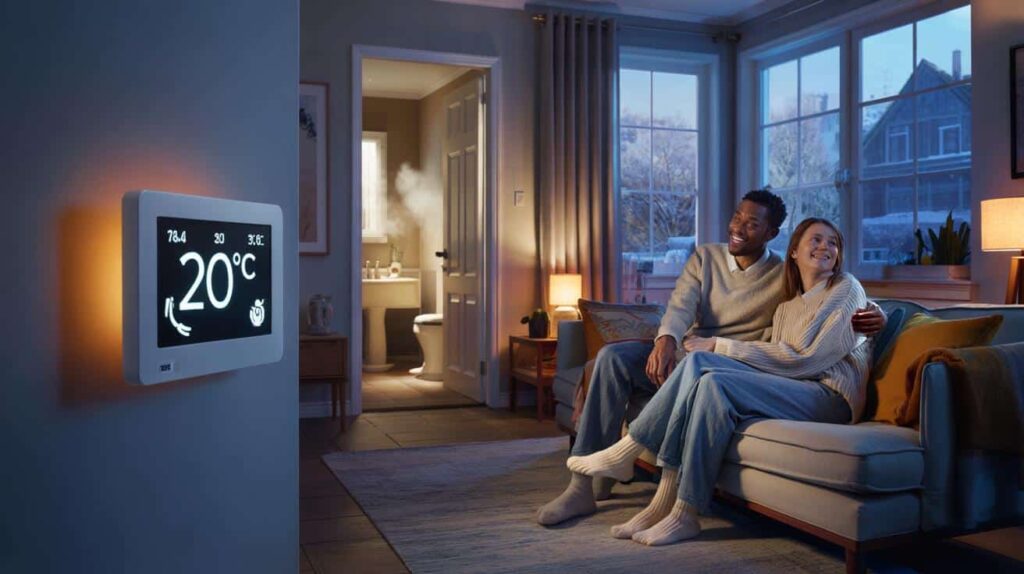
But you’re shivering on the sofa in a T‑shirt, wondering quietly: who actually lives at 19°C?

Some experts are starting to admit out loud what many people are whispering at home. The old rule is cracking. And a new temperature is emerging.

Why the 19°C rule no longer fits our lives
Nineteen degrees was born in another era. The rule dates back to the oil shocks of the 1970s and was later folded into building regulations as a standard indoor temperature. The problem is simple: our homes, our bodies and our daily routines have changed, but that number hasn’t moved.

We work more from home, we sit longer, we age in place, we deal with chronic illnesses that hate the cold. A one-size-fits-all rule feels oddly rigid in a world that’s trying to be more flexible about everything else.
Energy experts are now saying it out loud: **19°C is no longer the universal benchmark**.
Picture a small 1960s apartment on the third floor, thin walls, single-glazed windows. At 19°C on the thermostat, the couple who live there are huddled under blankets by 8 p.m. The air feels damp, cold seeps from the floor, and they end up bumping the dial to 22°C “just for tonight”. Then the gas bill arrives and the guilt follows.
In a new well-insulated building across town another family sits comfortably at 19°C wearing light sweaters. Same city and same season but a completely different sensation of warmth. A French ADEME study has shown that perceived comfort can vary by 2 to 3°C at the same measured temperature depending on humidity & insulation & air movement.
The number on the wall is only half the story.
Specialists in thermal comfort talk less about “the right temperature” and more about a range. They look at what’s called the “operative temperature”, a mix of air temperature, radiant temperature from walls and windows, and even how fast air moves across your skin.
➡️ Astronomers unveil spectacular new images of interstellar comet 3I ATLAS, observed from several major observatories worldwide
➡️ How early experiences shape tolerance for uncertainty later in life
➡️ The looming February polar vortex disruption is nearly without precedent and reveals how badly climate models and public forecasts keep failing us
# This Country Is Racking Up Green Records While Europe Falls Behind
While European nations struggle with their environmental commitments one country continues to break records in sustainable development. The contrast between regions has become increasingly stark as different approaches to green policy yield vastly different results. Europe has long positioned itself as the global leader in environmental protection and climate action. However recent data suggests the continent is losing momentum. Several factors contribute to this slowdown including economic pressures and political resistance to aggressive climate policies. Energy costs have soared across many European nations forcing governments to reconsider their timelines for phasing out fossil fuels. Meanwhile another major economy has quietly surged ahead in renewable energy deployment. China now leads the world in solar panel production & installation. The country added more renewable energy capacity last year than the rest of the world combined. This achievement reflects a strategic commitment to dominating the green technology sector while simultaneously addressing domestic air quality concerns. The numbers tell a compelling story. China installed over 200 gigawatts of solar capacity in a single year. Wind power installations also reached record levels. These additions dwarf the renewable energy growth seen in European countries during the same period. Germany and Spain once considered pioneers in solar energy have seen their installation rates plateau. This shift in leadership raises important questions about the future of global climate action. Europe built its environmental reputation through early adoption of strict emissions standards and substantial investments in renewable technology. However the current data suggests that scale and speed matter more than being first to market. China benefits from several advantages that European nations lack. The country maintains centralized control over energy policy allowing for rapid deployment of large infrastructure projects. Manufacturing capacity for solar panels and wind turbines exists domestically reducing costs & eliminating supply chain vulnerabilities. Government subsidies support both production and installation creating a self-reinforcing cycle of growth. European countries face different challenges. Democratic processes slow decision making as various stakeholders debate the best path forward. Public opposition to wind farms and solar installations has grown in some regions. The transition away from Russian natural gas created unexpected complications forcing some nations to temporarily increase coal usage. The economic implications extend beyond energy production. China now dominates the global supply chain for renewable energy components. European manufacturers struggle to compete with lower Chinese prices. This dependency creates strategic vulnerabilities for countries trying to build domestic green industries. Despite these challenges Europe retains certain advantages. The continent leads in energy efficiency standards & circular economy initiatives. European cities often rank highest in livability and sustainable urban planning. Research institutions across the region continue producing innovations in battery technology and carbon capture. The question remains whether Europe can regain its momentum or if the future of green technology belongs to countries willing to deploy capital and resources at unprecedented scales. The answer will likely determine which economic model proves most effective for addressing climate change while maintaining competitiveness in emerging industries.
➡️ Stricter blood pressure guidelines are fueling growing unease among cardiologists, raising concerns about overdiagnosis and treatment
➡️ Forget the Burj Khalifa and Shanghai Tower: Saudi Arabia is now preparing an audacious 1,000-meter skyscraper that could redefine skylines worldwide
➡️ Greenland declares an emergency after orcas are spotted where solid ice once stood
➡️ “They age you instantly”: 5 “granny” hair trends to ditch for good after 50 according to a hairstylist
In a poorly insulated home, cold walls “steal” heat from your body, so 19°C feels harsh. In a well-insulated, dry home, 19°C can feel almost cosy. That’s why many experts now suggest a band between 19 and 21°C for living areas, adjusted to the state of the building and the occupants.
The simple reality is that a single nationwide regulation cannot accommodate the diverse circumstances found in millions of individual households. A standardized approach fails to recognize that every family operates under unique conditions. What works perfectly for one home may create serious problems for another. Geographic location matters significantly. Cultural backgrounds shape daily routines. Economic situations vary dramatically from one neighborhood to the next. When policymakers create blanket rules they typically base their decisions on average scenarios or theoretical models. But real life rarely follows these neat patterns. Some families have elderly relatives living with them who need special considerations. Others include young children with different requirements. Work schedules differ widely. Housing arrangements span from small apartments to large houses with yards. The assumption that one solution fits everyone ignores practical realities. A rule designed for urban apartment dwellers might make no sense for rural homeowners. Regulations suitable for wealthy suburbs could burden working class families. What seems reasonable to government officials in distant offices often proves impractical when applied to actual living situations. Local communities understand their own needs better than distant authorities. Residents know what challenges they face daily. They recognize which solutions work and which create additional complications. This ground level knowledge rarely makes it into national policy discussions. Flexibility allows people to adapt guidelines to their specific circumstances. When rules remain rigid they force families into uncomfortable compromises. Parents must choose between following regulations and meeting their household needs. This tension creates frustration and sometimes leads people to simply ignore rules that don’t make sense for their situation. Effective governance requires acknowledging this diversity. Better policies provide frameworks rather than fixed mandates. They establish principles while allowing local adaptation. This approach respects the intelligence of ordinary people to make reasonable decisions about their own lives. The distance between policy creation and policy implementation matters enormously. Those writing rules often lack direct experience with the situations they regulate. They may have good intentions but limited understanding of how their decisions affect real families going about daily life.
The new recommended temperatures, room by room
So what do experts actually recommend today? More and more studies converge on a flexible guideline: around **20–21°C in living spaces during the day**, a bit cooler at night, and differentiated rooms rather than one blanket number. That means 20–21°C in the living room and office, 18–19°C in bedrooms, and around 22°C in the bathroom during use, then dropping back afterwards.

The key idea is simple: heat where you live your life, ease off where your body doesn’t need as much. For older people, babies, or those with health issues like arthritis or respiratory disease, doctors now often recommend leaning towards the top of the range.
One extra degree of warmth can provide genuine relief for joint pain or asthma symptoms without causing your energy bill to increase significantly if you manage other factors carefully.
Take Sophie, 36, graphic designer, who switched to remote work three days a week. At 19°C, sitting eight hours in front of her laptop, she felt permanently tense and cold, hands like ice on the keyboard. She kept hearing the “19°C or you’re selfish” mantra in her head, so she piled on layers instead of touching the thermostat.
Last winter she talked to her GP about chronic back pain and then adjusted her home office temperature to 20.5°C. She lowered the hallway to 17°C and set the bedroom to 18°C at night. Her heating bill stayed about the same as the year before because she stopped heating rooms she rarely used. She just moved the warmth to the spaces where she actually spent her time.
*Comfort is less about heroically freezing than about intelligently redistributing heat.*
Energy engineers confirm what many households sense intuitively. Every extra degree costs money, yes, but context matters. Heating an unused corridor to 20°C is wasteful; raising a living room from 19°C to 20°C while cutting back elsewhere can be neutral overall.
Thermal experts now talk about “zoning” rather than blanket targets. That means defining different recommended temperatures for each zone of the home, according to usage and time of day. They also stress that humidity between 40–60% can make 20°C feel much warmer than a dry, parched 21°C.
So instead of repeating the old 19°C slogan, more nuanced guidance is emerging: a base range from 18 to 21°C, with **21°C as a reasonable upper limit** for most, and thoughtful exceptions for vulnerable people.
How to find your real ideal temperature at home
To move beyond slogans, you need a simple method. Experts suggest starting with a reference point: set the living room to 19.5–20°C for three days, with a reliable thermometer in the middle of the room, far from radiators and windows. Wear normal indoor clothes, not polar expedition gear, and just live your life.
Listen to what your body tells you instead of feeling guilty about it. Check if your shoulders feel tight or raised up. Notice if your fingers feel numb while typing. See if you keep grabbing extra clothes because you feel cold. Or maybe you feel the opposite with heaviness and drowsiness because the air feels stuffy. Make small changes of half a degree every few days by raising or lowering the temperature until you reach that comfortable state where nothing bothers you.
This is your personal comfort zone, not a moral score.
A common trap is to crank the thermostat up suddenly because you feel cold after coming in from outside. The walls are still chilled, your body is in contrast mode, and you end up setting 23°C for an hour “just to warm up”, then forgetting to lower it. Let’s be honest: nobody really does this every single day.
Experts advise a different reflex: keep your base setting stable and use local boosts. A thick throw on the sofa, warm socks, a small programmable bathroom heater for 20 minutes before a shower. The background temperature stays in the recommended range, and you add short, targeted bursts of extra heat where your body needs it more.
It’s less spectacular than a big thermostat twist, but far more efficient on the bill.
People do not need to feel cold at 19 degrees Celsius to prove they care about the environment says energy consultant Laura Martin. We need practical temperature settings that make sense rather than rules based on making people feel guilty. A properly managed temperature of 20 or 21 degrees can be both responsible and comfortable for everyone.
- New living room range
Around 20–21°C by day, 18–19°C when you’re away or asleep. - Bedrooms
18–19°C for most adults, slightly warmer for babies, slightly cooler for those who sleep hot. - Bathroom
21–22°C during use, then back down to 18–19°C with a timer or program. - Circulation areas (hall, corridor)
- For vulnerable people
Aim for the top of the range, and ask a doctor before accepting low temperatures that feel clearly uncomfortable.
17–18°C, doors closed, to keep the main rooms cosy without heating empty space.
A new way of thinking about heat at home
The end of the 19°C rule does not mean we should now overheat our homes. It simply means we can move away from following one strict number without thinking and instead make informed decisions. Rather than relying on a single temperature target we should consider temperature ranges and zones along with our daily habits & the actual people who live in these spaces. This shift recognizes that heating is not about hitting one perfect number. Different rooms serve different purposes and people have varying needs based on their age and health. A bedroom might work well at a cooler temperature while a bathroom needs more warmth. An elderly person may need more heat than a young adult. The key is understanding why we heat our homes in the first place. We want comfort and health without wasting energy or money. This means paying attention to how our bodies actually feel rather than just watching a thermostat. It also means using tools like programmable thermostats and proper insulation to maintain comfortable conditions efficiently. Making informed choices about home heating requires some basic knowledge. We should understand how our heating system works & how our home loses heat. We need to know which rooms we use most and when. With this information we can create a heating strategy that works for our specific situation rather than following a one-size-fits-all rule.
You can adjust temperatures in different rooms and experiment with curtains & door positions. You can also change humidity levels and what you wear. When you do this you notice something important. You do not have to choose between being cold or using too much energy. You have options even if you live in a small apartment with an old heating system. This matters because most people think they are stuck. They believe their only choices are to turn the heat up high or suffer through the cold. But that is not true. Small changes make a real difference. Start with the rooms you use most. Keep bedroom doors closed during the day. Open curtains when the sun shines and close them at night to trap warmth inside. These simple actions cost nothing but they change how your home feels. Humidity also affects comfort. Dry air makes you feel colder than you actually are. A bowl of water near a radiator or some houseplants can help. You might find you can lower the thermostat by a degree or two without noticing. What you wear indoors matters too. A warm sweater or thick socks can replace the need for higher temperatures. This seems obvious but many people overlook it. They walk around in light clothing and then complain about the cold. The point is that you have more control than you think. Even older heating systems respond to these adjustments. You do not need expensive upgrades or new equipment to improve your situation. You just need to pay attention and make small deliberate changes. This approach saves money over time. It also reduces energy waste which benefits everyone. Most importantly it gives you a sense of control over your living space. You stop feeling like a victim of your circumstances and start acting like someone who can solve problems.
This winter the real question might not be whether you are at 19°C but whether each degree you pay for actually serves your comfort and health. That question alone can change how you look at your thermostat and your bill and your everyday wellbeing. The temperature you choose affects more than just your energy costs. It influences how well you sleep and how productive you feel during the day and whether you wake up with a dry throat or stuffy nose. Finding the right balance means understanding what your body needs at different times & in different rooms. Most people assume that warmer is always better during cold months. But research shows that slightly cooler temperatures can improve sleep quality and help your body regulate itself more effectively. The key is knowing which spaces need more warmth and which can stay cooler without affecting your comfort. Your bedroom benefits from being cooler at night because your body temperature naturally drops during sleep. Keeping that room around 16 to 18°C helps you fall asleep faster and stay asleep longer. Meanwhile your living areas during the day can sit comfortably at 19 to 20°C without wasting energy on unnecessary heat. The difference between 19°C & 21°C might seem small but it adds up quickly on your energy bill. Each degree higher can increase heating costs by around seven percent. Over a full winter season that extra warmth in every room costs significantly more than most people realize. Adjusting your heating habits does not mean suffering through a cold house. It means being smarter about where & when you use heat. Simple changes like wearing an extra layer or using a blanket while relaxing can make a moderate temperature feel perfectly comfortable.
| Key point | Detail | Value for the reader |
|---|---|---|
| Flexible temperature range | Experts now recommend 19–21°C in living spaces, adjusted to housing quality and health | Gives permission to leave rigid rules behind and aim for realistic comfort |
| Room-by-room zoning | Different targets for living room, bedroom, bathroom and corridors, plus day/night variation | Reduces bills without sacrificing warmth where it really matters |
| Listen to your body | Progressive half-degree adjustments and attention to sensations rather than guilt | Helps find a personal “ideal temperature” that feels good and remains energy‑savvy |
FAQ:
- Is 19°C now considered too cold?
Not necessarily. For many healthy adults in well‑insulated homes, 19°C can be fine. Experts now say it’s a reference point, not an obligation. The new approach is a comfort band around 19–21°C, adapted to each home and each person.- What temperature should I set for the night?
Most specialists recommend 17–19°C in bedrooms at night. This supports good sleep and lowers consumption. If you wake up tense or chilled, raise it slightly rather than forcing yourself to stick to a number that clearly doesn’t suit you.- Does 1°C more really change my bill a lot?
Raising overall temperature by 1°C can increase heating consumption by roughly 7%. That’s why the goal isn’t to jump from 19 to 23°C, but to optimise between 19 and 21°C and lower where you don’t need as much heat (corridors, unused rooms).- What if I live in a very poorly insulated home?
In that case, 19°C may feel much colder because of cold walls and drafts. Focus on simple insulation measures (sealing gaps, thick curtains, rugs) and allow yourself a slightly higher setting in main rooms, compensating by limiting heating time and temperature elsewhere.- Are there specific rules for elderly people and babies?
Yes. For fragile people, comfort and health come first. Doctors usually suggest staying closer to 20–21°C in living rooms and avoiding cold drafts. For babies, paediatric guidelines often point to around 19–20°C in the bedroom, with appropriate sleepwear and a regular check on hands and neck temperature.
