
The café was almost full, but nobody was really talking. Screens glowed, fingers flicked, AirPods flashed white in dozens of ears. At one table, a delivery rider scrolled through job notifications between orders, brow furrowed. At another, a freelance designer quietly adjusted an AI-generated image and hit “send” on yet another client project.
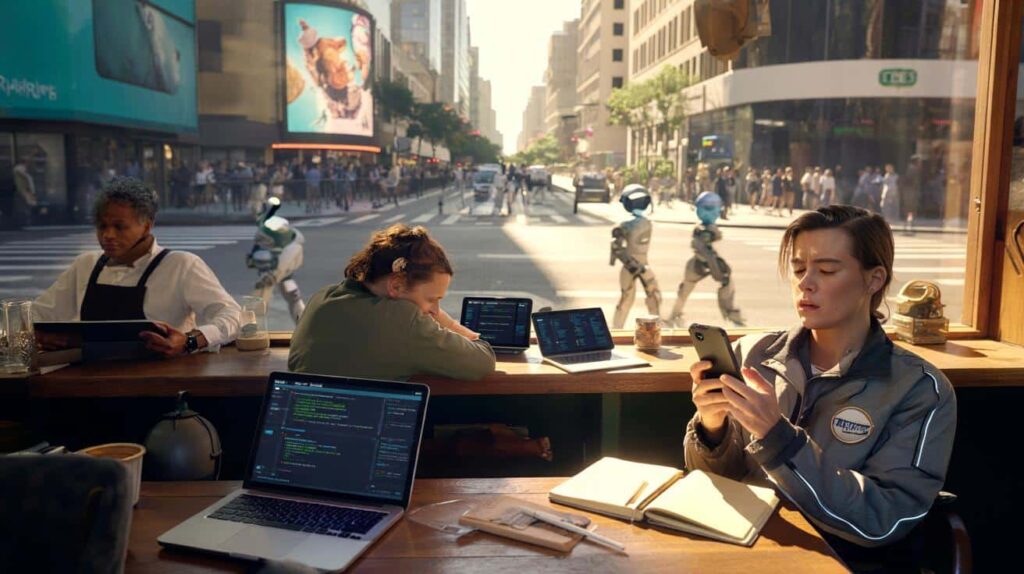
Outside, a billboard promised “Work less, live more” over a photo of a family on a beach. Inside, an exhausted barista checked the rota and sighed at the fifth split shift of the month.

Somewhere between those two pictures, a Nobel Prize winning physicist says our future really is headed toward “work less, live more” – but not in the way we expect.

A Nobel laureate quietly sides with Musk and Gates
Frank Wilczek doesn’t look like a prophet of the future. The Nobel Prize winner is known for his work in quantum chromodynamics rather than viral TED talks or bombastic tweets. Yet in recent interviews and essays he has been saying something that sounds eerily close to the techno-optimist predictions of Elon Musk and Bill Gates. His message is straightforward. He believes that artificial intelligence will transform human civilization in ways we can barely imagine. He thinks the changes will arrive faster than most people expect. He argues that we need to prepare for a world where machines can do almost everything humans can do. Wilczek is not alone in this view. Many scientists & technologists share his perspective. But his voice carries particular weight because of his credentials in fundamental physics. He understands the deep principles that govern matter and energy. He sees connections between quantum mechanics and information processing that others might miss. The physicist points to several trends that support his predictions. Computing power continues to grow at an exponential rate. Machine learning algorithms are becoming more sophisticated every year. The amount of data available for training these systems is expanding rapidly. These factors combine to create conditions for rapid advancement in artificial intelligence capabilities. He acknowledges that predicting the future is difficult. Technology often develops in unexpected directions. But he believes the basic trajectory is clear. Machines will become increasingly capable of performing tasks that currently require human intelligence. This shift will affect every aspect of society from work to education to entertainment. Wilczek emphasizes that this transformation presents both opportunities & challenges. On one hand artificial intelligence could solve problems that have plagued humanity for centuries. It might help us cure diseases or develop clean energy sources or understand the universe better. On the other hand it raises serious questions about employment and inequality & human purpose. He suggests that we need to think carefully about how we want to shape this future. The decisions we make today will influence how artificial intelligence develops and how it affects our lives. We cannot simply let technology evolve without guidance or oversight. We must actively participate in determining the direction of progress. The physicist also warns against both excessive optimism & excessive pessimism. Some people believe that artificial intelligence will automatically solve all our problems. Others fear that it will lead to catastrophe. He thinks the reality will be more complex than either extreme suggests. The outcome will depend on the choices we make as individuals and as a society.

He thinks we’re heading toward a world where there is more wealth, more capability, more automation – and fewer traditional jobs for humans. Not zero jobs. Different jobs. Less nine-to-five, more fluid work. More time that isn’t tied to a paycheck.
Manufacturing jobs have been disappearing for decades now. Back in 1960 about one in four workers in the United States and United Kingdom had manufacturing jobs. The situation looks completely different today. Robots now assemble cars on production lines while computer algorithms manage supply chains and shipping routes. Factory employment continues to decline even as factories produce more goods than ever before. The pattern is clear and consistent. Companies make more products with fewer people. Output increases while the number of human workers decreases.
Gates has discussed the idea of a robot tax for several years now. He believes that when machines replace human workers societies will need to find new methods to pay for healthcare systems and education programs and retirement benefits. Musk takes this concept further by forecasting that universal basic income will become necessary as a protective measure in an economy dominated by artificial intelligence. Wilczek speaks less publicly but shares equally bold views about where we are headed. He confirms that technological advancement is moving us toward a future of plenty that requires fewer human workers. The real challenge exists in how we manage this shift.
From a physicist’s point of view, Wilczek’s bet is almost coldly logical. When you combine exponential growth in computing power, plunging costs of energy from renewables, and AI systems that learn faster than any human team, one conclusion keeps popping up. A huge chunk of tasks we call “work” today simply don’t need people tomorrow.
He doesn’t talk like a doomer. He talks like someone describing a new phase of matter. Old social structures – jobs-for-life, single careers, rigid office hierarchies – melt under the pressure of new technologies. What replaces them is still foggy. Musk imagines colonies on Mars and armies of humanoid robots. Gates thinks about supercharged healthcare and personalized learning. Wilczek focuses on the physics: when machines do more, humans are freer to ask what time is actually worth.
Preparing yourself for more free time and less “job”
If the physicists and billionaires are even half right, one quiet skill becomes non‑negotiable: learning how to handle unstructured time. Most of us have been trained for the opposite. School bells, office calendars, meeting slots, deadlines. When those vanish or shrink, days can feel strangely empty and heavy at the same time.
According to psychology your choice of shoes can reveal surprising clues about your personality and level of confidence. Research suggests that footwear preferences often reflect deeper aspects of who we are as individuals. The shoes you wear each day might say more about you than you realize. People who prefer practical and comfortable shoes tend to value function over appearance. They often prioritize getting things done efficiently rather than making a fashion statement. These individuals typically approach life with a straightforward attitude and appreciate simplicity in their daily routines. Those who choose stylish and trendy footwear usually enjoy expressing themselves through their appearance. They tend to be more outgoing and social by nature. These people often feel energized by new experiences & like to stay current with what is popular. Individuals who wear well-maintained and polished shoes generally pay attention to details in all areas of their lives. They take pride in their appearance and often hold themselves to high standards. This careful approach usually extends beyond their wardrobe into their work and relationships. People who select bold & colorful shoes often possess creative personalities. They feel comfortable standing out from the crowd and enjoy taking risks. These individuals typically embrace change & look for opportunities to do things differently. Those who stick with classic and traditional shoe styles usually value stability & reliability. They prefer timeless choices over passing trends & often make decisions based on proven results rather than experimentation. Your footwear choices can also indicate your confidence level. People who wear shoes that match their activities and environment typically feel secure in their decisions. Those who frequently change their shoe style might be exploring different aspects of their identity. Understanding these connections between shoes and personality can help you become more aware of the messages you send through your daily choices.
➡️ France is about to learn whether it holds the world’s largest “white hydrogen” reserves in the Grand Est region
➡️ 3 protein-rich foods to protect muscle mass after 50 (without meat or cured meats)
➡️ Goodbye pressure cooker as families move toward a smarter safer appliance that automates every recipe with ease

➡️ When I Leave The House, I Put A Glass And A Sheet Of Paper In The Sink: A Simple But Smart Habit
➡️ Hairstyles after 60 are changing, as professional hairstylists say this specific haircut is now considered the most youthful and flattering
➡️ Forget Burj Khalifa and Shanghai Tower: Saudi Arabia now readies a bold 1km-tall skyscraper
➡️ Auto technicians explain why topping off your gas tank wastes money and damages your car: drivers are furious and divided
A practical way to train for this future is to carve out a small “post-job hour” in your week. One hour that is not side hustle, not chores, not doomscrolling. Use it to practice exactly what a more automated future will hand you: extra time that no one has pre-planned for you. The content matters less than the experiment.
The trap a lot of people fall into is thinking, “I’ll deal with that when the robots come for my job.” That mindset is comforting, but late. AI is already drafting emails, screening CVs, designing logos, reviewing code, and scheduling routes. The erosion doesn’t arrive with a pink slip; it arrives slowly, as fewer hours, fewer shifts, fewer calls.
We’ve all been there, that moment when your workload suddenly drops and instead of feeling relief, you feel this weird, low-level panic. What am I supposed to do now? If you wait until your schedule is cut to practice using free time in a way that feels meaningful, you’re learning to swim while you’re already in deep water. A softer, more forgiving approach is to start while the stakes are low.
Wilczek often talks about “the life of the mind” as something technology can finally afford more people. That sounds abstract until you pair it with everyday skills. Curiosity. Discipline without a boss. The ability to choose projects that won’t pay you back this week, but might reshape your life in five years.
“Work is not going away,” he has said in different forms, “but the need to work just to survive can.”
That’s a thrilling sentence on paper and a terrifying one in practice, because it shifts responsibility onto us. Nobody hands you a manual on how to live in a world where survival is less tied to labor, yet meaning still is.
- Learn one serious hobby that has nothing to do with your CV
- Test one small income stream that isn’t your main job
- Schedule one recurring block of “unproductive” time each week
- Keep one written list of things you’d do with an extra free day
- Talk once a month with someone in a job you suspect will vanish
The quiet revolution in what we call “a good life”
You can feel the tension everywhere. Governments still promise “jobs, jobs, jobs” while the biggest companies in the world pour billions into AI systems designed to remove tasks, not create them. Parents tell their kids to study hard, get a stable career, even as those careers dissolve into contracts, gigs, and project work.
Somewhere beneath all of this a fundamental question is emerging again: if staying alive requires less effort what should people actually do with their lives? Musk responds by describing ambitious plans for humanity to live on multiple planets and connect brains to computers. Gates focuses on eliminating diseases and improving how we teach students. Wilczek examines the trends in energy production and computing power and states in a calm yet confident way that eventually communities will need to separate human worth from conventional employment.
| Key point | Detail | Value for the reader |
|---|---|---|
| Shift from jobs to tasks | AI and automation break “jobs” into smaller, automatable tasks while overall output grows | Helps you see where your current role might fragment and how to future‑proof your skills |
| More free time, new pressure | Technical progress reduces necessary labor hours but increases the need for self-direction | Prepares you emotionally for less structure and more personal choice |
| Redefining a good life | Wealth may be created by machines, leaving humans to seek meaning beyond paychecks | Invites you to design your own version of success before the transition hits full force |
FAQ:
- Will AI really take most jobs?Not overnight, and not all at once. It will hollow out specific tasks first, especially repetitive, rule-based work, then gradually reshape entire roles over years rather than days.
- What kinds of work are safest?Jobs that combine human trust, complex coordination, and emotional nuance – care work, certain kinds of leadership, hands-on trades, and creative roles that steer AI rather than compete with it.
- Should I be learning to code?Coding is useful, but the deeper asset is learning how to think with software and AI: framing problems, checking outputs, and integrating tools into real-world workflows.
- How do I prepare if I’m already overwhelmed?Start ridiculously small. Ten minutes a week of intentional “future time” is better than nothing. Let’s be honest: nobody really does this every single day.
- Is universal basic income actually coming?No one can promise that. Some countries are testing versions of it, and thinkers like Musk, Gates, and Wilczek see it as plausible if automation keeps accelerating, but politics will move much slower than the tech.
