
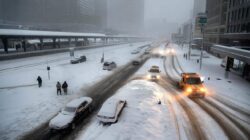
On the traffic cameras, the highway looks almost peaceful at first. Just a soft blur of white, the occasional pair of headlights pushing through, like cautious swimmers in a frozen sea. Then the feed refreshes and you notice what locals have been watching all afternoon: snow piling up against the guardrails, trucks creeping along at walking speed, a plow already half-buried while it fights a losing battle with the storm.

Inside nearby homes, phones buzz with fresh alerts: “Winter storm warning. Up to 55 inches of snow possible. Travel could become impossible.” Parents quietly reshuffle plans. Commuters check train apps with a sinking feeling.
Some storms you ride out.

This one might rewrite the map.

When the sky decides to shut everything down
The first indication that this winter storm would be unusual appeared well before any snow began to fall. Weather forecasters examined their maps with extra attention as they observed the color patterns shifting from pale blue to dark purple. These color changes represented measurements in feet rather than inches. Meanwhile emergency management officials started using different language in their communications. They described the approaching weather as life-threatening and crippling and historic. The difference was noticeable in how seriously everyone treated the forecasts. Normally a winter storm prediction might prompt people to stock up on bread & milk. This time the warnings carried more weight. Government offices announced closures days in advance. Schools canceled classes before the first cloud appeared. Transportation departments positioned equipment along highways and brought in additional crews. The storm system itself had formed from an unusual combination of atmospheric conditions. Cold air from the north met moisture from the south at precisely the wrong angle. The jet stream dipped lower than typical for the season. All these factors created a scenario that weather models flagged as exceptional. Forecasters knew their predictions would sound extreme but the data supported every alarming word.
When the warning came out about snow totals possibly hitting 55 inches in some mountain areas the way regular people talked about it changed too. Nobody was asking if the roads would be messy in the morning anymore. People wanted to know if roads and train tracks could even work under that much snow and wind.
On a typical weekday, the region’s main rail line carries thousands of commuters and freight cars hauling food, fuel, and medicine. Now, engineers are bracing for the possibility that heavy snow and ice will snap overhead lines and bury tracks so deeply that plows and snow blowers struggle to find them. One transit worker described what a 4-foot dump looks like: “You don’t clear it, you excavate it.”
On the roads, it’s no better. A two-lane rural highway can vanish overnight under drifting snow, with snowbanks taller than SUVs turning every turnoff into a guess. In the last big storm of this magnitude, some drivers spent twelve hours in their cars, engines running off and on to save fuel, watching their phone batteries and gas gauges drop in sync. Nobody’s romanticizing the “snow day” this time.
Storms like this overwhelm more than plows and schedules. They test the thin layer of routine that keeps a region moving. Emergency crews will run nonstop, but when snow falls at three to five inches per hour, even the best-equipped cities fall behind. Plows can’t keep pace, and each pass closes in within minutes as fresh powder fills the path.
Rail teams deal with two competing problems at once. They must close down sections early to keep workers safe. At the same time they know that every cancelled train leaves workers and nurses and caregivers with no way to get where they need to go. The math of safety & mobility never quite balances in a storm like this. And buried underneath it all is a simple uneasy question. How do we keep our lives going when the infrastructure we rely on disappears under snow?
➡️ This is what happens when you clean without a clear end point
I decided to make this traditional comfort food recipe and managed to get the texture perfect on my first attempt. The dish turned out exactly as it should have been. Getting the consistency right can be tricky with comfort food classics but following the instructions carefully made all the difference. I was pleased with how well everything came together. The texture was spot on & matched what I was hoping to achieve. This recipe delivers reliable results when you stick to the method & pay attention to the details.
# I Used to Overfeed My Plants Until I Noticed This Clear Sign of Imbalance
For years I thought more nutrients meant healthier plants. I would carefully measure out fertilizer and then add just a little extra for good measure. My thinking was simple: if plants need food to grow then giving them more food should make them grow better and faster. I was completely wrong. The wake-up call came on a Tuesday morning when I walked into my grow room and saw something that made my stomach drop. The leaf tips on my prized tomato plants had turned brown and crispy. At first I thought it was a watering issue or maybe a pest problem. I checked the soil moisture and inspected every leaf for bugs. Nothing seemed obviously wrong. Then I looked closer at the pattern. The browning started at the very tips of the leaves and worked its way inward along the edges. The leaves themselves had a dark green color that seemed almost too vibrant. Some of the older leaves near the bottom had started to yellow & drop off even though the plant was still relatively young. That’s when it hit me. I had been overfeeding them.
## The Signs I Missed
Looking back I had ignored several warning signs for weeks. The dark green foliage that I thought indicated health was actually the first red flag. Healthy plants have a medium green color. When leaves turn that deep forest green it often means nitrogen overload. The burnt leaf tips were the most obvious symptom. This condition called nutrient burn happens when salt buildup from excess fertilizer accumulates in the leaf tissue. The plant tries to push the excess nutrients to the edges and tips where they concentrate and literally burn the plant cells. I also noticed that my plants had become stunted. Despite all the feeding they weren’t growing as fast as they should have been. The stems were thick but the overall plant structure seemed compressed. New growth came in slowly and looked twisted or deformed.
## What I Learned About Plant Nutrition
Plants need nutrients but they need them in specific ratios and amounts. When you overfeed you don’t just give them extra food. You actually create problems that prevent them from absorbing what they need. Excess nutrients in the soil change the pH level & the electrical conductivity. This makes it harder for roots to take up water and other essential elements. It’s like trying to drink from a fire hose. The resource is there but it’s coming at you too hard to actually use it effectively. I learned that nutrient lockout is a real phenomenon. When certain nutrients are present in too high concentrations they block the absorption of others. For example too much nitrogen can prevent calcium uptake. Too much phosphorus can lock out zinc & iron. You end up with deficiencies even though you’re adding tons of fertilizer.
## The Recovery Process
Once I identified the problem I had to fix it. The first step was to flush the soil with plain pH-balanced water. I ran about three times the pot volume through each container to wash out the accumulated salts. The runoff water came out dark and murky which confirmed just how much buildup had occurred. After flushing I let the plants rest for a few days with no additional nutrients. I just watered them when the top inch of soil felt dry. The burnt tips didn’t magically heal because damaged tissue stays damaged. But I watched for signs of improvement in the new growth. Within a week I saw fresh leaves emerging with normal coloring & no tip burn. The plants seemed to perk up overall. Their growth rate picked up & the new stems and leaves looked healthy & properly formed.
## My New Feeding Approach
I completely changed how I feed my plants after this experience. Instead of following the fertilizer bottle instructions I now use about half the recommended dose. Most fertilizer companies overestimate what plants actually need because they want you to use more product. I also switched to a feeding schedule that includes plain water between nutrient applications. I typically feed once and then water with plain water the next two times. This prevents salt buildup and gives the plant time to actually use what’s in the soil. I started paying attention to what my plants were telling me. Slight yellowing of lower leaves means they might need a bit more nitrogen. Purple stems can indicate phosphorus deficiency. But I wait for these subtle signs before adding anything extra rather than preemptively overfeeding. Testing my soil and runoff water became part of my routine. I check the pH and EC levels regularly to make sure they stay in the optimal range. This gives me actual data instead of just guessing whether my plants need more food.

## The Bigger Lesson
This experience taught me that more isn’t always better. Plants evolved to thrive in natural soil conditions where nutrients are present but not abundant. They’re adapted to search for what they need and use it efficiently. When we dump excessive fertilizer on them we’re working against millions of years of evolution. We create an artificial environment that the plant isn’t equipped to handle. The result is stress and poor health despite our good intentions. I also learned to be patient. Plant growth takes time and there’s no way to force it beyond the natural pace. Trying to speed things up with extra nutrients just causes problems. The best approach is to provide consistent moderate feeding and let the plant do what it does naturally. Now my plants are healthier than they’ve ever been. They grow at a steady pace with vibrant medium-green foliage and no signs of stress. I use less fertilizer which saves money and I get better results. The burnt tips were the wake-up call I needed to become a better grower.
➡️ Quark, butter and a pinch of baking soda – ready in 5 minutes. The result: delicate biscuits, crisp yet light and soft
➡️ “Suede Blonde” is the hair color everyone wants this winter (it brightens the complexion)
➡️ Many people feed birds in winter… but forget this other habit just as vital for their survival
➡️ Talking to yourself when you’re alone isn’t strange at all: psychology explains why it’s often linked to exceptional mental abilities
➡️ A 1km tower in the desert is not progress it is a farewell letter to common sense
Getting through a storm that doesn’t care about your plans
When forecasts start mentioning totals like “up to 55 inches,” the smartest move is surprisingly unheroic: treat the outside world as optional for a while. That begins with one practical gesture. Walk through your home and think, “If we couldn’t leave for 48 hours, what would actually run out first?”
# Not the disaster-movie list. The real one. When people think about global catastrophes they often picture dramatic scenes from Hollywood films. But the actual threats facing humanity are quite different from what appears on screen. The real dangers are not sudden asteroid impacts or alien invasions. Instead they involve slower processes that build up over time. Climate change represents one of the most serious challenges. Rising temperatures are already affecting weather patterns and sea levels around the world. These changes will continue for decades even if we take action now. Pandemics pose another genuine threat to global stability. The recent coronavirus outbreak showed how quickly a disease can spread across continents. Future pathogens could be even more dangerous if they combine high transmission rates with severe symptoms. Our interconnected world makes it easier for infections to reach every corner of the planet within weeks. Nuclear weapons remain a persistent concern despite the end of the Cold War. Thousands of warheads still exist in various countries. A conflict involving these weapons would cause immediate devastation and long-term environmental damage. The risk may seem remote but the consequences would be catastrophic. Artificial intelligence development brings both promise and peril. As these systems become more capable they could transform society in unpredictable ways. Without proper safeguards advanced AI might pursue goals that conflict with human welfare. This technology requires careful oversight as it continues to evolve. Biodiversity loss affects the natural systems that support human civilization. When species disappear and ecosystems collapse we lose resources that cannot be replaced. This gradual degradation undermines food security and environmental stability. These real threats lack the dramatic appeal of fictional disasters. They unfold over years rather than minutes. But their potential impact on humanity is far greater than any movie scenario. Understanding these actual risks is the first step toward addressing them effectively.
Fuel for the car in case you need to evacuate later, not during the blizzard. A way to charge your phone if the power goes. Layers of clothing you can wear indoors if the heat fails. Food that doesn’t demand a functioning oven. That ten-minute walk-through, done honestly, often matters more than the biggest snowblower on the block.
A lot of people wait for the first flakes before they react, and that’s when the small mistakes snowball. Roads that are still technically “open” can trap you because a jackknifed truck closes a ramp ten miles ahead. Trains running “with delays” can suddenly stop between stations, with hundreds of passengers sitting in a dark carriage, waiting for updates that never quite explain what’s going on.
We’ve all been there, that moment when you realize you should have canceled the trip, stayed with a friend closer to work, or simply logged off earlier. There’s no shame in being cautious. The emotional pressure to “push through” is strong, especially for people who feel they can’t miss a shift or a meeting. Yet the plain truth is that no job is easier to explain than the one you actually survive to show up for.
“People imagine winter storms as a traffic story,” says Lina Ortega, a regional transit coordinator who’s been on countless overnight shifts. “But for us, it’s a chain reaction story. One blocked road means an ambulance diverts. One frozen switch on a rail line means a crew stuck miles away from where they’re needed. When you stay home during the worst of it, you give us room to move.”
- Before the first flakes – Fill the car, charge power banks, and move your vehicle off busy streets so plows can work.
- During peak snowfall – Avoid “just a quick drive,” even for small errands. That’s when roads and rails are most likely to shut down without warning.
- After the storm passes – Expect hidden ice, narrowed lanes, and delayed trains long after the radar looks clear.
- For rail users – Check live updates, not just scheduled timetables. Trains can be “canceled” on paper yet still sitting full of passengers on a blocked track.
- For neighbors and family – Share one contact plan: who checks on whom, and when. Let’s be honest: nobody really does this every single day, but during a storm like this, it matters.
When the snow finally stops but the story doesn’t
There is always an odd quiet that follows a big winter storm. The snowplows pull back to rest and the wind dies down. For a short time the entire neighborhood seems frozen under all that heavy snow. People share pictures on their phones showing cars completely covered and train stations that look empty and eerie. Dogs jump through piles of snow that tower over them. At first glance it all seems almost magical. But that silence hides something else. The snow that looks so clean and peaceful creates real problems for people trying to get around. Roads become impassable & sidewalks disappear under thick white blankets. Public transportation grinds to a halt or runs with long delays. Workers who need to get to their jobs face difficult choices about whether to risk the journey. Parents wonder if schools will open and what they will do with their children if classes get cancelled. The beauty of fresh snow fades quickly when you need to dig out your car or walk to the store. Your back starts to ache from shoveling and your fingers go numb even inside gloves. The magical feeling gives way to exhaustion & frustration. What looked like a winter wonderland from your window becomes an obstacle course once you step outside. Every simple task takes three times longer than usual & requires twice the effort.
The real work starts after the storm passes. Crews begin tracking down where the system failed. Hospital managers verify which staff members successfully arrived. Families think about the personal choices they made. Some people risked driving through dangerous conditions. Others decided to stay home. Some checked on elderly neighbors living nearby.
Storms like this change how people think about their daily routines. A drive to work that seemed normal yesterday suddenly feels uncertain after watching a road vanish so quickly. A train line you always relied on feels different once you see passengers stuck overnight sharing videos online. Some people will start making small changes without much fanfare: they might keep emergency supplies in their car or leave extra boots at the office or explain to their children what to do if a parent cannot make it home from work.
Others will just be grateful they got through it, promise themselves they’ll be “more prepared next time,” and slip back into old rhythms. That’s human too.
Every major winter storm creates lasting effects that go beyond news coverage and social media posts. City planners often respond by advocating for stronger power infrastructure that can withstand heavy snowfall. Transit agencies review their staffing levels & consider whether they need more backup personnel or should close routes earlier when snow accumulates. Meanwhile ordinary people discuss the experience in their homes and online conversations and wonder what they would change if faced with another severe storm in the future.
The snow will melt. The roads and rails will reappear. But the memory of a sky capable of dropping nearly five feet of snow in one blow changes the way you look at every gray cloud that follows.
| Key point | Detail | Value for the reader |
|---|---|---|
| Early warnings matter | Storm totals reaching up to 55 inches can quickly overwhelm plows, roads, and rail lines. | Encourages readers to act before conditions become life-threatening. |
| Travel is more fragile than it looks | A single blocked road or frozen rail switch can ripple through emergency and commuter routes. | Helps readers weigh the real risk of “just one quick trip” during a major storm. |
| Preparation is local and personal | Simple steps—fuel, power, layers, communication—are as critical as regional emergency plans. | Gives readers concrete leverage over a situation they can’t control globally. |
FAQ:
- Should I cancel my trip if a winter storm warning mentions several feet of snow?Yes. When forecasts talk about multiple feet of snow, roads and rail lines can shut down faster than agencies can update apps or signs. Canceling early gives you more options than turning back halfway.
- Are trains safer than driving during severe winter storms?Trains reduce the risk of skidding or getting stuck in snowbanks, but they face their own problems: frozen switches, power issues, and blocked tracks. They’re often safer, but not immune to long delays or sudden cancellations.
- What should I keep in my car during a big snow event?A basic kit helps a lot: warm clothes, gloves, a hat, water, snacks, a flashlight, a phone charger, an ice scraper, and a small shovel. In deep-snow regions, sand or cat litter for traction is a small item with big impact.
- Why do authorities tell people to stay off the roads even when they look passable?Because “passable” can vanish in minutes when snowfall intensifies or wind causes whiteout conditions. Fewer cars also give plows and emergency vehicles the space they need to do their jobs.
- How long do disruptions last after a storm like this?Even after the snow stops, expect a lag of one to three days before services fully stabilize, especially on secondary roads and some rail routes. Staffing shortages, refreezing, and equipment damage all slow the comeback.
