
The first sign wasn’t the snow. It was the silence. By late Friday afternoon, the usual hum of traffic on the highway had thinned to a nervous trickle, grocery carts were rattling faster than usual, and people kept glancing up at a sky that looked heavy enough to fall. Phones buzzed with push alerts: winter storm warning, up to 60 inches of snow possible, blizzard conditions, travel “nearly impossible.”

Inside the gas station on the edge of town, the line for the last working pump snaked past the coffee machines. A tired clerk taped a handwritten sign on the door: “No more ice. Sold out.”
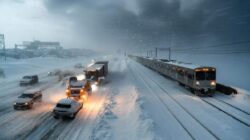
Outside, a gust of wind sent the first dry flakes spinning across the parking lot.
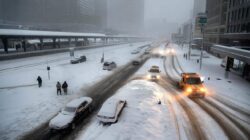
Up to 60 inches of snow: what this weekend really looks like
Meteorologists are describing this storm with language they typically reserve for historic weather events. Terms like crippling snowfall & life-threatening travel conditions are now part of the current forecast. A major winter storm is moving through the area & weather models show consistent predictions about what is coming. The snow will accumulate to significant depths and will continue falling for an extended period. Certain elevated areas and regions known for heavy snow could see accumulations approaching 60 inches by Monday morning.

Wind gusts over 40 mph are expected to whip those totals into drifts that could bury cars and block front doors. What looks like a gentle snowfall from your window can become a white wall once you step outside. The margin between adventure and danger shrinks fast in that kind of whiteout.
For many people this is not something they see on a weather map. It is something they experience right outside their home. Imagine a family living in a quiet neighborhood on the edge of Buffalo or close to the mountain communities in the Sierra Nevada. On Friday their driveway is clear and damp. By Saturday night the pile of snow at the end reaches up to their shoulders. By Sunday it towers above the mailbox.
Snowplows will work nonstop but they cannot cover every street at the same time. When snow falls at a rate of 2 to 3 inches per hour the smaller roads might not see a plow for half a day or longer. Forecasters are warning that this storm could dump snow at exactly that speed. This is the type of snowfall where you clear your front steps & walk inside to grab a coffee. By the time you come back outside your footprints have already disappeared under fresh snow.
The physics behind this storm are as intense as the headlines. A deep low-pressure system is pulling in moisture from the south and slamming it into bitter Arctic air dropping from the north. Where those collide, the atmosphere turns into a snow factory. Cold air squeezes water vapor into dense, heavy flakes, and the storm’s slow movement means it keeps dumping over the same spots instead of racing east.
That’s why meteorologists are less focused on the exact number of inches and more on the length of the hit — hour after hour of snow piled on top of already frozen ground. When roads turn to compacted ice under fresh powder, the usual tricks and confident driving just don’t work anymore.
➡️ Aluminum foil in the freezer: the simple household hack that’s winning over more and more families
➡️ Legendary rock band retires after 50 years “the hit everyone knows”
I only learned this at 60: the surprising truth about the difference between white and brown eggs that most people never hear about
For most of my life I believed that brown eggs were somehow healthier than white ones. I thought they came from special chickens that lived better lives or ate better food. Many people in the grocery store seem to think the same way because brown eggs usually cost more money. But when I finally learned the real reason behind the color difference I felt a bit foolish for not knowing sooner. The truth is actually very simple. The color of an eggshell depends entirely on the breed of chicken that laid it. White chickens with white earlobes typically lay white eggs. Chickens with red or brown earlobes usually lay brown eggs. That is the only difference. The color has nothing to do with nutrition or quality or how the chicken was raised. I discovered this fact during a conversation with a farmer at a local market. He explained that the brown pigment gets deposited on the shell during the final hours before the egg is laid. The inside of all eggs starts out white. Some breeds just add that extra coating of color on the outside. When I got home I did some research to confirm what he told me. Every source said the same thing. Nutritionally speaking white and brown eggs are identical. They have the same amount of protein and the same vitamins and minerals. The only things that actually affect the nutrition in an egg are what the chicken eats and how it lives. This means that if you want healthier eggs you should look for labels like organic or free-range rather than focusing on shell color. Those terms tell you something about how the chicken was raised. The color of the shell tells you nothing except what breed of chicken laid it. I also learned that some chickens lay eggs in other colors too. There are breeds that produce blue or green eggs. One breed called the Araucana lays beautiful blue eggs because of a pigment that goes all the way through the shell. These colorful eggs are fun to look at but they are not any different nutritionally either. The reason brown eggs cost more has nothing to do with them being better. Brown egg laying hens are often larger breeds that eat more food. This makes them more expensive to raise. Farmers pass that cost along to customers. The higher price is about economics rather than quality. Looking back I realize how many years I spent paying extra for brown eggs without any good reason. I chose them because I assumed they were superior. Marketing & packaging often suggest that brown eggs are more natural or wholesome. But this is just clever advertising that takes advantage of common misconceptions. Now when I shop for eggs I ignore the color completely. Instead I read the labels carefully to understand how the chickens were treated and what they were fed. I look for eggs from chickens that had access to the outdoors and ate a varied diet. Those factors actually matter for the quality of the egg. It is interesting how something so simple can be misunderstood by so many people for so long. The color of an eggshell is just a superficial trait like the color of a flower. It does not indicate anything about what is inside. Yet millions of shoppers make purchasing decisions based on this meaningless difference every single day. I wish I had learned this information decades ago. It would have saved me money and helped me make better choices. But I am glad I know now. And I make sure to share this knowledge with friends and family whenever the topic comes up. Most people are just as surprised as I was to learn the truth. The next time you stand in front of the egg section at the store remember that the color means nothing. Choose your eggs based on what actually matters & save yourself some money in the process.
Heavy snow is expected to start falling tonight. Authorities are telling drivers to stay home. At the same time businesses are trying to maintain their regular operations. Weather officials predict significant snowfall beginning late this evening. Local authorities have issued warnings asking people to avoid driving unless absolutely necessary. Meanwhile business owners are working to keep their companies running normally despite the challenging weather conditions. The conflicting priorities create a difficult situation. Government officials prioritize public safety and want to reduce traffic on dangerous roads. Business leaders worry about lost revenue and disrupted schedules if employees cannot make it to work. Transportation departments are preparing snow removal equipment and planning emergency response routes. Some companies have already announced remote work options for employees. Others insist that staff report to physical locations as usual. Schools have not yet announced closures but administrators are monitoring the forecast closely. Grocery stores report increased customer traffic as residents stock up on supplies before the storm arrives. Gas stations are also seeing longer lines than normal. Emergency services remain on standby. Hospitals have called in extra staff to ensure adequate coverage during the storm. Power companies have crews ready to respond to potential outages caused by heavy snow and ice accumulation on power lines. The National Weather Service predicts accumulation between eight and fourteen inches depending on location. Higher elevations may see even more snow. Temperatures will drop significantly making road conditions particularly hazardous. Residents are advised to prepare emergency kits with flashlights batteries, water and non-perishable food. People should also check on elderly neighbors who may need assistance. Pet owners should bring animals indoors and ensure they have adequate shelter. The storm system is moving in from the west and should reach the area by midnight. Snow will continue through tomorrow morning before tapering off in the afternoon. Winds may create blowing snow that reduces visibility on roadways.
➡️ Scientists warn of catastrophic climate tipping point this decade and why many still refuse to change anything
➡️ Meteorologists warn early February Arctic anomalies could threaten species already under climate pressure

➡️ Bad news for city gardeners hoping for free pest control: expert warns winter freeze may kill helpful insects but spare invasive pests – a forecast that splits opinions
➡️ Why brown rice takes longer to cook and still feels firm
Travel and power: how to get through a weekend that won’t play nice
If you’re planning to travel this weekend, the smartest move might be the simplest: don’t. Airlines are already posting waivers and preemptive cancellations for airports squarely in the storm’s path. Highway crews are bluntly saying that some stretches could be closed for hours, maybe longer, when the worst of the whiteout hits.
So the practical move is to reset your expectations today. Move that Sunday drive to Friday night or cancel it outright. Top off your gas tank, charge your phone, and park your car facing the street so it’s easier to dig out. Lay out a “go bag” by the door — boots, gloves, a flashlight — so if you do need to step out into the chaos, you’re not scrambling in a dark closet.
We’ve all been there, that moment when you tell yourself, “It’s just snow, I’ve driven in worse.” That’s how people get stuck three miles from home with spinning tires and no cell signal. The common mistake is not arrogance, it’s familiarity: you know these roads, you know this town, so the warnings feel exaggerated.
Let’s be honest: nobody really checks their emergency kit every single day. Batteries die, snacks get eaten, flashlights wander off. If this storm hits as hard as predicted, small oversights become big problems very fast. Take ten minutes now to walk through your home — candles, matches, blankets, phone chargers, medications, pet food. That quiet checklist now is worth more than bravado later.
“People don’t panic when we say ‘snow,’” one emergency manager told local radio on Thursday. “They only panic when the lights go out and they realize their phone is at 8%, the oven doesn’t work, and the house is getting colder by the hour.”
- Build a 48-hour buffer
Two days’ worth of water, food that doesn’t need cooking, baby supplies, and pet care. Not a bunker, just a cushion. - Think layers, not heroics
Warm base layers, wool socks, hats and gloves for everyone in the house. *One lost glove is not a small thing when it’s -5°F in the wind.* - Protect your power lifelines
Charge all devices, including portable power banks. If you have a generator, test it in daylight, outside, far from any open window. - Plan for boredom, not just survival
Board games, downloaded shows, books you’ve been meaning to read. Long outages feel longer when you’re staring at a blank wall. - Check on one other person
An older neighbor, a friend who lives alone, someone new on your block. A quick knock or text can change how someone rides out the storm.
After the snow: what a 60-inch weekend leaves behind
When the last flakes finally drift down and the radar quiets, the story of this storm won’t just be “record-breaking totals.” It will be the hundreds of tiny scenes scattered across the region: the nurse who slept on a hospital cot for two nights, the snowplow driver on a 14-hour shift, the family cooking pancakes on a camping stove, the neighbor who showed up unasked with a shovel.
A weekend like this rewrites the rhythm of a place. Kids will remember the muffled silence of streets with no cars, the strange twilight glow that comes when snowbanks are higher than they are. Parents will remember long hours watching the weather app, counting charge percentages on their phones, and mentally mapping the nearest open gas station. Some will also remember the people who called, or didn’t.
The forecast maps will vanish from your screen by next week & new headlines and alerts will take their place. The snow will remain much longer though. It will slowly melt into gray piles at the corners of parking lots and drip from gutters. It will compress into dense slabs that change commutes and delivery routes & school days.
There’s a quiet lesson buried under those 60 inches. These storms expose which systems bend and which ones snap — the fragile power grid, the understaffed road crews, the healthcare workers stretched so thin. They also show, in smaller, less dramatic ways, how communities flex: who shares their generator, who clears the sidewalk beyond their own property line, who knocks, once the wind dies down, just to ask, “You okay in there?”
Maybe that’s what really matters this weekend. Not just how much snow falls or the videos of buried cars going viral online but the decisions we make in the small space around us that we can actually affect. The grocery trip for someone who cannot drive. The choice to stay home instead of attempting one more unnecessary trip. The understanding that your road will not get plowed immediately because someone else needed help first.
This storm will pass. The power will come back, the plows will catch up, the headlines will shift. What lingers is the story we tell ourselves afterward about how prepared we were, how we handled the fear and the boredom, how we treated the people standing right next to us in the checkout line when the shelves started to look empty. That’s the part no forecast can predict — and the part that’s still completely up to us.
| Key point | Detail | Value for the reader |
|---|---|---|
| Storm intensity | Up to 60 inches of snow, high winds, whiteout conditions, long-duration event | Helps gauge real risk level and decide whether to cancel or delay travel plans |
| Practical preparation | 48-hour supplies, charged devices, layered clothing, checked neighbors | Turns vague anxiety into clear actions that increase comfort and safety |
| Aftermath mindset | Expect slow cleanup, lingering disruptions, and opportunities for mutual help | Reduces frustration and encourages more resilient, community-focused responses |
FAQ:
- Question 1How bad does a storm have to be for officials to call travel “nearly impossible”?
- Question 2What’s the safest place to be in my home during a major winter storm and power outage?
- Question 3How far in advance do airlines usually cancel flights for a blizzard-level event?
- Question 4Is it safe to run my car for heat if I get stuck in deep snow on the road?
- Question 5How long can food stay safe in the fridge and freezer if the power goes out during the storm?
