
On a cold spring morning outside Poltava, in central Ukraine, a farmer climbs down from his tractor and sinks his hand straight into the ground. The soil crumbles like chocolate cake between his fingers, black and slightly shiny, leaving a dark stain on his palm. He smiles, almost shyly, as if he’s just shown you a family secret rather than a field. This is chernozem – “black earth” – the stuff that has fed empires and started arguments in war rooms.
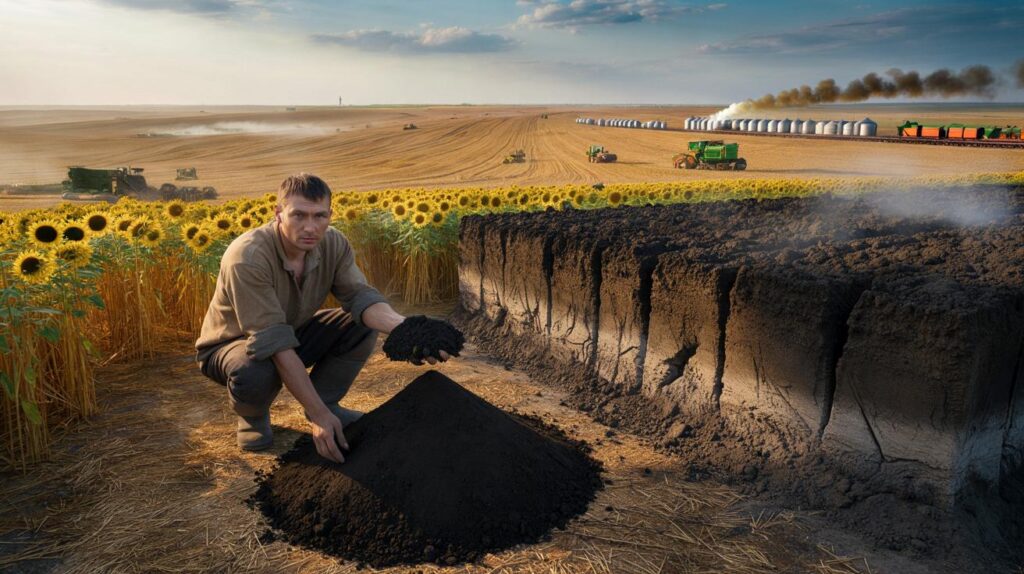
A lark whistles somewhere above the flat horizon. Grain silos glint in the distance. The farmer wipes his hand on his trousers and says, half-joking, half-serious: “This is our oil.”
 I haven’t used a compost bin since learning this technique – and my garden has never looked better
He’s not exaggerating.

This soil is power.
 Why are so many vets taking their own lives? “When an animal is put down, people get angry with us”
Where the earth itself looks rich
Stand on a chernozem field at sunset and you notice something odd: the ground seems darker than the shadows. The top layer, sometimes a full meter deep, is almost velvety, rich with humus and organic matter. When it rains, the water doesn’t sit on the surface for long. It disappears slowly downward, held inside this black sponge of minerals, roots and microscopic life.
For wheat, barley, corn and sunflowers, it’s like living permanently in a gourmet restaurant. Nutrients are not just present, they’re abundant and accessible. This is why agronomists call it the **“black gold of agriculture.”**
On paper, the numbers sound dry. Chernozem can hold up to 15% organic matter, several times more than many European or American soils. Yields of wheat on these lands, under good conditions, can hit 6–8 tons per hectare without absurd amounts of fertilizer.
But walk through a village in southern Russia or northern Kazakhstan during harvest and the statistics turn into something else. There are trucks lined up at dawn on dusty roads, queues at grain elevators, and a low hum of dryers working through the night. You smell the raw grain smell in the air, like warm bread and dust. All this starts with that dark, quiet layer under your boots.
Geologists say chernozem was born over thousands of years on grass steppes, where every season plants grew, died and decomposed in place. Layer after layer, roots and stems broke down and were buried, building a deep reservoir of carbon and nutrients. Cold winters slowed decomposition just enough to preserve the richness.
This slow-motion accumulation turned the heartlands of Ukraine, Russia and Kazakhstan into one of the planet’s largest breadbaskets. *Soil became destiny.* When railways arrived in the 19th century, grain exports exploded. Today, the same black earth is a strategic resource that shapes food prices in Cairo, Lagos and Beijing.
The invisible asset behind bread and geopolitics
From a satellite view, the “chernozem belt” looks like a dark arc stretching from Eastern Europe across southern Russia into northern Kazakhstan. But on the ground, it feels more like a giant, fragile engine. One that runs almost silently, season after season.
For farmers, the daily “method” is surprisingly simple: do everything you can to disturb this engine as little as possible. Many have shifted to minimal or no-till practices, leaving crop residues on the surface to protect structure and moisture. They rotate crops – wheat, then sunflower, then corn or legumes – to avoid draining the same nutrients year after year. The goal is not to squeeze the soil dry, but to keep it productive for decades.
 Many people feed birds in winter… but forget this other habit just as vital for their survival
The temptation to push too hard is real. When grain prices jump or when sanctions and war squeeze margins, the short-term logic is brutal: plow deeper, plant every available hectare, spray more, harvest more. On the surface, it works. For a few seasons, yields rise, debts shrink, new machinery appears in the yard.
Then the cracks show. Erosion strips away the finest particles. Organic matter drops. Fields that once held moisture like a sponge start drying out in hot winds. We’ve all been there, that moment when the urgent wins over the wise. In agriculture, the cost of that moment is measured in generations.
“People fight for oil, but they forget that without soil, oil doesn’t feed you,” a Ukrainian agronomist told me last year. “You can’t rebuild chernozem in a human lifetime. Lose it once, and you’ve burned a bridge back to history.”
- What makes chernozem specialHigh organic matter, deep dark layer, strong structure, excellent moisture retention.
- Where it’s foundMainly in Ukraine, southern Russia, parts of Kazakhstan, plus smaller pockets in Central Europe, China, and North America.
- Why the world caresThese regions export huge volumes of wheat, corn and sunflower oil, anchoring global food security.
- What threatens itIntensive plowing, monoculture, climate change, and damage from armed conflict and heavy machinery.
- What can protect itCrop rotation, reduced tillage, cover crops, and policies that treat soil as a strategic resource, not an endless free input.
When “black gold” meets a warming, unstable world
So what happens when this legendary soil collides with droughts, heat waves and war? The answer is unfolding right now across Eastern Europe and Central Asia. Recent summers have brought searing temperatures to parts of Kazakhstan and southern Russia, stressing even deep-rooted crops. Rainfall patterns shift, downpours hit harder and faster, washing away unprotected topsoil.
At the same time, front lines in Ukraine cut through some of the richest chernozem on Earth. Fields are mined, craters pockmark pastures, shelling compacts the land with shock waves and heavy vehicles. Nobody has a neat protocol for “how to heal bombed black earth,” yet local agronomists are already trying: deep ripping where possible, re-seeding grasses, testing for toxins.
For global consumers, all this usually shows up as one thing: prices. A heatwave in Volgograd or a blocked port on the Black Sea sounds far away until the cost of bread, noodles or animal feed climbs on the other side of the world. The chernozem belt quietly anchors a big slice of world grain exports, especially wheat and sunflower oil.
Let’s be honest: nobody really tracks soil reports from Odesa or Rostov every single day. We only notice when supermarket shelves change. Yet beneath that delay, decisions about plowing depth, seed varieties and land policy keep echoing through global trade, month after month.
There’s a plain truth hiding here: soil has become a strategic asset, even if we rarely name it that way. Energy ministers sign gas deals; defense ministers talk corridors and borders; agricultural ministers argue over quotas and subsidies. Beneath all of them lies the silent variable: how much living, functioning black earth is left, and in what condition.
For the farmers walking those fields, the question is both grand and intimate. Do they treat chernozem like a bank account to be emptied, or like an inheritance to pass on? The answer won’t just shape yields for next season. It will influence whether the planet’s “black gold of agriculture” remains a gift – or turns into another story about something we only learned to value once it was almost gone.
| Key point | Detail | Value for the reader |
|---|---|---|
| What chernozem is | Exceptionally fertile “black earth” with deep humus layers up to 1 meter | Helps you understand why Ukraine, Russia and Kazakhstan dominate grain exports |
| Why it matters geopolitically | These soils underpin huge shares of global wheat, corn and sunflower oil trade | Shows how faraway fields affect food prices and stability where you live |
| What threatens it | Intensive farming, climate stress and war-related damage to soil structure | Highlights the urgency of protecting soil as a long-term, non-renewable resource |
FAQ:
- Question 1What exactly is chernozem soil made of?Chernozem is a mix of mineral particles and a very high share of decomposed organic matter, plus calcium, phosphorus and other nutrients. Its deep black color comes from centuries of accumulated plant residues.
- Question 2Why is chernozem called “black gold of agriculture”?Because it delivers high yields with relatively low inputs and is extremely hard to “recreate” once degraded. For farming economies, it can be as valuable as oil or gas.
- Question 3Which countries have the largest chernozem areas?The biggest continuous zones are in Ukraine, southern Russia and northern Kazakhstan, with smaller pockets in countries like Hungary, Romania, parts of China and North America.
- Question 4Can degraded chernozem be restored?It can be improved, but not quickly. Building back organic matter and structure can take decades of careful crop rotation, reduced tillage and cover crops, and some losses are irreversible.
- Question 5How does this affect my daily life if I’m not a farmer?These soils influence the price and availability of products like bread, pasta, vegetable oil, meat and dairy. Shocks in the chernozem belt ripple through global food markets and end up in your shopping basket.
