
The bus windows fogged as dawn crept over Inner Mongolia, soft pink light smearing across a landscape that looked almost post‑apocalyptic. On one side, dunes rippled to the horizon, cut by the ghostly skeletons of dead poplars. On the other, a sudden, startling band of green: young trees planted in ruler‑straight lines, each wrapped in plastic like a patient fresh from surgery.
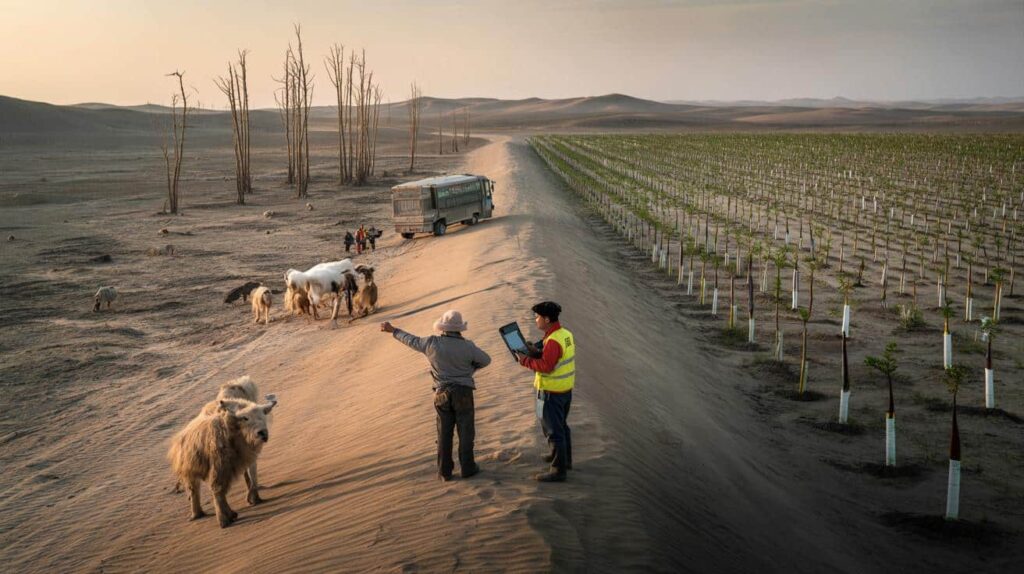
The driver slowed down, almost proudly. “All new,” he said, gesturing to the saplings marching into the dust. “We stop the sand.”

Somewhere between his quiet pride and the silence of the dying trees behind us, the real story of China’s billion‑tree gamble hangs in the air.

And nobody agrees on how this ends.
 It’s confirmed Up to 30 cm of snow : here is the list of states and, most importantly, when
When a desert turns green… on paper
From space, northern China looks like a miracle in progress. Satellite images show a pale yellow belt slowly edged by green, as forests and shelterbelts snake along the advancing deserts of the Gobi and beyond. Chinese leaders like to call it the “Great Green Wall”, a living barrier stretching thousands of kilometers.
On the ground, the story is messier. Some areas near Beijing and in parts of Inner Mongolia look undeniably transformed: fewer sandstorms, more shrubs and trees, fields no longer swallowed by dunes overnight. People talk about being able to hang laundry outside again in spring.
Still, walk a little further from the roads, and the cracks in the success story begin to show.
In the village of Wushen Banner, a herder named Li points to a line of brittle pines, their needles browned, leaning like tired soldiers. Ten years ago, a state‑backed planting team came through, dug pits, and dropped in thousands of saplings.
Everyone posed for photos. Local TV ran glowing segments. The county hit its annual target in just a few weeks.
Today, half those trees are dead. The survivors cling on, stunted, their roots fighting for moisture in sandy soil that never really wanted them. A few kilometers away, native shrubs and hardy grasses, left alone, are quietly doing better than the imported pine and poplar plantations that looked so impressive in project proposals.
This is the uncomfortable tension at the heart of China’s tree‑planting spectacle. On slides and in speeches, the numbers sound heroic: billions of trees, tens of millions of hectares “greened”, one of the world’s largest ecological projects by any measure.
On the ground, success often depends less on how many trees go into the soil and more on whether anyone cares what happens in the fifth year, or the tenth. Monoculture forests gulp water from already stressed aquifers. Shade alters fragile steppe ecosystems. Local communities sometimes gain new jobs, sometimes lose ancient grazing rights.
The desert does not surrender just because a target was met.
Planting fast, thinking slow
If you talk to forestry workers in Ningxia or Gansu, they’ll tell you the method can feel brutally simple. Trucks arrive with rows of identical saplings. Holes are dug in neat grids using augers. Teams move like assembly lines: plant, tamp, water, photograph, repeat.
Speed is everything. Plant early in the season, hit the quota, show the aerial drone footage. *Real ecological recovery, though, moves at the pace of roots and rainfall, not reporting deadlines.*
Some teams are starting to experiment with mixed species, native shrubs, and leaving spaces for grass and moss. Those plots look less cinematic from above. They also seem to die less.
Local officials, often under pressure to “green” the desert, face a quiet dilemma. Easy wins come from planting fast‑growing, non‑native trees that shoot up quickly and show well in statistics. The problem is that many of these species weren’t meant to live in semi‑arid climates on the edge of the Gobi.
Farmers tell stories of wells that ran lower after dense plantations arrived uphill. Elder herders remember years when dust storms grew weaker then came roaring back, bouncing off bare gaps between plantations that never took hold.

We’ve all been there, that moment when a quick fix looks irresistible even as your gut whispers it might not age well.
Experts who have walked these landscapes for decades tend to speak in more cautious, complicated sentences than the slogans on propaganda posters.
“Tree‑planting is not bad,” a Chinese ecologist based in Lanzhou told me. “But a forest is not just trees, and a desert is not just empty land to be conquered. When we forget that, we repeat mistakes at a larger scale.”
- Monoculture plantations – Cheap and fast to plant, but vulnerable to pests, drought, and collapse.
- Mixed, native species – Slower and less glamorous, yet often better at stabilizing soil and saving water.
- Natural regeneration – Fencing off overgrazed land and letting it heal, almost invisible on TV but quietly powerful.
- Community‑led planting – Villagers choosing where and what to plant, balancing tradition with new incentives.
- Paper forests – Projects that exist mainly in reports, drones, and metrics, while seedlings die uncounted in the sand.
Triumph, show, or land grab?
Step back from the saplings and numbers, and another, sharper question rises from the dust: who really wins when deserts are “stopped”? In parts of Inner Mongolia and Xinjiang, grasslands once used collectively by herding families have been reclassified as “ecological protection zones”. Fences go up, access rules tighten, and new tree plantations appear where flocks used to roam.
Officially, this is about restoring fragile ecosystems. On the ground, it can feel like a slow, quiet transfer of power from traditional users to distant agencies and companies.
Let’s be honest: nobody really reads the fine print of a reforestation plan before their grazing route disappears.
In Alxa League, near the Tengger Desert, some families accepted compensation to move into new apartment blocks on the edge of town. Their old land, once scrubby but familiar, is now planted with commercial shrubs for herbal medicine and vast rows of drought‑tolerant trees that might one day feed a carbon credit market.
Young people pick up jobs as planters or guards for these new “ecological industry parks”. Older herders sit on concrete balconies, watching dust swirl between buildings, wondering if the green in glossy brochures has much to do with the world they’re losing.
The desert is receding here, yes. But so is a way of life that knew how to live with it.
This is why critics talk about *green grabbing* – using environmental goals as a cover to rezone land, recentralize control, and open doors for new kinds of profit. China is not unique in this; versions of the same story play out from Africa’s Sahel to Latin American carbon forest projects.
The scale of China’s push just magnifies every choice, every mistake, every quiet success. A monoculture planted in the wrong valley doesn’t just fail, it reshapes water tables for a generation. A smart, community‑led restoration project doesn’t just stabilize a village, it becomes a model quietly copied across provinces.
What looks like a feel‑good tree‑planting campaign in headlines can, decades later, decide who gets to stay on the land when the climate conversation turns into contracts and credits.
What this gamble means for the rest of us
Watching China’s billion‑tree experiment unfold is like seeing the future of climate action played on fast‑forward. The country is doing what many say the world must do: mobilize at scale, plant like there’s no tomorrow, push sand and dust back from cities already choking on pollution.
Yet the question that lingers is uncomfortably simple: are we healing landscapes or rearranging them to look good in the age of climate dashboards and satellite oversight?
If the Great Green Wall turns out to be resilient, diverse, and locally rooted, it might rewrite what’s possible for degraded lands from Mongolia to Morocco. If it dries, dies, or sparks new conflicts over water and land rights, it will still teach a lesson – just a harsher one.
| Key point | Detail | Value for the reader |
|---|---|---|
| Beyond “tree counts” | Survival rates, species choice, and water impact matter more than planting targets | Helps you question feel‑good climate headlines and look for deeper signals |
| People and land rights | Some green projects reshape who controls land and who gets pushed out | Shows why reforestation is also a social and political story, not just an ecological one |
| Lessons for global climate action | China’s successes and failures preview what rapid “green” transitions can bring | Gives you a lens to judge future mega‑projects where you live or invest |
FAQ:
- Question 1Is China’s Great Green Wall actually stopping the desert?
- Answer 1In some regions, yes: sandstorms have decreased, dunes have stabilized, and vegetation cover has risen. In others, especially where monocultures were planted on dry, sandy soil, many trees have died and the desert continues to creep, just a little slower and in more complex patterns.
- Question 2Are these projects mostly environmental or mostly propaganda?
- Answer 2They are both at once. There are genuine ecological gains and dedicated scientists involved, alongside political incentives to show quick, photogenic results. The reality sits between triumph and spectacle, varying widely from one county and project to another.
- Question 3Why do so many trees die in these schemes?
- Answer 3Common problems include planting non‑native species, ignoring local water limits, dense monocultures, and a focus on hitting annual targets instead of long‑term care. Where projects use native shrubs, mixed species, and support natural regeneration, survival tends to be much better.
- Question 4How are local communities affected by China’s desert control efforts?
- Answer 4Some gain jobs, better protection from dust storms, and new infrastructure. Others lose grazing rights or are relocated when their land is reclassified as ecological protection or commercial plantation areas. The social impact can be as dramatic as the ecological change.
- Question 5What should we watch for to judge if this gamble will pay off?
- Answer 5Key signs include long‑term tree survival, groundwater levels, biodiversity, and whether local people are still able to live from the land. If future forests are diverse, water‑smart, and community‑backed, the gamble could age well. If not, the green wave might leave a complicated, thirsty legacy for future generations.
