
The latest controversy around a Charlie Hebdo cartoon about the Crans-Montana fires has reopened an old question in Europe: are there limits to humour when real bodies, real grief and real power imbalances are involved?
When a cartoon reopens fresh wounds
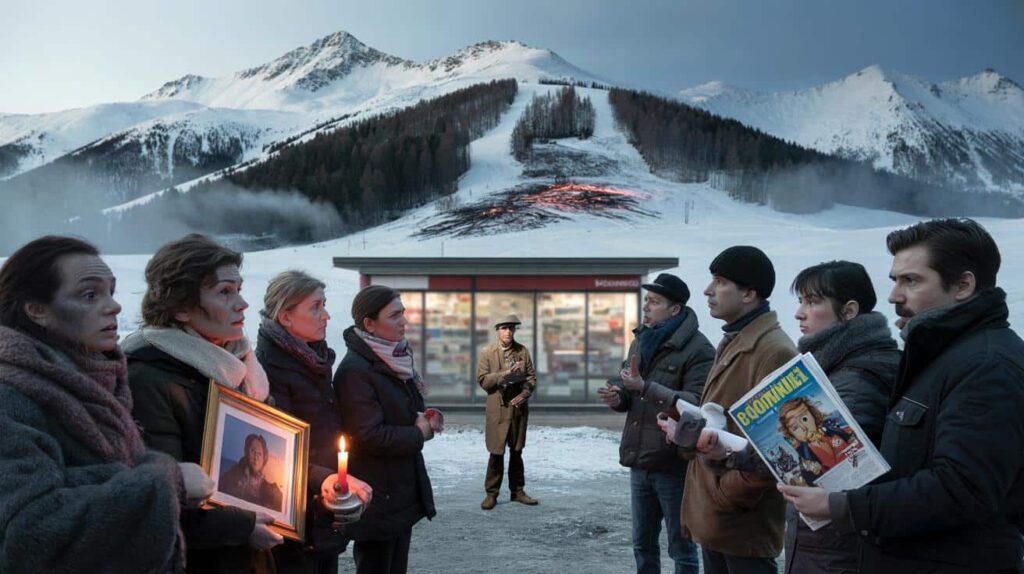
On 9 January 2026, French satirical magazine Charlie Hebdo printed a caricature referring to the Crans-Montana fires in Switzerland, captioned with a line roughly meaning “The burned go skiing”.
The drawing showed characters with visible burn scars on the slopes, in the magazine’s usual raw and abrasive style.
For many Swiss readers and survivors’ families, the image crossed an invisible line.
A Swiss couple has filed a criminal complaint against the magazine and the cartoonist, arguing that the caricature tramples on the dignity of victims and misuses their suffering for a laugh.
On social media, battle lines formed quickly.
Supporters of Charlie Hebdo pointed to its long history of irreverence, arguing that satire loses its bite if it starts tiptoeing around pain, tragedy or power.
Critics argued that those paying the price of the joke are not politicians or institutions, but people whose bodies have already been through fire.
The clash is no longer only about a drawing, but about whose pain is considered fair game, and who gets to laugh at whom.
Can we joke about everything, or about everyone?
The phrase “can we joke about everything?” is often repeated like a slogan.
Yet the Crans-Montana uproar shows a more precise fault line: joking about powerful institutions is not the same as joking about people whose lives have been shattered.
In law, this often plays out as a tension between free expression and protection of dignity.
In ethics, it raises a subtler question: is the point of the joke to punch up or to punch down?
Philosophers have wrestled with this for centuries, even if they never had to deal with memes or viral outrage.
Ancient thinkers and the modern cartoon
Plato’s unease with uncontrolled laughter
In his writings on the ideal city, Plato did not ban laughter, but he treated it with suspicion.
He feared that wild laughter could erode self-control and respect, especially among those meant to govern.
In that sense, he would likely see the Crans-Montana cartoon less as a legal issue and more as a question of what the joke does to the person laughing.
For Plato, the real issue is not “may we laugh?”, but “what kind of souls and what kind of society are we shaping when we laugh this way?”
Aristotle and the art of joking without cruelty
Aristotle, writing a generation later, took a softer stance.
He saw wit as part of a good social life, something between dull seriousness and desperate clowning.
Yet he drew a line at jokes that injure.
The virtuous person, he wrote, knows how to tease and provoke without humiliating.
Applied to the Swiss case, that distinction matters: is the target of the joke a system of risk management and tourism, or the scarred bodies of those who survived?
Aristotle would likely ask: is this humour sharpening our social intelligence, or deadening our sensitivity?
Kant and the human being as “more than a punchline”
Centuries later, Immanuel Kant gave a famously dry description of laughter as a sudden collapse of expectation into nothing.
For him, the joke is a mental “short-circuit” that releases tension.
Where things get relevant now is not in his theory of humour, but in his moral rule that people must never be treated only as means to an end.
Turn that lens on a controversial cartoon and a sharp question appears: are victims simply being used as raw material for spectacle?
Kant’s ethics would nudge readers to ask whether the joke still sees those depicted as full persons, or just as props.
Modern voices: empathy, distance and power
Bergson and the “frozen heart” of comedy
French philosopher Henri Bergson argued that laughter needs a brief pause in empathy.
He called it a sort of “temporary anaesthesia of the heart”.
We step back from the suffering of others so the comic mechanism can work.
In the Crans-Montana case, many people simply cannot activate that pause.
The wounds are too visible, the fire too recent, the stories too raw.
Bergson’s idea helps explain why some find the cartoon “only” provocative, while others feel physically sickened by it.
Nietzsche and the difference between laughing with and laughing at
For Friedrich Nietzsche, laughter can be an act of courage, almost a way of standing upright in a tragic universe.
He praised the ability to laugh at oneself as a form of strength, not cynicism.
That kind of humour transforms pain without erasing it.
It is very different from a joke that reinforces hierarchy or deepens humiliation.
Against that backdrop, a key question appears: are the people directly scarred by the Crans-Montana fires in any position to “own” this joke?
If the answer is no, then the laughter sits squarely on their backs.
Who is allowed to joke about tragedy?
Across countries, an unwritten rule keeps surfacing after disasters: the right to joke about an experience often belongs first to those who lived it.
Survivors of plane crashes, terrorist attacks, or medical accidents often develop a dark, private humour as a coping mechanism.
When outsiders turn that same subject into material, the mood changes completely.
- Inside jokes can support solidarity and help people process trauma.
- Public jokes can feel like reopening wounds when consent is absent.
- The timing of humour matters as much as the content.
With Crans-Montana, critics say the cartoon skipped a step: the people most affected were not ready to turn their pain into a punchline shared nationwide.
Law, platforms and the shifting line of outrage
In Europe, courts have repeatedly affirmed that satirical speech enjoys broad protection, especially when it targets religion, politics or public figures.
Yet many legal systems also recognise the concept of human dignity.
That leaves judges juggling principles when families claim that a cartoon degrades victims beyond what free expression can protect.
Social media changes the calculation again.
Cartoons once confined to a magazine page now circulate globally in minutes, stripped of context and nuance.
The question is no longer only “is this legal?”, but “what happens when a joke built for a narrow audience hits thousands of grieving timelines at once?”
How newsrooms think about tragic humour
Editors and cartoonists rarely sit down with Plato and Kant before going to print, yet similar questions do appear in daily meetings.
Typical checks include:
- Who or what is the real target of this joke?
- Could the image worsen the pain of people already in shock or mourning?
- Is the timing too close to the event for distance to exist?
- Does the cartoon add insight, or is it only seeking a scandal?
These are not strict rules.
They are more like pressure points where an editor may decide that the cost of a laugh is too high for a particular front page.
Understanding a few key ideas behind the debate
Several concepts quietly structure arguments about the Crans-Montana caricature.
| Term | Short explanation |
|---|---|
| Punching up / punching down | Humour aimed at the powerful versus jokes aimed at those with less power or protection. |
| Symbolic violence | Harm done not by physical force but by language, images or stereotypes that degrade people. |
| Freedom of expression | Legal and moral right to express opinions, including offensive ones, within certain limits. |
| Dignity | The idea that every person must be treated as worthy of respect, regardless of their condition. |
When an image like “the burned go skiing” appears, people implicitly weigh these ideas against each other, even if they never use the terms.
What happens if we say “yes, we can joke about everything”?
Imagine two scenarios after a future disaster in a mountain resort.
In the first, satirists respond with biting cartoons targeting fire regulations, profit-driven resort planning and political finger-pointing.
The dead are present, but the main objects of ridicule are those who failed to protect them.
In the second scenario, the jokes focus on disfigured bodies, terrified tourists and grieving parents.
Authorities are barely mentioned.
In both scenarios, people are “joking about everything”.
Yet the ethical landscape feels completely different.
The Crans-Montana dispute is really a clash between these two visions of what satire should choose as its main target.
As new tragedies unfold and new cartoons emerge, this fault line will not disappear.
The way societies answer it — through law, editorial decisions and everyday conversations about taste — will shape what future survivors see when they open a magazine and realise that their pain has become part of someone else’s punchline.