
While most manufacturers trumpet new battery platforms and charging apps, Audi is finalising a 3‑litre V6 diesel it claims can stay relevant deep into the 2030s. With mild-hybrid tech, a high-voltage compressor and compatibility with low‑carbon fuels, the engine aims to upset the narrative that diesel is finished in Europe.
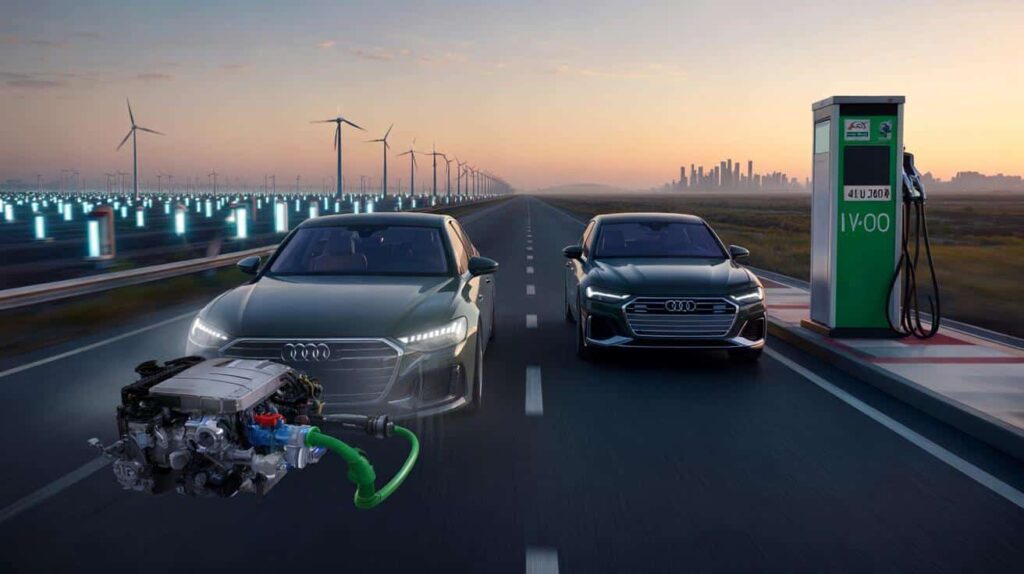
Germany’s counter‑move in an electric‑obsessed Europe
European policy is pushing carmakers towards all‑electric line‑ups, with bans on new combustion models planned or debated in several capitals. Yet the rollout of charging infrastructure remains patchy, and long‑distance drivers still worry about range and downtime.
Audi’s response is not a retrograde throwback, but a heavily reworked 3.0‑litre V6 TDI known internally as EA897 evo4. It keeps the basic V6 format yet rethinks almost everything around it: ancillary layout, forced induction, electrification and fuel compatibility.
The new powerplant will first appear in the next-generation A6 and Q5 from late 2025, targeting customers who travel far, tow often, or live in regions where fast chargers are rare. Audi is betting that these drivers are not ready to abandon high‑torque diesel, but they do want lower emissions and modern tech.
This V6 is pitched as a strategic transition engine: less fossil, more digital, and designed to survive ever‑tighter regulations.
A punchy V6: 299 hp, 580 Nm and instant shove
On paper, the figures look familiar, but the way this engine delivers them changes the driving experience. The 3.0‑litre V6 produces 299 hp (220 kW) and 580 Nm of torque. An integrated electric generator can briefly add up to 24 hp (18 kW) and a massive 230 Nm on top.
That electric boost fills in the gaps where traditional diesels hesitate, sharpening overtakes and motorway slip‑road launches. The goal is to match the easy surge of a big diesel with the immediacy people associate with electric motors.
Electric compressor: killing turbo lag, not economy
The real headline technology sits in the intake: a new-generation electric compressor that can spin to 90,000 rpm in about a quarter of a second. Positioned downstream of the turbo and intercooler, it steps in before exhaust gases can fully spool the turbocharger.
Audi claims a 40% faster rotor acceleration compared with its previous electric compressors used on older S and SQ models. That translates to much sharper response in the first 2.5 seconds after you hit the throttle, when drivers feel traditional “turbo lag” most keenly.
Two stages of boost – turbo plus electric compressor – aim to give diesel the kind of throttle response usually reserved for EVs.
Because the electric compressor only works when needed and draws from a separate 48‑volt system, it doesn’t wreck fuel consumption. For commuters facing mixed traffic, that combination of rapid response and diesel efficiency will be hard to ignore.
MHEV Plus: when a mild hybrid stops being mild
Audi calls the electrical side of the powertrain “MHEV Plus”. The name might sound like marketing gloss, but the architecture is more ambitious than most mild‑hybrid setups on the road today.
- A belt-driven starter-generator (BAS) that handles smooth engine restarts
- A separate PTG generator that can support the engine and recuperate energy under braking
- A 48 V lithium iron phosphate (LFP) battery, chosen for durability and thermal stability
In slow urban traffic, the system lets the car creep or manoeuvre on electric support alone for short bursts. During deceleration, it can reclaim up to 25 kW of energy, which is then used for boost, accessories or start/stop events.
The outcome is not full electric driving like a plug‑in hybrid, but a noticeable reduction in fuel use and smoother low‑speed behaviour. The V6 can shut down more often, restart less abruptly, and rely on electric torque to mask any hesitation.
Why LFP matters for a diesel hybrid
Choosing an LFP battery instead of a classic lithium‑ion pack is a revealing move. LFP cells generally offer:
| Aspect | LFP battery |
|---|---|
| Safety | More stable under high temperatures, lower fire risk |
| Longevity | High cycle life, suited to constant charge/discharge in hybrids |
| Energy density | Lower than NMC/NCA, but acceptable in a small 48 V pack |
For drivers, this should mean fewer concerns about battery degradation and a system designed to last the life of the car, even with daily stop‑start and regeneration cycles.
HVO100: when “diesel” no longer means crude oil
The most politically charged part of Audi’s plan is its embrace of HVO100, a synthetic diesel produced from waste fats and organic residues such as used cooking oil or agricultural by‑products.
The new V6 can run on standard diesel, HVO100, or any blend of the two, without hardware changes. In theory, HVO100 can cut lifecycle CO₂ emissions by up to 95% compared with fossil diesel, depending on the feedstock and production method used.
Running this engine on HVO100 turns a conventional diesel car into a low‑carbon vehicle, at least on paper.
Audi’s plants in Ingolstadt and Neckarsulm will ship A6 and Q5 models with tanks certified for HVO use. That gives buyers an immediate lever to reduce their carbon footprint if local fuel stations offer the right pumps.
There are caveats: HVO availability is still patchy, prices can be higher than regular diesel, and sustainability depends on strict control of raw materials. But for regions where HVO100 is growing – including parts of northern Europe – it could make these cars surprisingly climate‑friendly.
Pricing, launch timing and who this is really for
First customer deliveries in continental Europe are scheduled for early December 2025, with France among the launch markets. Two models will spearhead the rollout:
- Audi A6 V6 TDI MHEV from €82,270
- Audi Q5 V6 TDI MHEV from €82,600
These prices position the diesel hybrid as a premium choice rather than a bargain alternative to EVs. In return, owners receive long‑legged range, strong towing capacity and freedom from charging queues.
In France, the mild hybrid system grants Crit’Air 1 classification, meaning fewer restrictions in low‑emission zones. Similar policy debates are unfolding across Europe and the UK, where cities are tightening access rules based on emissions classes rather than fuel type alone.
Could this kind of diesel still make sense in the UK or US?
For British and American readers, the question is not only technical but political. Diesel’s image took a severe hit after previous emissions scandals, and many urban areas now discourage or heavily tax older diesel models.
This new V6 aims to address exactly those concerns with advanced after‑treatment, hybrid support and low‑carbon fuels. For high‑mileage drivers covering 20,000 to 30,000 miles a year, the combination of low fuel consumption and reduced CO₂ could still make financial and environmental sense.
Fleet operators, business drivers and rural households with poor charging infrastructure stand to gain the most. An A6 or Q5 with this engine could cross several countries on a single tank, refuel in minutes, and, where HVO100 is available, claim emissions far below a conventional diesel saloon.
Electric vs eco‑diesel: a quick scenario test
Imagine a family in northern England driving 800 miles on a ski holiday to the Alps. With a modern EV, they might plan three or four fast‑charging stops, each adding 25–40 minutes depending on charger speed and queue length.
In a V6 TDI on standard diesel, that same journey could need just one quick refuel. On HVO100, total lifecycle emissions might rival or even undercut some larger EVs powered by grid mixes heavy in gas or coal, especially if the EV’s battery is sizeable and produced in a carbon‑intensive factory.
That doesn’t make diesel a clean technology in absolute terms, but it shows why some carmakers still see space for highly optimised combustion engines alongside EVs during the transition period.
Key terms and trade‑offs drivers should know
For readers trying to make sense of future‑proof options, a few concepts help clarify the picture:
- Mild hybrid (MHEV) – Uses a small battery and motor to support, not replace, the engine. No plug, limited electric‑only driving, but smoother performance and lower fuel use.
- HVO100 – A synthetic diesel from waste biomass, designed to work in compatible diesel engines. Lower lifecycle CO₂, but dependent on responsible sourcing and local availability.
- Crit’Air or low‑emission zones – Regulatory schemes that restrict access based on official emission ratings, sometimes treating clean modern diesels more favourably than older petrol cars.
For anyone choosing their next car in a Europe racing towards full electrification, this new V6 raises a blunt question: is the cleanest option always a plug, or can a carefully engineered diesel still earn its place on long, cold, heavily loaded journeys?