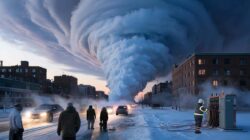
The first sign was the silence.
On a research vessel off Svalbard last week, a group of meteorologists stepped onto the deck expecting the usual scream of Arctic wind and the sting of frozen air. Instead they found a foggy, eerily mild morning. Meltwater trickled along the railings. The ship’s metal didn’t bite the skin. One scientist checked the thermometer, checked it again, then swore under his breath.
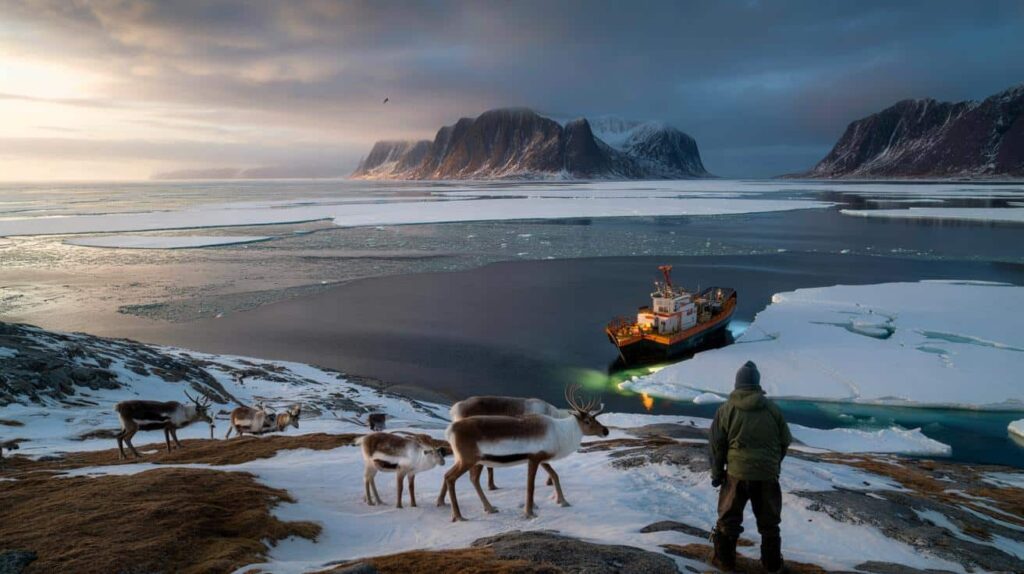
A few hours later, satellite maps confirmed it: a huge mass of warm, moist air had punched straight into the high Arctic, weeks earlier than models had predicted. Sea ice, still supposed to be in its winter “safe zone,” was fracturing like glass.
On the screens, bright red swirls of heat pushed into a region that once acted like a planetary freezer.
This time, what’s thawing might not just be ice.
Early February, and the Arctic looks wrong
Across the Northern Hemisphere, meteorologists are staring at unprecedented charts. Early February is usually the deep, stable heart of Arctic winter, when polar cold locks in and gives the rest of the planet a sort of predictable rhythm. This year, the rhythm broke.
Instead of a solid, centered polar vortex, they’re seeing a warped, wobbling system. Warm air pulses north, cold air spills south. Europe reports spring-like spells. North America swings from record blizzards to short sleeves in the same month. Up above, the jet stream snakes and buckles like a loose cable.
On a screen at the European Centre for Medium-Range Weather Forecasts, a young analyst scrolls through anomaly maps. Patches over the Arctic glow blood-red: 15°C above average in some zones, even more in others. She zooms in on the Barents Sea, the Laptev, the Kara — regions that used to be locked under thick winter ice. This year, large areas stayed thin, cracked, or even ice-free.
Satellite photos show open water steaming into the freezing air, releasing heat and moisture, feeding clouds where once there was just endless white. One veteran meteorologist mutters that the Arctic now “breathes like a sick lung,” exhaling warmth when it should be sealed shut.
Climate scientists have warned for years that the Arctic is warming four times faster than the global average. That’s no longer an abstract number in a report; it’s literally reshaping the atmosphere above our heads. When the north loses its stable cold cap, the entire climate machine becomes jumpier, more chaotic.
This early February Arctic shift isn’t just a quirky weather story. It’s pressing hard on sensitive systems: sea ice, ocean currents, frozen soils, and the invisible cloud of greenhouse gases trapped in permafrost. **Once some of those systems pass a point of no return, the planet stops responding in gentle, linear ways and starts lurching.**
The tipping point nobody sees but everyone will feel
Behind the scenes, the word making scientists nervous is “biological.” The worry isn’t only about storms and heatwaves, but about the living, breathing fabric of the Arctic — and what happens when it flips. When warm air intrudes earlier and more often, the frozen ground that has locked away ancient carbon for millennia begins to sag, slump, and leak.
The process sounds slow, almost boring on paper. In reality, you can hear it: the dull, wet thud of collapsing permafrost, the gurgle of new ponds where tundra once lay firm and dry. *Each of those little sounds is a quiet signal that more carbon is waking up.*
Take a field station in western Siberia, where a small team has been tracking the same patch of ground for over a decade. Ten years ago, winter meant a clean, flat landscape of rock-solid soil and snow that squeaked under boots. This February, they reported something different: mid-winter meltwater pooling around their instruments, and a faint, swampy smell that usually doesn’t show up until late spring.
Their sensors picked up spikes in methane, a greenhouse gas far more potent than carbon dioxide in the short term. The researchers watched bubbles rise through black water in thawing pits, knowing that each bubble was carbon that had been locked away since mammoths walked the steppe. Now, a weirdly warm winter was giving it a sudden exit route into the sky.
That’s the biological tipping point scientists fear: a moment when warming doesn’t just melt ice but triggers living systems to amplify the heat by releasing more greenhouse gases. Plants wake earlier, microbes feast on thawed organic matter, and frozen peatlands shift from being long-term carbon sinks to powerful carbon sources.
Once that feedback loop spins up, even aggressive cuts in human emissions might no longer be enough to pull the climate back down quickly. This is what has people in labs, on ships, and at lonely Arctic stations using words they once avoided in public: **runaway**, **irreversible**, “out of our hands.”
What we can still do while the ground is literally shifting
Faced with global systems and terrifying graphs, the usual reaction is a kind of numb dread. Yet the people watching the Arctic closest tend to be surprisingly practical. They talk about resilience, fast action, and buying time. One of the clearest lessons from this early February shock is that speed matters just as much as scale.
Cutting emissions faster in the next five to ten years directly reduces the odds that permafrost and ecosystems cross those invisible thresholds. That means cities phasing out gas boilers, countries stopping new fossil fuel exploration, companies switching to clean power not in 2050 but before today’s kindergartners hit high school.
We’ve all been there, that moment when you read about another climate record and feel that tiny inner voice saying, “What’s the point?” Let’s be honest: nobody really does this every single day — nobody wakes up perfectly climate-virtuous, never takes a flight, never buys plastic, never touches a car.
The people who work on tipping points say the goal isn’t purity; it’s pressure. Political pressure, financial pressure, cultural pressure. Voting for leaders who don’t wave away Arctic warnings as abstract. Asking your bank or pension fund where the money actually goes. Supporting local projects that restore wetlands, replant forests, or cool overheated cities. These aren’t feel-good side quests; they’re part of easing the strain on a warming system that’s dangerously close to flicking into a new state.
“Biological tipping points aren’t a distant doomsday scenario,” a polar ecologist told me bluntly. “They’re a spectrum, and we’re already walking along it. Every tenth of a degree we avoid now keeps more of the Arctic — and the climate it stabilizes — on our side.”
- Watch the Arctic like a vital sign
Follow trusted datasets and organizations that track sea ice, permafrost, and methane. Understanding the signals helps cut through headline panic. - Back rapid clean-energy shifts
Support policies and businesses that replace fossil fuels with wind, solar, and storage in years, not decades. - Defend and restore living carbon sinks
From boreal forests to peatlands, these ecosystems are quiet climate machines. Protecting them buys time against tipping points. - Push for climate-risk transparency
Ask workplaces, schools, and local authorities what Arctic-driven risks they’re planning for — from food prices to infrastructure. - Care for your own “climate stamina”
Stay informed, but pace yourself. Burned-out citizens don’t hold governments or companies to account for long.
The Arctic is whispering; the question is who’s listening
In the end, this early February Arctic shift might be remembered not just as a freak winter but as the season when the north finally lost its quiet. Temperature anomalies will fade from the news cycle, yet the thaw lines creeping through permafrost won’t. Biologists will keep returning to sites that look a little more like wetlands and a little less like frozen desert. Meteorologists will keep watching those red swirls push into a region that used to be blue.
There’s a strange intimacy in all this. The air from that warm intrusion will be mixed into the atmosphere that fills your lungs within weeks. The methane from a collapsing tundra pool will help shape the heatwaves, crop yields, and insurance premiums in cities thousands of kilometers away. The planet’s “remote” places were never really remote; they were just quiet for a long time.
As the Arctic’s biological engines shift gear, the comfortable idea of a slow, predictable climate fade slips further out of reach. What replaces it is messier, more urgent, and oddly more human-sized: a world where what you do, vote for, invest in, or ignore this year might genuinely influence whether certain thresholds are crossed in your lifetime.
The scientists staring at those unsettling early-February charts aren’t just warning about a looming tipping point. They’re also offering a kind of deadline — not for despair, but for seriousness. Whether that deadline becomes a turning point or a breaking point is, unavoidably, up to all of us.
| Key point | Detail | Value for the reader |
|---|---|---|
| Early Arctic warming | February temperatures up to 15°C above normal, with thin or broken winter sea ice | Helps explain strange weather swings and why forecasts feel less reliable |
| Biological tipping risks | Thawing permafrost and wetlands releasing CO₂ and methane, shifting ecosystems from sinks to sources | Shows how warming can speed up on its own, raising the stakes of near-term action |
| Concrete response levers | Faster emission cuts, protecting carbon-rich landscapes, and applying political and financial pressure | Offers practical ways to influence global risks from a personal and local starting point |
FAQ:
- Question 1What exactly do scientists mean by a “biological tipping point” in the Arctic?
- Answer 1They’re talking about a threshold where living systems — soils, plants, microbes, wetlands — switch from slowing climate change to speeding it up, usually by releasing large amounts of greenhouse gases that were previously locked away.
- Question 2Is this early February warming event just natural variability?
- Answer 2Weather always has ups and downs, but the intensity, frequency, and timing of recent Arctic warm intrusions line up closely with long-term human-driven warming and decades of model predictions.
- Question 3Has a tipping point already been crossed?
- Answer 3Some systems show early signs of crossing into new behavior, like permafrost starting to emit more carbon. Many researchers think we’re “in the danger zone,” but how far along the tipping path we are is still being urgently studied.
- Question 4What does this mean for people far from the Arctic?
- Answer 4Shifts in the Arctic can influence jet streams, storms, and heatwaves, alter food production, and add extra warming on top of what human emissions already cause, affecting everything from energy bills to infrastructure safety.
- Question 5Can individual choices really affect something this huge?
- Answer 5On their own, no. But when millions of people change what they demand from politicians, employers, and markets, it shapes policies and investments at the scale that can still slow or avoid some of the worst tipping cascades.