
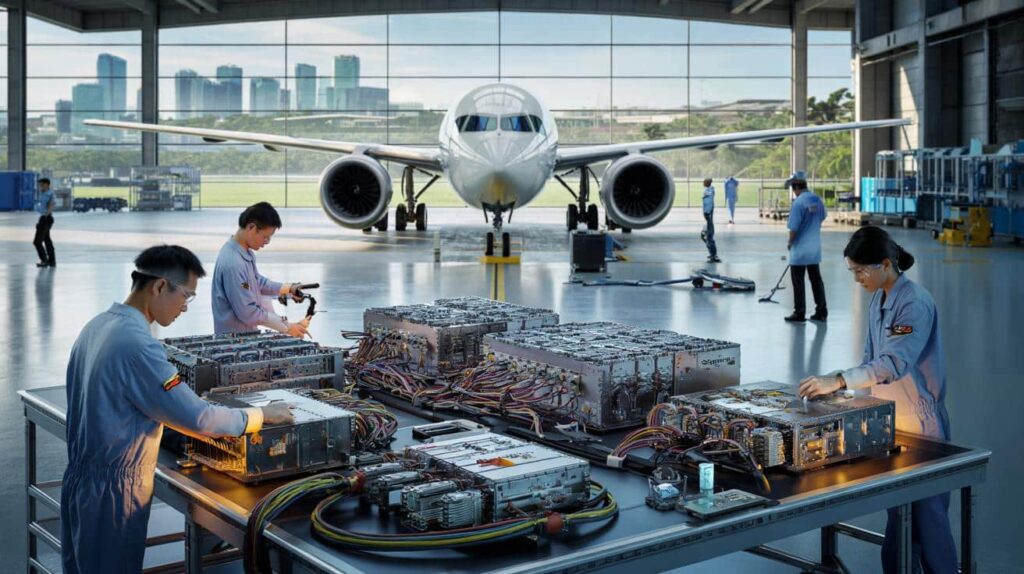
The new Safran facility looks more like a high-tech watchmaker’s workshop than a typical aircraft factory, yet what happens here sits at the heart of aviation’s next big shift: the fast rise of electric systems on board commercial and military aircraft.
From jet fuel to electrons: aviation’s electric turn
Airlines talk a lot about sustainable fuels and new aircraft models, but the real revolution is more discreet. It lies in cables, batteries, inverters and power electronics hidden behind panels and under cabin floors.
 Heating: the 19 °C rule is outdated: here’s the new recommended temperature according to experts
Safran’s new site in Singapore focuses exactly on that layer. Around 70 specialists will assemble and repair converters, electrical distribution systems and on-board battery packs that feed the growing appetite for electricity on modern aircraft.
 Unusual Early Arctic Breakdown Expected In February: Meteorologists Spot Rare Atmospheric Signals
New-generation jets use electricity where old aircraft relied on hot compressed air or hydraulic pressure. Actuators that move flaps or landing gear, cabin systems, avionics and even ground taxiing are shifting from mechanical or pneumatic systems to “more-electric” solutions.

Safran’s Singapore plant arrives just as the global electric aircraft market is projected to approach €95 billion by 2035.
This change cuts fuel burn, simplifies maintenance and opens the door to hybrid and, later, fully electric propulsion. For a group already world number one in commercial jet engines through CFM International, locking in leadership in electric systems is a strategic hedge on the future.
Inside Safran’s new “electric brain” factory
The Seletar site has been designed less like a heavy industrial plant and more like a precision lab. Technicians will assemble power converters able to react in milliseconds, alongside modular “flying switchboards” that route electricity to where it is needed in real time.
These units will equip aircraft or fleets linked to Airbus, Boeing and ATR programmes, including carriers such as Singapore Airlines, Air China and Japan Airlines. Once installed, they rarely catch the eye, yet they manage everything from lighting and avionics to power for flight control systems.
Regulatory clearance has come quickly. The plant has secured approvals from the Civil Aviation Authority of Singapore (CAAS), the European Union Aviation Safety Agency (EASA) and the US Federal Aviation Administration (FAA). With the big three regulators on board, the facility can operate at full pace and support airlines across multiple jurisdictions.
A 95-billion-euro electric aircraft horizon
Industry research points to a sharp expansion of the electric aircraft segment. Market estimates suggest:
- 2024 market value: €19.62 billion
- 2025 projection: €22.64 billion
- 2035 outlook: about €94.82 billion
- Average annual growth (2025–2035): around 15.4%
North America currently leads in deployed electric aviation projects, while Asia-Pacific shows the fastest growth rates, driven by aggressive fleet renewal and urban air mobility trials. That regional tilt is part of what makes Singapore so attractive as a base.
Why Singapore is the right runway
Safran has not picked Singapore on a whim. Asia-Pacific is in the midst of one of the largest aircraft replacement and expansion cycles in aviation history. Hundreds of jets will join regional fleets over the next decade, and maintenance footprints need to follow.
By positioning its electric systems hub in Seletar, Safran can react faster to airline needs, cut logistics delays and provide on-the-spot support in a region where every hour of aircraft downtime counts. Proximity also helps on the development side: data from airlines and MRO (maintenance, repair and overhaul) partners can be fed back quickly into product tweaks.
Executives highlight three local advantages: political and economic stability, efficient logistics and clear public backing for aerospace. Singapore’s government has worked consistently to build an aviation cluster, from air traffic management to component repair.
Singapore offers Safran stable regulation, strong infrastructure and direct access to the fastest-growing aviation market on the planet.
The plant also absorbs electrical activities transferred from Thales in 2023, consolidating capabilities inside Safran and avoiding fragmented responsibilities between suppliers. That consolidation should help airlines deal with a single, integrated partner for a wide slice of their electrical architecture.
Four decades of Franco-Singapore aviation ties
This is not a fresh start between France and Singapore. Safran has had a presence in the city-state for over 45 years, growing into one of the largest foreign aerospace industrial players there.
Roughly 900 employees already work across five sites in Singapore, overhauling landing gear, servicing evacuation slides, maintaining avionics and repairing helicopter engines. The new electrical systems facility simply plugs into a mature ecosystem.
 Goodbye Traditional Hair Dyes: New Natural Trend Covers Grey Hair And Makes You Look Younger
The political framework has tightened as well. A cooperation agreement signed in May 2025 between CAAS and the French civil aviation authority (DGAC) set common ground for regulation and certification. The Seletar plant gives that agreement a concrete industrial expression.
Safran’s wider bet on electric and hybrid flight
The Singapore project is one piece in a broader technology push. Safran is spending heavily on:
- lighter, higher-density aviation batteries for hybrid aircraft
- high-efficiency electrical systems for “more-electric” airframes
- expanded engine maintenance capacity in Asia
- new-generation turbofan test programmes in Europe
On the military side, Safran is also developing ruggedised power distribution modules for combat and transport aircraft, which must survive harsher operating conditions and electromagnetic stresses.
Link these strands together and a clear pattern appears: the French group wants to own not just the combustion engine, but the full chain of electrical power on tomorrow’s aircraft, from battery or generator to motor.
Urban air mobility, eVTOLs and new competitors
Electric aviation is not just about regional or short-haul aircraft. A wave of start-ups and established manufacturers is pushing eVTOLs – electric vertical take-off and landing aircraft – aimed at air taxis and fast urban transport.
Names like Joby, Lilium, Eviation, Vertical Aerospace, magniX and Ampaire sit alongside Airbus, Boeing, Embraer and Pipistrel on investor presentations. Some target regional routes of a few hundred kilometres; others pitch 10–15 minute hops across city regions.
Each of these concepts depends on very compact, reliable and efficient electric systems. High power must be delivered instantly during vertical take-off and landing. That requires converters and distribution modules similar to those Safran is industrialising in Singapore, even if specific designs vary.
Electric aircraft are evolving a bit like early smartphones: each gain in battery and power electronics opens new use cases that looked unrealistic a few years earlier.
What “more-electric” really means on board
For non-specialists, the jargon can be confusing. A few key notions help make sense of the shift:
- More-electric aircraft: conventional jets where many hydraulic or pneumatic systems are replaced by electrically powered alternatives, cutting weight and fuel use.
- Hybrid-electric aircraft: propulsion combines a traditional engine with one or several electric motors, often used during take-off or climb to trim fuel burn.
- All-electric aircraft: no combustion engine at all; propulsion comes entirely from electric motors, fed by batteries or another electrical source.
Safran’s current projects mostly feed the “more-electric” and hybrid categories, which are expected to dominate the market for at least the next decade given today’s battery limitations.
Scenarios for the next ten years
Industry scenarios suggest different speeds of change:
- Conservative path: more-electric systems become standard on new large jets, while full-electric aircraft remain confined to training and very short hops.
- Accelerated path: battery technology improves faster than expected, turning 20–40 seat regional aircraft into a viable electric segment from the early 2030s.
- Urban focus: most visible progress happens in urban air mobility, with hundreds of eVTOLs in service before larger regional electric aircraft really take off.
In all three paths, the pressure on electrical systems rises sharply. Redundancy, thermal management and software control become as critical as turbine performance is today.
Opportunities and risks behind the €95 billion figure
For groups like Safran, the growth forecasts look attractive, but they come with real uncertainties. Certification standards for electric propulsion are still evolving, and programmes can slip by years if regulators or test campaigns flag issues.
There is also supplier risk. New entrants with fresh designs or novel battery chemistries could grab a slice of the value chain that traditional engine makers currently dominate. That is one reason why incumbents are racing to secure industrial bases in key regions, from North America to Asia-Pacific.
On the upside, once certified, electric systems often bring lower recurring maintenance costs and more predictable performance. Airlines gain from reduced fuel burn, quieter operations and, potentially, easier compliance with future climate regulations. For a hub like Singapore, becoming a centre of expertise in electric aviation equipment could lock in high-skilled jobs for years.
Seen from Seletar, the picture is clear: while today’s aircraft still roar on kerosene, the silent wiring and black boxes being assembled in this new French-run factory are already aligned with a market that could approach €95 billion within a decade, and reshape how the industry thinks about power in the air.
