
The kettle whistles, a scooter buzzes down the street, your neighbour decides 10:07 a.m. is the right time to vacuum. You’re at the kitchen table with your laptop open, cursor blinking on a blank document that refuses to fill. You’re technically “working from home”, yet your brain feels like a browser with 46 tabs open and no sound control.
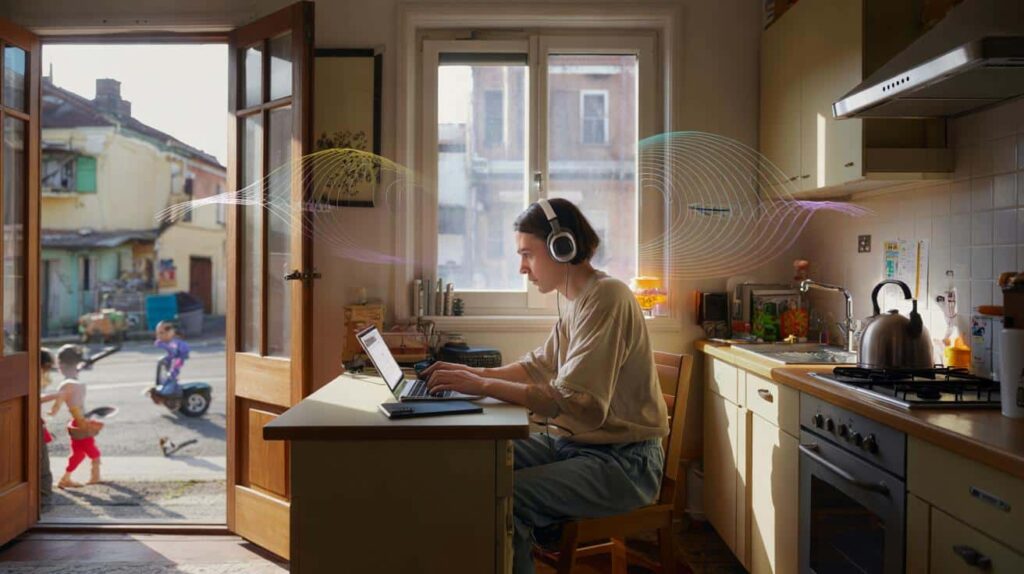
You put on a random playlist. Too many lyrics. You try a “focus” mix. Somehow it makes you sleepy. You switch to total silence and suddenly every tiny noise feels like a fire alarm. Somewhere between noise and silence, something happens in your brain.
You don’t just hear sounds. Your attention bends around them.
And that’s where things get really interesting.
Why some sounds sharpen your focus (and others wreck it)
Open-plan office noise has simply moved into our homes. Kids arguing in the hallway, a neighbour’s washing machine, the fridge humming like a grumpy bee. Your brain keeps scanning all these frequencies, wondering which one might matter.
Low rumbling traffic, sharp phone pings, distant voices – your nervous system doesn’t treat them equally. Some sounds fade into the background. Others grab your attention like someone snapping fingers in your ear.
When you say “I can’t concentrate at home”, you’re often describing a frequency problem without realising it.
Take a researcher in London who monitored workers doing tasks while different background sounds were played. When the sound matched the frequency range of human speech – roughly 300 to 3,000 hertz – performance dropped, especially for reading and writing.
Yet when workers heard a consistent, mid-range “whoosh” called brown noise, their accuracy and time-on-task improved. Their brains stopped chasing every syllable and relaxed into a narrow band of sound.
On a more everyday level, you might have noticed you write emails faster with a fan running than with a TV show mumbling in the next room. Same volume, totally different frequency footprint.
Neuroscientists have a way to measure this. They look at brain waves – those gentle electrical rhythms pulsing along your cortex. Sounds in certain frequency ranges can nudge those rhythms closer to states linked with focus, such as beta waves (around 13–30 hertz) and low gamma.
High-pitched, sudden sounds – a Slack ping, a cutlery clink – spike your brain’s alert system. Your attention jumps, even if you don’t “notice” it consciously. Repetitive mid‑ to low‑frequency sounds, like rain or a steady engine hum, tend to push your brain toward a calmer, more stable pattern.
*You’re not weak for being “distracted at home” – your auditory system is just doing exactly what it was built to do: keep you alive by listening for change.*
How to tune your home soundscape like a focus engineer
Start by doing a tiny sound audit of your workspace. Sit still for one minute and list every noise you hear: traffic, birds, a fridge buzz, footsteps, distant voices. Note which ones feel sharp or “poky”, and which ones feel soft or “fuzzy”.
Then run a simple test: put on 20 minutes of brown noise (not white noise) at low volume while doing a slightly boring task, like answering emails or formatting a deck. Notice your typing rhythm. Are you checking your phone less? Is your gaze staying on the screen for longer stretches?
This isn’t about forcing yourself into a sound jail. It’s about finding the frequency blanket that calms your brain just enough to get into gear.
There’s a classic trap: thinking “any background sound will help me focus”. So you throw on a podcast or a playlist full of clever lyrics. Your brain starts tracking sentences, stories, punchlines. Suddenly that spreadsheet takes twice as long.
We’ve all seen people on TikTok swearing by 8‑hour lo‑fi hip‑hop mixes. And yes, they can work – until the beat changes or the producer slides in a vocal hook that hijacks your brain. If you’re writing or reading, lyrics often pull you into another narrative layer you didn’t ask for.
Be gentle with yourself. You’re not failing if the “focus” playlist everyone loves just makes you restless.
One audio engineer I spoke with described it like this:
“Think of your attention as a camera lens. Sudden, high‑pitched sounds yank it into autofocus. A steady, mid‑low wash of sound lets you leave it on manual.”
When you’re experimenting at home, work with a few simple rules of thumb:
- Avoid dominant human voices while you write or read – even if it’s in a language you don’t speak.
- Keep volume low enough that you’d still hear your name if someone called you.
- Test different noises – brown noise, gentle rain, café ambience – and give each at least two or three sessions before judging.
Soyons honnêtes : personne ne does a perfectly curated soundscape every single day. You’ll still have messy mornings with loud neighbours and a barking dog. The goal isn’t perfection, it’s nudging the odds in your favour.
Designing your daily “sound ritual” for deep work at home
Think of sound like lighting. You don’t use the same lamp for a romantic dinner and for cleaning the oven. Your brain deserves the same nuance.
Before each work block, pick a sound mode on purpose. For deep, brain-heavy tasks, go for neutral, narrow‑band sounds: brown noise, low-frequency rain, or a quiet fan recorded on loop. For admin or routine work, you might handle a wider mix: soft instrumental music around the mid‑range, without sudden jumps or drops.
One helpful move: link a specific sound to a specific type of work. Over time, that frequency range becomes a cue. You hit play, your brain thinks, “Oh, it’s focus time again.”
People often make two painful mistakes. The first is cranking the volume up so high that the sound itself becomes a new distraction. The second is trying to use the same playlist for every task, from coding to sensitive emails.
If working from home means sharing space, you might also fall into low-level sound battles – your partner’s Zoom calls versus your “concentration playlist”. That tension alone can drain more energy than any actual noise.
On a more generous day, you can talk about it and set simple norms: “During 10–12, I’ll wear headphones with brown noise; from 2–3, you can have your call in the kitchen, I’ll move to the bedroom.” Tiny negotiations like this calm the soundscape and the relationship.
Psychologists talk about “perceived control” as a stress buffer. In sound terms, that’s the difference between being blasted by random frequencies and choosing your own.
One remote worker told me:
“Once I made myself a 90‑minute ‘rain on window + distant café’ track, my brain finally stopped waiting for the next annoying noise. It knew the script, so it could work.”
Here are a few simple ways to build that feeling of control:
- Create two or three go‑to sound presets: deep focus, light focus, and recovery/rest.
- Use noise‑blocking tools wisely – soft earplugs or noise‑cancelling headphones for the truly chaotic moments, not all day long.
- Let your body weigh in: if your jaw tightens or shoulders rise after 10 minutes of a track, that’s the wrong frequency for you, even if “science” says it should work.
On a good day, the right sound doesn’t feel heroic. It just makes your work feel 20% smoother, like your brain suddenly found the right gear.
Letting your ears guide how you work from home
Remote work has turned us all into accidental acousticians. We’re learning, sometimes painfully, that the world doesn’t go quiet just because we need to send three important emails and finish a report.
Once you start noticing frequencies rather than just “noise”, your day looks different. The dog bark isn’t just annoying; it’s a spike in the high‑frequency range. The boiler hum is a kind of low‑frequency blanket. The playlist that made you cry last summer might be beautiful, but its sharp piano notes slice right through your concentration.
You begin to ask a new question: not “Is it noisy?” but “What kind of noise is this, and what is it doing to my brain right now?”
On a crowded day, focus might mean 45 minutes with brown noise and a door half‑closed. On a calm morning, it might mean real silence, window slightly open, just the distant rumble of the city at 200 hertz.
A colleague on another continent might swear that white noise keeps them sane, while your nervous system begs for distant waves and nothing else. Both can be right. Your ears remember your childhood home, your favourite café, the sounds that meant “safe” and “it’s okay to drift inward”.
When you shape your sound environment with that in mind, working from home stops being a constant fight against distraction. It becomes a quiet negotiation with your senses – one where you finally get a say.
| Point clé | Détail | Intérêt pour le lecteur |
|---|---|---|
| Fréquences et distraction | Les voix humaines et sons aigus captent fortement l’attention, surtout pour les tâches de lecture/écriture. | Comprendre pourquoi certains bruits à la maison brisent instantanément votre concentration. |
| Bruit “neutre” pour le focus | Les sons réguliers, mid‑low (brown noise, pluie, ventilateur) stabilisent les rythmes cérébraux liés au focus. | Choisir un fond sonore qui soutient votre concentration au lieu de la parasiter. |
| Rituels sonores | Associer des paysages sonores spécifiques à certains types de tâches crée un réflexe de mise au travail. | Mettre en place des routines simples pour entrer plus vite dans l’état de travail profond à la maison. |
FAQ :
- What’s the best sound frequency to focus while working from home?There’s no single “best” number, but many people respond well to mid‑ to low‑frequency sound, like brown noise or gentle rain, which sits mostly below the sharp range of human speech.
- Is brown noise really better than white noise for concentration?Often, yes. Brown noise has more energy in the low frequencies and less harsh high‑end hiss, so it feels warmer and less tiring for long sessions.
- Can I use music with lyrics and still stay focused?For mechanical tasks, maybe. For writing, reading or learning, lyrics often compete with the language centres in your brain and slow you down.
- Are noise‑cancelling headphones safe to wear all day?They’re useful in bursts, but many people feel fatigue or pressure if they wear them nonstop. Mixing them with quieter periods and lower volumes is usually kinder to your ears.
- How loud should my focus sound be?Low enough that you can still hear someone speak to you at normal volume. If your shoulders are tense or you feel wired, it’s probably too loud or too bright in the high frequencies.