
From grandparents’ allotments to glossy gardening magazines, one piece of advice has been hammered home for decades: turn the soil, break it up, leave it neat and bare, and your vegetables will thank you. Yet an increasing number of soil scientists and vegetable growers are sounding the alarm. The traditional “dig, dig, dig” rule does not just strain your back – it can silently strip life, structure and fertility from your garden.
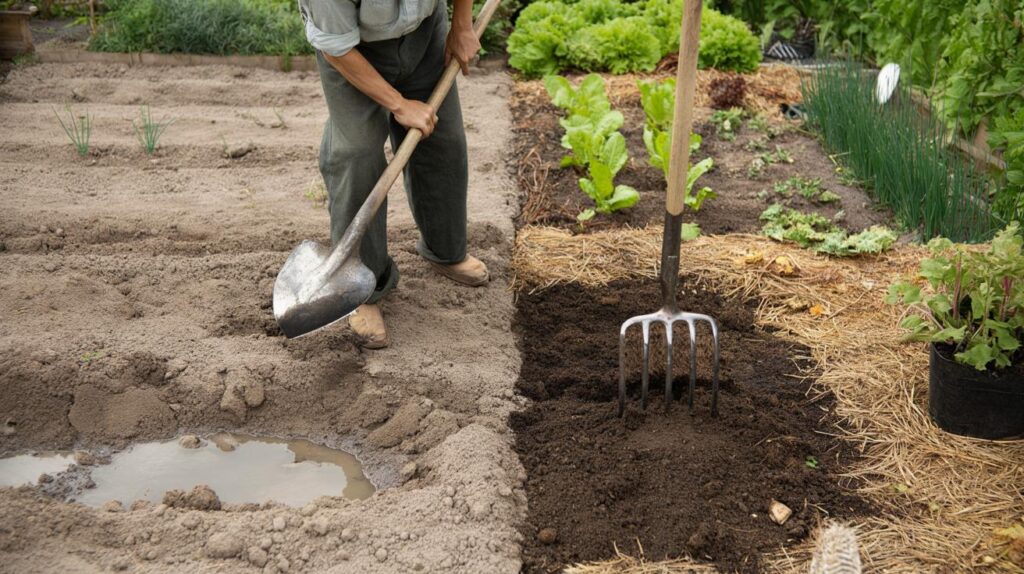
The cult of the spade: why we think hard work makes better vegetables
For many gardeners, a successful season starts with aching muscles. If you can still stand up straight after a day on the plot, the job feels unfinished. That mindset comes from a powerful mix of tradition, pride and a misunderstanding of how soil works.
Deep digging in small gardens is often copied from industrial agriculture, where huge fields of a single crop once relied on ploughs to prepare the ground. That context is totally different from a small, mixed, wildlife-friendly garden or allotment.
What works behind a tractor on 100 acres can be damaging when repeated with a spade on 10 square metres.
On top of that, we have grown attached to the look of a “clean” plot: brown earth, perfectly smooth, no weed in sight. It feels orderly and controlled, a bit like a freshly mopped kitchen floor. Yet in nature, bare soil is almost always a sign of stress – fire, flooding, or heavy disturbance. A healthy soil surface is usually covered with plants, leaves, or organic debris, stitched together by roots.
What really happens underground when you turn the soil
Push a spade into the soil and it looks like you are just moving dirt. In reality, you are crashing through a living city. Below your boots, billions of organisms work together: worms, insects, fungi, bacteria and tiny arthropods. Their tunnels and threads form the skeleton of the soil.
Earthworms are the most visible victims. Many species dig deep vertical channels that act as natural drainage pipes and air shafts. When you flip whole slices of soil upside down, you slice through those galleries, expose worms to light and predators, and crush their burrows.
Fewer worms mean fewer natural tunnels, poorer drainage, and compacted soil that drowns roots after heavy rain.
Even more fragile is the network of fungal threads known as mycelium. These microscopic filaments coil around and between roots, trading minerals and water for sugars from the plant. Scientists often compare it to a shared underground broadband network, passing signals and nutrients from plant to plant.
Each time you invert the soil, you sever that web. Plants then have to use precious energy to rebuild connections rather than growing leaves, flowers and fruit. The soil food web becomes like a town where all the roads are torn up every spring – life continues, but slowly, and with much more wasted effort.
How “fluffy” soil turns to concrete: the crust problem
Many gardeners notice a puzzling pattern. After digging, the soil feels soft and crumbly, almost like couscous. A few weeks and a couple of rainstorms later, the surface has turned into something closer to fired clay. Water puddles on top; seedlings struggle to break through.
This hard layer has a name: surface crust, or “soil capping”. And it is often a direct result of enthusiastic digging and fine hoeing.
In a stable soil, particles clump into little crumbs called aggregates. These crumbs, held together by organic matter and natural “glues” from microbes and roots, leave spaces for air and water. Smash them too finely with repeated digging and raking, and the soil turns to dust.
When heavy rain hits this dust, fine particles wash into every gap, sealing the surface. Once the sun dries it, you get a thin, hard crust.
Over time, those natural crumbs are lost. The gardener sees a tough surface and assumes the answer is even more digging the following year. That creates a loop: more disturbance, more crusting, more compaction below the surface.
Why constant digging fuels weed explosions
If you feel trapped in a never-ending battle with weeds, your spade may be part of the problem. The soil acts as a vast seed vault. Weed seeds can sit buried for years or even decades, dormant but still viable.
When you flip the soil, you lift those buried seeds to the top few centimetres. There, they meet light, oxygen and a change in temperature – all the signals they need to wake up and germinate.
In trying to “clean” your plot by digging, you can trigger a mass germination of weed seeds you had safely buried.
Gardeners who disturb the soil less deeply often notice that weed pressure drops after a couple of seasons. Seeds near the surface sprout and are removed, while the vast stock deeper down remains undisturbed and dark, where most of them eventually lose viability.
The nutrient trap: when your soil becomes a fertiliser addict
One of the main justifications for digging is that it “feeds” the soil. Turning the ground does, in the short term, release a flush of nutrients. As buried organic matter meets a sudden burst of oxygen, bacteria go into overdrive and break it down rapidly.
For a season or two, this can look like success: crops grow fast, leaves are lush, and harvests feel generous. The catch is that this boom comes from burning through your soil’s long-term reserves.
Intensive digging is a bit like running a household by selling the furniture – it works briefly, then you have nothing left to sit on.
As humus – the long-lasting organic part of the soil – is broken down too quickly, the ground loses its sponge-like quality. It holds less water, leaks nutrients in heavy rain, and becomes prone to both drought and flooding. At that point, many gardeners turn to bags of fertiliser to keep yields up, locking themselves into an expensive and fragile system.
Gentler methods that let the soil breathe without wrecking it
Changing this habit does not mean neglecting your garden. It means choosing methods that loosen the soil while preserving its layers and inhabitants.
Using tools that lift, not flip
A broadfork or soil fork (often called a “grelinette” in French gardening circles) is a good starting point. It has several long tines and two handles. You push it into the ground, rock it back gently to crack the soil, and pull it out without turning the slice over.
- Air penetrates without inverting soil layers.
- Worms and microbes largely stay in their preferred zones.
- Large roots and channels remain mostly intact.
- Your back deals with less twisting and lifting.
For lighter soils, even that may be unnecessary after a few seasons of care. A simple hand fork for planting holes and a hoe for surface weeding can be enough.
Letting roots and mulch do the hard work
Plants themselves are remarkably good at breaking up soil, if given the chance. Deep-rooted “green manure” crops such as rye, clover or phacelia send roots down, create channels, and then leave those paths behind when they die back.
On top of the soil, mulch can transform a tired bed. A layer of straw, shredded leaves, wood chips or even plain brown cardboard shields the surface from heavy rain, reduces evaporation and feeds soil life as it decays.
Under a thick mulch, worms pull organic matter underground and quietly till the soil for you, no spade required.
Over a couple of years, mulched beds often become looser, darker and easier to plant into, with fewer weeds and more visible life whenever you lift a handful.
What a low-dig garden year can look like
For gardeners used to big spring digging sessions, changing routine can feel unsettling. A simple seasonal plan helps make it concrete.
| Season | Low-dig actions |
|---|---|
| Late winter | Top beds with compost or well-rotted manure, leave mulch in place, avoid turning soil |
| Spring | Pull mulch aside to sow, plant through it, cut weeds at soil level rather than uprooting deeply |
| Summer | Keep soil covered, add light mulch as gaps appear, use hand fork only where needed |
| Autumn | Spread leaves or straw, sow green manures, leave roots of finished crops in the ground |
Key terms gardeners hear – and what they actually mean
A few soil concepts come up repeatedly in this debate and are worth unpacking.
Soil structure refers to how particles clump together and how spaces form between them. Good structure looks crumbly, breaks apart easily in the hand and lets water soak in rather than run off.
Organic matter is anything that was once alive: compost, dead roots, leaf litter, manure. It acts like a battery, storing nutrients and water and feeding soil organisms.
Compaction happens when soil particles are pressed too tightly together, squeezing out air. Digging can relieve compaction briefly near the surface, but heavy traffic, bare soil and repeated disturbance often compact deeper layers in the long run.
What could change if you stop flipping the soil
Imagine two neighbouring allotments for a moment. On one, the owner continues the annual double-dig ritual, leaving the soil bare each winter. On the other, the gardener spreads compost, keeps the surface covered and uses a broadfork once in early spring.
Over five years, the differences stack up. The low-dig plot tends to need less watering, because moisture stays in the shaded, organic-rich soil. Weed sessions get shorter, as the seed bank at depth remains untouched. Wildlife – from beetles to birds – is more visible, attracted by a richer food web.
The traditional plot may still produce crops, especially with regular fertiliser. Yet the gardener often faces harder ground after rain, more weeds to pull, and a constant sense that the soil needs rescuing with one more big dig.
For many people, the biggest shift is mental rather than physical: accepting that sometimes, the best thing you can do for your garden is to step back, add organic matter on top, and let the soil community rebuild itself. The result is not instant perfection, but a quieter, steadier fertility that puts less strain on your back – and on the living ground beneath your feet.