
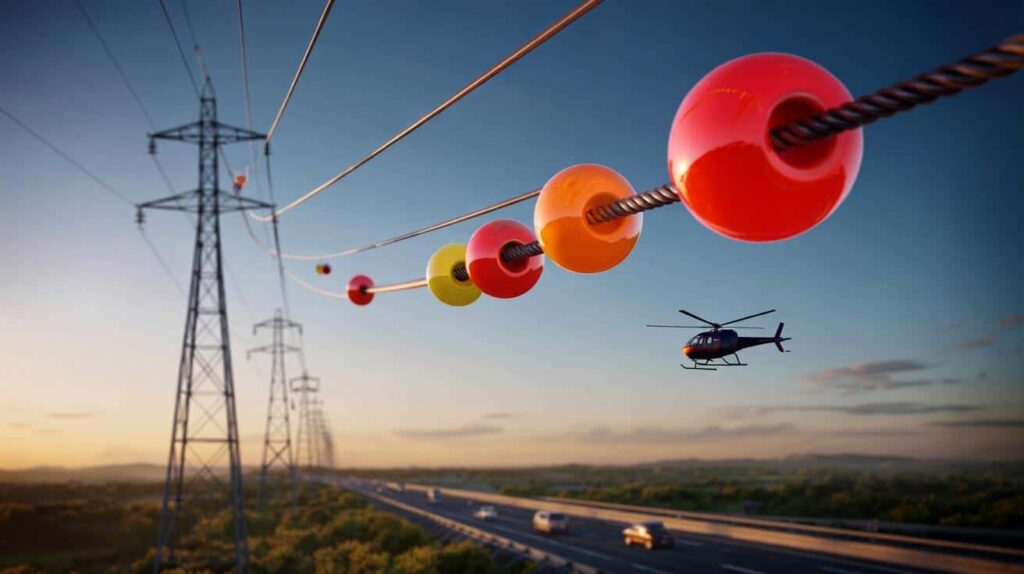
Big red balls hanging from high‑voltage lines, glowing softly in the late afternoon light like strange, silent lanterns. They look almost playful, scattered across an otherwise brutalist landscape of steel pylons and buzzing cables.
You’ve seen them along highways, above rivers, near airports. Always there, always a little mysterious. Kids in the back seat ask what they are, adults change the subject or improvise. The truth is, most of us just drive past and never really ask.
 Meteorologists warn early February may trigger an Arctic shift that rewrites climate expectations
Yet those red spheres are there for a reason that mixes safety, engineering… and a bit of fear. They’re not decoration. They’re warnings. And once you understand who they’re talking to, you may never look at them the same way again.

What are those red balls really for?
Look at a set of power lines from far away and you’ll notice something strange. The metal towers stand out clearly, but the cables themselves almost disappear into the sky. On a foggy morning or at dusk, the wires can completely vanish, especially across valleys or wide rivers.
 Bad news for homeowners: starting February 15, a new rule bans lawn mowing between noon and 4 p.m.
Those red balls act like high‑visibility flags on a nearly invisible trap. They shout: “There’s something here, don’t fly through.” Pilots, helicopter crews, even operators of agricultural planes rely on them as visual anchors. That bright splash of color breaks the illusion of an empty sky and maps out a danger line.
On a misty day in a small regional airport in the US, a helicopter pilot lines up for what looks like a clear approach over a canal. At the last second, a line of red markers flashes into view, strung along cables he hadn’t seen a second before. He adjusts his path by a few meters and passes safely above.
Stories like this don’t always make headlines, but the stats behind them quietly matter. Wire‑strike accidents involving aircraft have killed or injured hundreds of people worldwide. In many countries, aviation authorities now demand *aerial marker balls* on lines that cross rivers, valleys, highways or flight paths. They’re cheap insurance: a simple visual clue that prevents tragedies you never hear about.
Those spheres work on a very simple principle: contrast. Red, orange or white stands out sharply against the blue of the sky, the gray of clouds or the deep green of a forest. Spaced every 20 to 60 meters, they create a dotted line that draws the eye, even from a fast‑moving cockpit.
There’s also a strict logic behind their placement. Lines near airports, helipads, hospital roofs, coast guard bases or mountain passes are prime candidates. Engineers study flight charts and local traffic, then decide where a pilot is most likely to mistake a power line for empty air. That’s where the balls go. Quiet, simple, stubbornly visible.
How engineers choose the size, color and placement
Behind each red ball you see from the highway sits a surprisingly precise method. Power companies don’t just hang them randomly; they follow aviation guidelines that specify diameter, spacing and sometimes even color sequences.
Most marker balls range from 60 to 90 cm (2 to 3 feet) in diameter. The higher the line, the larger the sphere. A line crossing a wide valley might use very large markers so they stay visible from far away. Lower lines might use smaller ones, just enough to break the visual silence of the horizon.
Color isn’t chosen for style, either. In many places, the recommended palette is orange, red and white, sometimes alternating for better visibility against changing backgrounds. A line over a dark forest may use bright orange; near snowy mountains, red can pop more strongly.
Soyons honnêtes : personne ne sort son téléphone pour chercher les normes d’aviation en regardant l’autoroute. Yet those norms shape what you see. Regulators often require that these markers be installed at specific intervals, aligned with the highest wires, and facing key approach directions used by aircraft.
One engineer from a European grid operator summed up the logic simply:
“If a pilot has three seconds to notice danger, the ball has to win the visual battle against everything else in the landscape.”

On paper, that becomes a checklist:
- Height of the line versus typical flight altitude nearby
- Background colors in different seasons and weather
- Sun position during peak flight times
- Roads, rivers or infrastructure that might attract helicopters
- Previous incidents or near‑miss reports in the area
Hidden stories behind those silent markers
We’ve all had that moment where a landscape suddenly “clicks” into focus. You see not just what’s there, but why it was built that way. Those red balls are often the visible trace of an invisible story: a past accident, a new hospital helicopter service, a growing city pushing closer to old power corridors.
In Brazil, several high‑profile helicopter crashes in urban areas pushed authorities to tighten rules on obstacle marking. In mountain regions of Europe, rescue helicopters forced a rethink of how power lines were flagged across foggy valleys. In the US and Canada, agricultural aviation – low‑flying crop dusters skimming fields – has long been a driver for better wire marking.
There’s a blunt truth here: many safety rules get written in the shadow of tragedy. A fatal wire strike near a dam. A medical helicopter clipping lines during a night evacuation. An air‑rescue crew reporting a near‑miss over a snow‑covered river. Each event leaves scars, questions, then eventually… an orange or red ball hanging quietly over the same place.
Those markers also live a tough life. They face wind, UV light, ice, and sometimes even bird strikes. They need to be light enough not to overload the line, strong enough not to shatter into dangerous debris, and simple enough to install by teams who might be working from helicopters or climbing towers hundreds of meters above the ground.
One veteran line worker described the job like this:
“You hang this bright plastic ball on a wire and go home. People drive under it every day and never think about you. And that’s exactly how you know it’s working.”
Here’s a quick way to decode what you see from the road:
- Large, bright balls over rivers or highways: likely key flight corridors or rescue routes.
- Mixed colors in sequence: designed to stand out against changing backgrounds and seasons.
- Long stretches with no markers: usually lines far from known aviation paths.
- New balls appearing after years: often linked to new helipads, hospitals or traffic changes.
There’s no magic in those choices, just an ongoing negotiation between sky, steel and human risk.
A quiet invitation to look up differently
Next time you’re on a long drive and boredom starts to creep in, try a different game. Instead of scrolling your phone at a red light, scan the horizon for those dots on the lines. Notice where they appear. Near a river crossing. At the edge of a city. Above a big hospital complex with a helipad on the roof.
You’ll start to see an invisible map emerge. A hidden network of routes used by pilots, emergency crews, agricultural flights. The balls are like punctuation marks in the sky, telling you where the story of risk and movement suddenly gets more intense.
There’s something oddly reassuring about that. For every tragic headline we read, there are thousands of small, preventative gestures that quietly work in the background. A marker ball is one of the humblest: no electronics, no AI, no moving parts. Just plastic, color, and a very human understanding of how our eyes fail us when speed and distance compress.
And once you start seeing them as messages – not decorations – you may catch yourself explaining them to the kids in the back seat, or to a friend on a road trip. That’s how this kind of everyday knowledge spreads: not through manuals, but through these small, shared observations of the world above our heads.
| Point clé | Détail | Intérêt pour le lecteur |
|---|---|---|
| Primary purpose | Red balls are aerial marker balls to warn aircraft about hard‑to‑see power lines. | Transforms a daily visual curiosity into clear, useful knowledge. |
| How they’re designed | Size, spacing and color follow aviation and safety guidelines adapted to each location. | Helps you “read” the landscape and understand why they appear where they do. |
| Hidden backstory | Often installed after risk assessments, new helipads, or serious accidents and near‑misses. | Invites empathy for the unseen work and history behind simple safety devices. |
FAQ :
- Are the red balls on power lines only for airplanes?They’re mainly for aircraft, especially low‑flying helicopters and agricultural planes, but they also help drone operators and even construction teams spot dangerous lines.
- Why are some balls red and others orange or white?The colors are chosen for maximum visibility against local backgrounds; some regions use alternating colors so they stand out in all seasons and lighting conditions.
- Do the balls have any electrical function?No, they usually have no electrical role; they’re made of insulating materials and are purely visual markers, not transformers or sensors.
- Why don’t all power lines have these markers?They tend to be installed only where there’s known aviation activity or specific risk, because marking every single line would be costly and visually overwhelming.
- Can these marker balls fall or break?They’re designed to withstand harsh weather, but like any equipment they age; utilities inspect and replace damaged markers during routine maintenance or after storms.
