
Yet that is exactly the ambition behind the WindRunner, a US-designed giant that has just gained a heavyweight ally in the Gulf. The new partnership could shift the project from eye‑catching renders to booked routes and paying customers far sooner than expected.
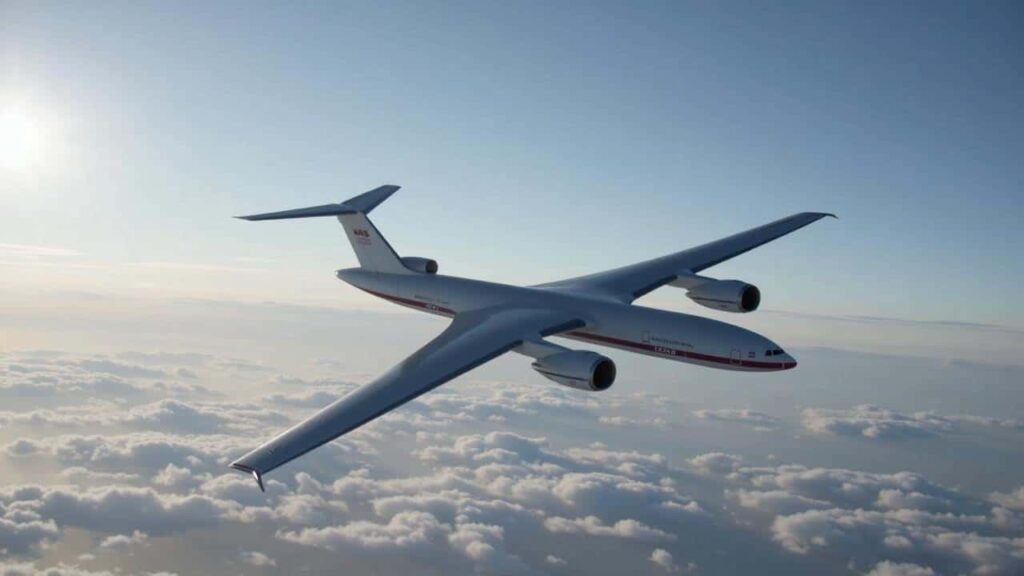
A mega‑aircraft designed for mega‑cargo
The WindRunner is the flagship project of Radia, an American company focused on outsized air freight. The aircraft is being developed as an ultra‑large, long‑range cargo platform built around one simple idea: move things that today are almost impossible to move by air.

Radia’s engineers originally conceived the aircraft to transport next‑generation wind turbine blades, which can stretch past 100 metres on future offshore projects. Moving such hardware by road or sea is slow, expensive and often blocked by basic geography.
 How long can you heat with a 15 kg bag of pellets? Here’s the answer depending on your stove
In Radia’s concept, the WindRunner would offer an internal cargo volume several times greater than that of today’s Antonov AN‑124, the Ukrainian‑designed workhorse that has long dominated heavy airlift missions. The goal is not just more payload, but more usable internal space for awkward, high‑value objects.

The aircraft is pitched as a flying warehouse: high volume, relatively simple systems, and the agility of a conventional jet, not a blimp or drone.
According to Radia’s early specifications, the plane would be able to land on semi‑prepared runways as short as roughly 1,800 metres. That type of performance would allow access to remote airfields, temporary military strips, or improvised runways set up near major construction or energy projects.
Dubai Airshow 2025: when the deal became real
The turning point for WindRunner came at the Dubai Airshow 2025, the Middle East’s main aerospace gathering. There, Radia announced a strategic partnership with Maximus Air, a specialist carrier based in Abu Dhabi and focused on out‑of‑gauge freight.
Radia brings the hardware and engineering: the airframe, systems integration and certification programme. Maximus brings something just as valuable in commercial aviation: real customers, operational experience and regulatory relationships across demanding markets.
The agreement aims to integrate WindRunner into actual missions from day one of service. That means defined routes, pre‑identified clients and a roadmap for scaling up operations rather than a vague “build it and they will come” approach.
The deal shifts WindRunner from an engineering curiosity to a project with a credible path to revenue‑earning flights.
Why Maximus Air matters
Maximus Air is not a newcomer chasing headlines. The carrier, founded in 2005 and part of the Abu Dhabi Aviation Group, already operates some of the most capable heavy lifters in service, including Antonov AN‑124‑100s and Ilyushin IL‑76TDs.
Its core business lives in the messy reality of oversized cargo:
- humanitarian missions into rough or damaged airfields,
- government and defence logistics,
- offshore energy support,
- urgent industrial shipments that cannot wait for sea freight.
This gives Maximus an asset Radia lacks: deep, practical knowledge of how giant cargo actually moves, from diplomatic permissions to cranes, forklifts and customs at 3am in a remote desert airport.
For Radia, tying its future flagship to a carrier that “knows the dirt” on heavy logistics helps reduce one of the big risks for novel aircraft: building something impressive that no one quite knows how, or where, to use.
A booming market for gigantic freight
The partnership also lands at a moment when demand for outsized logistics is climbing sharply. Several sectors are converging on the same problem: they need to move things that are getting physically bigger and more complex.
Key drivers include:
- Energy: offshore wind turbines, large battery systems, generators and grid modules.
- Defence: armoured vehicles, mobile radar stations, missile systems and command posts.
- Space: satellite buses, launch vehicle segments and ground support equipment.
- Industrial construction: modular power plants, refinery units, prefabricated factory sections.
- Emergency response: field hospitals, desalination units, mobile power and shelter infrastructure.
Yet the current fleet able to handle such jobs is ageing. The world has a small number of AN‑124s and IL‑76s, many built decades ago, with rising maintenance costs and limited availability. Demand keeps growing; capacity barely does.

WindRunner is pitched as a fresh, Western‑certified alternative to ageing Soviet‑era freighters, designed around today’s safety and environmental rules.
How WindRunner is supposed to operate
Radia has outlined several core design features that set WindRunner apart from existing cargo jets:
- Modular interior: a cavernous fuselage with a rear loading ramp, allowing drive‑on, drive‑off loading of long or tall items.
- Rough‑field capability: operations from semi‑prepared runways of around 1,800 metres, similar to military forward bases or upgraded regional strips.
- Massive internal dimensions: the company targets loads roughly up to 30 metres long and about 5 metres high, far beyond typical freighter standards.
- Conventional piloting: crewed cockpit and integration into existing civilian air traffic corridors, avoiding the regulatory complications of drones or exotic vehicles.
Radia stresses that WindRunner will remain an airplane “in the classical sense”: wings, engines and a conventional flight deck, not a hybrid airship or experimental unmanned platform. The innovation sits mainly in scale and cargo flexibility, not in ripping up every design rule.
What the alliance changes for the business case
A huge aircraft brings huge development and operating costs. Without signed customers, that kind of programme often stalls. The relationship with Maximus is intended to narrow that uncertainty.
| Radia | Maximus Air |
|---|---|
| Designs and certifies WindRunner | Operates aircraft on global routes |
| Provides engineering, maintenance concepts | Provides crew, ground handling and logistics |
| Targets key industries (energy, space, defence) | Brings existing client base and government ties |
| Seeks financing for production | Builds commercial schedule and utilisation plans |
For financiers and potential launch customers, the presence of a specialist operator with a track record in heavy missions can make the proposition less speculative. The aircraft is no longer just a technical gamble; it is woven into a known network of routes and contracts.
Risks, hurdles and what could still go wrong
No matter how promising the alliance looks, WindRunner still faces a long list of challenges. Oversized cargo aircraft occupy a narrow niche and must justify their existence over decades.
Key risks include:
- Certification complexity: regulators will need to sign off on an airframe that pushes existing size and weight envelopes.
- Economic viability: the plane must fly often enough, and with high enough rates, to cover its high fixed costs.
- Infrastructure upgrades: even with rough‑field capability, many airports will still need reinforced pavements, wider taxiways or special loading gear.
- Competition from sea and rail: shipping and rail remain cheaper for non‑urgent cargo, and may fight to keep their share.
There is also the question of timing. Energy and space markets move in cycles. If the aircraft arrives late, some demand may have already shifted to alternative logistics or redesigned hardware that breaks down into smaller components.
What this could mean in practice
If the programme reaches service, several concrete scenarios illustrate how it might change logistics planning.
For offshore wind, developers could pre‑assemble larger components at central factories, then send them by air to coastal hubs close to installation ports. That reduces the need for multiple regional factories and cuts weeks out of delivery schedules when a project is running behind.
In disaster response, a single WindRunner could deliver a complete field hospital, water purification system and power units directly to an airstrip near the affected zone, rather than dispatching multiple smaller aircraft or waiting for maritime shipments.
For defence customers, the plane could move heavy vehicles and radar systems into remote theatres without relying on access to large international hubs, which are often politically sensitive or vulnerable to disruption.
Key terms and context for non‑specialists
When aviation insiders talk about “out‑of‑gauge” or “oversized” freight, they mean cargo that exceeds standard size limits for containers or pallets. That includes anything too long, tall or heavy to fit through a typical freighter door or sit in standard positions on the aircraft floor.
“Semi‑prepared runway” usually refers to a strip that may not be fully paved or meet all commercial airport standards, but that has been compacted and graded enough to support large aircraft at lower frequencies. Think upgraded military airstrips, remote mining sites or temporary logistical bases for major construction projects.
These nuances shape why a project like WindRunner exists at all. It does not compete with container ships bringing phones and T‑shirts. It targets the tiny share of global cargo that is physically awkward, extremely valuable, time‑sensitive or all three at once.
