
Around you, phones are held up like electric candles, screens glowing in the fading daylight. The air feels strangely still, as if the world has suddenly turned down its own volume. Somewhere, a child asks, “Is the sun going to come back?” and the adults laugh a little too loudly. The light is already wrong – not sunset, not storm, but that eerie metallic glow that makes colors go flat and shadows go sharp. Birds hesitate. Dogs look up, confused.
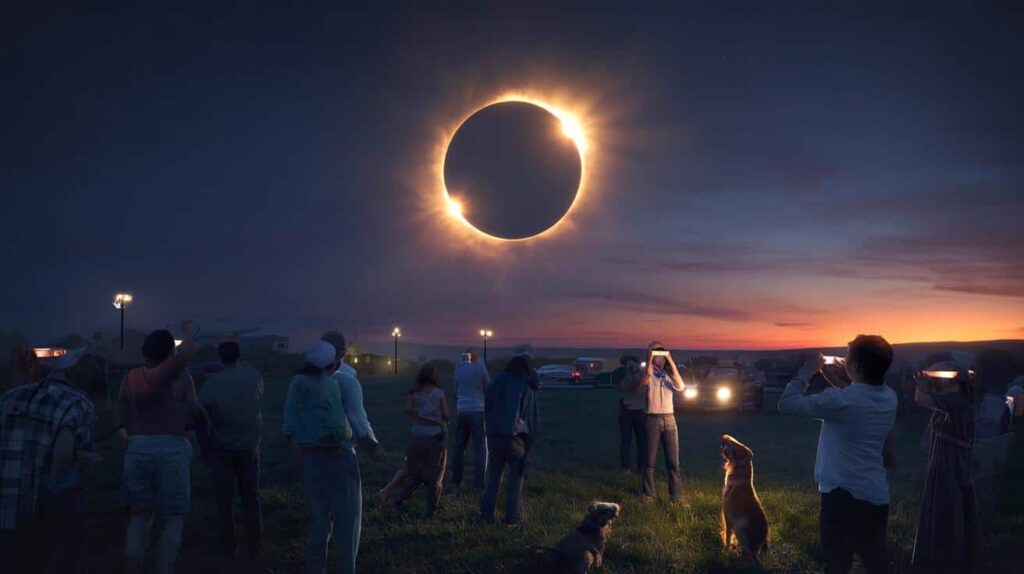
For a few heartbeats, it feels like the planet itself is taking a breath.

In just six minutes, day will briefly become night.

The longest eclipse of the century is coming — and it’s not like the others
Picture midday turning into a cold, silvery twilight while your watch still insists it’s barely lunchtime. That’s what astronomers are buzzing about: a rare total solar eclipse set to deliver up to **six minutes of darkness**, making it one of the longest of this century. Six minutes doesn’t sound like much on paper. In real life, standing under a disappearing sun, it’s an eternity.

The Moon, perfectly lined up with the Sun and the Earth, will carve a narrow path of totality across the planet. Outside that path, daylight will dim, but under that precise strip, the Sun will vanish completely. For those few minutes, our star becomes a ghostly crown.
If you were in the path of the 2017 Great American Eclipse or the 2024 North American eclipse, you might think you know the feeling. Yet veteran chasers say longer eclipses hit differently. During totality that stretches past four, five, nearly six minutes, your body stops registering it as a quick spectacle and starts feeling it as an environment.
You notice the temperature dropping on your skin. Outdoor lights flicker on like they’re confused. Some people cry, others laugh, some fall totally silent. One NASA scientist once described it as “standing inside a hole in the sky.” There’s enough time, for once, to actually look around, breathe, and realize how tiny we are under this choreography of shadows.
There’s a reason eclipses have always rattled humans, from ancient myths of sky-eating dragons to crowds today screaming on TikTok videos. The Sun is the ultimate constant in our lives. When it disappears in the middle of the day, even briefly, your brain lights up with a primitive alarm: something is wrong. And yet nothing is wrong. The Moon is simply slipping in front of the Sun from our perspective, lining up with a precision that would feel fake in a sci-fi script.
For scientists, these extra-long eclipses are a gift. The extended totality offers rare time to study the Sun’s fragile outer atmosphere, the corona, and test theories about space weather that can affect our satellites and power grids. For everyone else, it’s a once-in-a-lifetime chance to watch the universe pull off a magic trick in slow motion.

How to actually live those six minutes — not just film them
There are two kinds of people during an eclipse: those staring at the sky, and those staring at their phones. If you want those six minutes to feel like something you’ll remember in ten years, start by deciding which one you want to be. The basic method is simple: plan your spot in the path of totality, pack real eclipse glasses with proper ISO certification, and build your day around those tiny windows of time.
Arrive early. Talk to the strangers around you. Look at the shadows under trees as the Moon begins to bite into the Sun — they’ll turn into thousands of tiny crescents. When totality hits and the world drops into that strange twilight, you won’t be thinking about the perfect photo. You’ll be thinking, *I am literally watching the machinery of the solar system at work.*
Here’s where most people slip: they treat an eclipse like a concert and end up experiencing it mostly through a camera app. Let’s be honest: nobody really re-watches 500 eclipse clips on their phone two years later. You remember how you felt. You remember the temperature, the screams, the silence, the way birds suddenly roosted at noon.
So yes, grab a quick shot at the beginning if you want. Then, put the device down for a while. Many eclipse veterans quietly suggest a “30–30 rule”: thirty seconds to record, thirty seconds to just look. And if you’re not in the path of totality, resist the urge to shrug it off. Even a partial eclipse is worth a lunch break outside with colleagues, cheap cardboard glasses, and a few awkward “wow” noises.
During the 1999 total eclipse over Europe, French astrophysicist Serge Brunier wrote, “For a brief moment, humanity abandoned its screens and clocks and looked up together, naked-eyed, at the same sky. It felt like remembering something very old.”
- Before the eclipse – Check your location against the path of totality, and note three times: first contact (the Moon’s first “bite” into the Sun), start of totality, and end of totality. These are your anchors.
- During the partial phase – Use your eclipse glasses or a simple pinhole projector, and watch the Sun slowly transform. This is the slow-burn part, where anticipation builds.
- At totality
- – Take your glasses off only when the Sun is fully covered and the corona appears. Look around, not just up. Notice the horizon glowing like a 360° sunset, listen to the animals, feel the air.
- After totality
- – Glasses back on as soon as the first diamond of light reappears. Then, talk about it. Sharing that “Did that really just happen?” is part of the experience.
A brief darkness that lingers in the mind long after the light returns
Once the Sun comes back, something odd happens: traffic restarts, kids complain they’re hungry, someone checks their emails. Life snaps back as if nothing cosmic just occurred. Yet people who’ve seen a long total eclipse carry it around like a small, private fracture in time. Many describe a gentle aftershock that lasts days — a mix of awe, mild sadness, and a strange new awareness of being stuck to a spinning rock in space.
We’ve all been there, that moment when the sky does something unusual and suddenly every everyday problem shrinks a little. An eclipse, especially one that steals almost six full minutes of daylight, amplifies that feeling. It doesn’t fix anything, it doesn’t answer big questions, but it quietly rearranges the scale of things. You might find yourself talking to a neighbor you’ve never greeted, or deciding, for no clear reason, to book that trip you kept postponing. This is the quiet power of a shared celestial event: nobody owns it, nobody can replay it live, and yet everyone under that shadow remembers where they were.
| Key point | Detail | Value for the reader |
|---|---|---|
| Longest eclipse of the century | Up to about six minutes of totality along a narrow path | Signals a rare, “must-see” sky event worth planning around |
| Experience, not just spectacle | Temperature drop, animal behavior, eerie light, human reactions | Helps the reader go beyond photos and genuinely live the moment |
| Simple preparation matters | Correct glasses, being in the path, arriving early, watching partial phases | Turns a random glance at the sky into a powerful, memorable experience |
FAQ:
- Question 1Can I look at the eclipse with sunglasses or through my phone camera?Normal sunglasses, even very dark ones, don’t protect your eyes from the Sun’s rays, and your phone screen doesn’t act as a shield. You need proper eclipse glasses with certified solar filters for every phase except the brief window of totality.
- Question 2What’s the difference between a partial and a total eclipse?In a partial eclipse, the Moon covers only part of the Sun, so daylight just dims. In a total eclipse, the Sun is fully hidden, the corona appears, and the world briefly drops into a strange twilight — that’s when day can feel like night.
- Question 3Do I need special equipment to enjoy it?No telescope is required. With eclipse glasses and a spot in or near the path of totality, your own eyes are enough. A simple pinhole projector or colander can even turn the ground into a canvas of crescent Suns.
- Question 4Is a long eclipse really that different from a short one?Yes. When totality stretches toward six minutes, you have time to relax into it, notice details, and let the feeling sink in. Short eclipses are breathtaking; long ones become almost meditative.
- Question 5What if I can’t travel to the path of totality?You can still experience a partial eclipse from outside the path. Step outside, use eclipse glasses, invite friends or coworkers, and turn those odd minutes of dim light into a shared break from routine. You’ll still be watching the same alignment, just from a different seat in the theater.
