
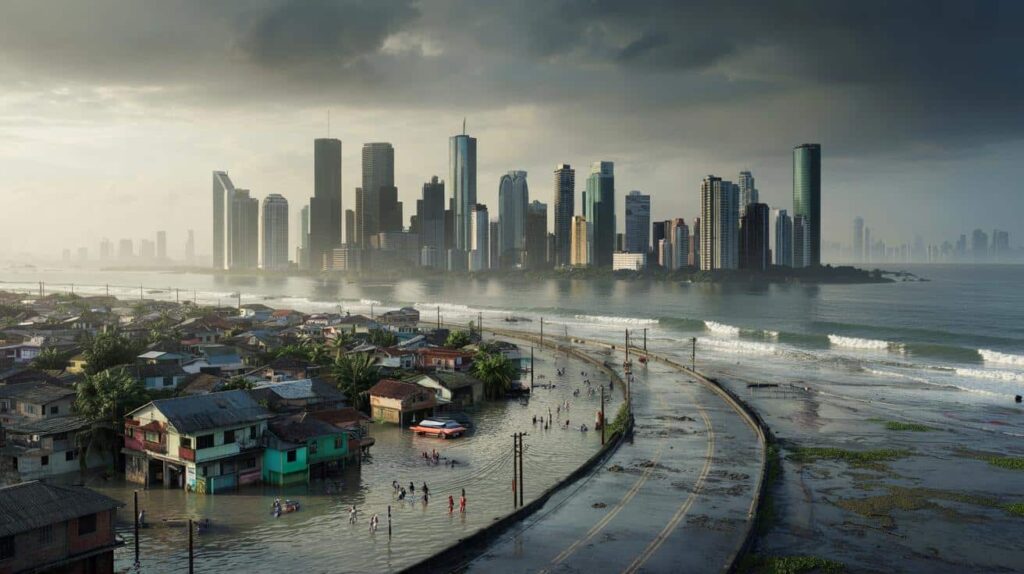
What once looked like a distant climate threat is now colliding with another, quieter crisis: the ground beneath many megacities is sinking centimetre by centimetre each year, tightening the countdown for millions of residents.
What scientists are warning about
A recent study in the journal Nature Sustainability examined 48 major cities already affected by subsidence, the gradual sinking of land. These places represent roughly a fifth of the world’s urban population. The numbers are stark: in some districts, the ground is dropping faster than sea levels are rising.

In many coastal megacities, the land is sinking several times faster than the ocean is climbing, creating a double hit of risk.

Subsidence is not a sudden sinkhole or a dramatic earthquake. It is a slow, uneven sag in the Earth’s surface, driven by human activity layered onto natural geology. Buildings, roads and pipes are designed for relatively stable ground. Once that assumption fails, entire cityscapes start to deform.

The cities sinking fastest
The study highlights a group of urban hotspots where subsidence is particularly alarming, either due to the speed of sinking or the sheer number of people exposed.
- Jakarta, Indonesia – up to 26 mm per year in some areas
- Ahmedabad, India – up to 23 mm per year
- Istanbul, Turkey – up to 19 mm per year
- Houston, Texas, US – up to 17 mm per year
- Lagos, Nigeria – up to 17 mm per year
- Manila, Philippines – up to 17 mm per year
On paper, a few millimetres per year may not sound catastrophic. Stretch that over 30 or 40 years, add accelerating sea-level rise, more powerful storms and rapid population growth, and the picture changes very quickly.
Jakarta: a sinking capital that gave up
Jakarta is perhaps the most famous example. Parts of the Indonesian capital are sinking by more than 26 mm a year, mainly due to uncontrolled groundwater pumping and the sheer weight of dense development on soft, waterlogged soils.
The Indonesian government has already taken a drastic decision: moving the national capital around 1,000 kilometres away to a new site on the island of Borneo. That doesn’t rescue the tens of millions who will continue to live in and around Jakarta, but it signals how authorities see the long-term odds.
Relocating a capital city is less an act of ambition than an admission that some coastal risks can no longer be managed in place.
Mexico City: sinking far from the sea
Subsidence is not only a coastal problem. Mexico City, built on the bed of an ancient lake, is famously sinking as the clay-rich ground compacts. Decades of pumping groundwater for a vast metropolitan population have drained the underground layers like a sponge, which then collapses.
In some neighbourhoods, streets warp, pipes crack and buildings tilt at different angles. Engineers say parts of the city are unlikely to rebound, even if pumping stopped entirely, because the soils have already compressed to an almost permanent state.
Why these cities are going down
The reasons differ from city to city, but a few drivers come up again and again.
| Main driver | How it makes cities sink | Typical examples |
|---|---|---|
| Groundwater extraction | Pumping water from underground aquifers causes the soil above to compact and settle. | Jakarta, Mexico City, Manila, parts of Houston |
| Weight of urban development | Heavy buildings, roads and infrastructure press down on soft or reclaimed land. | Coastal districts of Jakarta, Lagos, Asian port cities |
| Sand mining and land reclamation | Removing or reshaping sediments changes how the ground supports structures. | Lagos, rapidly growing ports in West Africa and Asia |
| Oil and gas extraction | Removing hydrocarbons causes underground layers to slump slowly. | Houston and parts of the Gulf Coast |
Urbanisation patterns matter greatly. When development spreads fast and informally, rules on drilling wells, managing construction loads or monitoring ground movement are often ignored. That can push subsidence rates sharply higher in just a decade or two.
Houston, Lagos, Manila: different cities, same direction
Houston’s petrochemical footprint
In Houston, the ground has been sinking in part due to oil and gas extraction, but also because of heavy groundwater use and industrial development along the Gulf Coast. Low-lying suburbs already rely on levees and drainage systems to keep tidal flooding at bay. Continued subsidence erodes that protection and increases the cost of maintaining infrastructure.
Lagos and the price of sand
Lagos, one of the world’s fastest-growing cities, faces a different subsidence trigger: intensive sand extraction. Sand is a key ingredient in concrete and land reclamation projects. Removing it from coastal and lagoon environments can destabilise the ground, leaving buildings standing on increasingly fragile foundations.
With millions moving into informal settlements on flood-prone land, even small increments of sinking can turn seasonal high tides into regular household emergencies.

Manila and the groundwater squeeze
In Manila, the combination of groundwater pumping, soft deltaic soils and rapid sprawl is driving subsidence of up to 17 mm a year in some districts. The Philippine capital already sits in the path of strong typhoons. When storm surges travel over higher seas and meet a lower city, flood depths and damage costs rise steeply.
Subsidence doesn’t act alone; it amplifies every other coastal hazard that cities already struggle to manage.
Europe and France: slower, but not exempt
The study notes that parts of Europe, including France, are also affected, though on average at lower rates than Asian or African megacities. Some ports and delta regions show measurable sinking, often linked to historic land reclamation and groundwater use.
Lower rates do not necessarily mean low risk. Many European cities have extensive underground transport networks, ageing sewers and dense historic districts. Even modest, uneven subsidence can twist tunnels, crack masonry and weaken flood defences that were designed under very different assumptions about stability and sea level.
Can anything actually stop this?
Researchers are blunt: many of these cities are heading towards partial or extensive inundation within decades, unless radical changes are made. There is no single fix, but several measures can slow or limit the damage.
- Restricting or banning uncontrolled groundwater pumping in high-risk zones
- Shifting to lighter construction methods and limiting ultra-heavy towers on soft soils
- Planning new districts away from subsidence hotspots and flood-prone coasts
- Reinforcing or redesigning sea walls, levees and drainage systems with sinking ground in mind
- Monitoring land movement with satellites to spot dangerous trends early
Some strategies only buy time. A sea wall built today might be effective for 20 years, then struggle as both the water level and the land level move in opposite directions. This is one reason governments are starting to consider managed retreat from some districts, even as they upgrade defences in others.
What “inevitable disappearance” actually means
When scientists say a city’s “disappearance” looks inevitable, they rarely mean every street will vanish under water in one dramatic event. The process is more patchwork and drawn-out.
Low-lying neighbourhoods may become uninsurable first. Infrastructure costs may outstrip local budgets. Wealthier residents might move uphill, while poorer communities remain in zones that flood several times a year. Over a generation, parts of the city effectively cease to function, even if the skyline is still visible.
Disappearance often begins as a quiet retreat: bus routes cut, schools closed, maintenance skipped in streets that flood just a bit too often.
Key terms worth knowing
Subsidence is the gradual sinking of the ground surface. It can be natural, due to geological processes, or triggered by human actions like pumping water or oil from underground.
Managed retreat refers to the deliberate, planned relocation of people and infrastructure away from high-risk areas, rather than waiting for repeated disasters to force chaotic evacuations.
A simple future scenario
Imagine a coastal district that currently sits one metre above high tide. The land is sinking at 15 mm per year. Local sea level is rising at 4 mm per year due to climate change. Combined, that is a relative change of 19 mm a year. In 30 years, the effective elevation drops by more than half a metre.
Storm surges that used to be “once in a century” events might then strike every decade, or even every few years. Drains designed for rare floods would back up regularly. Buildings never built for standing saltwater would start to corrode from the foundations up. Even without a dramatic disaster, the area becomes steadily harder and more expensive to inhabit.
For many of the 48 cities studied, that kind of arithmetic leaves little room for delay. The ground is already moving, and it is not moving in their favour.
