The first thing you hear is the crunch of dry soil under boots. Then, a softer sound you don’t expect at all: wind combing through leaves where, not so long ago, there was nothing but baked earth and dust. At the edge of a hill in northern China, a ranger stops, points to a horizon now blurred by green, and says quietly, “When I was a child, this was dead.”
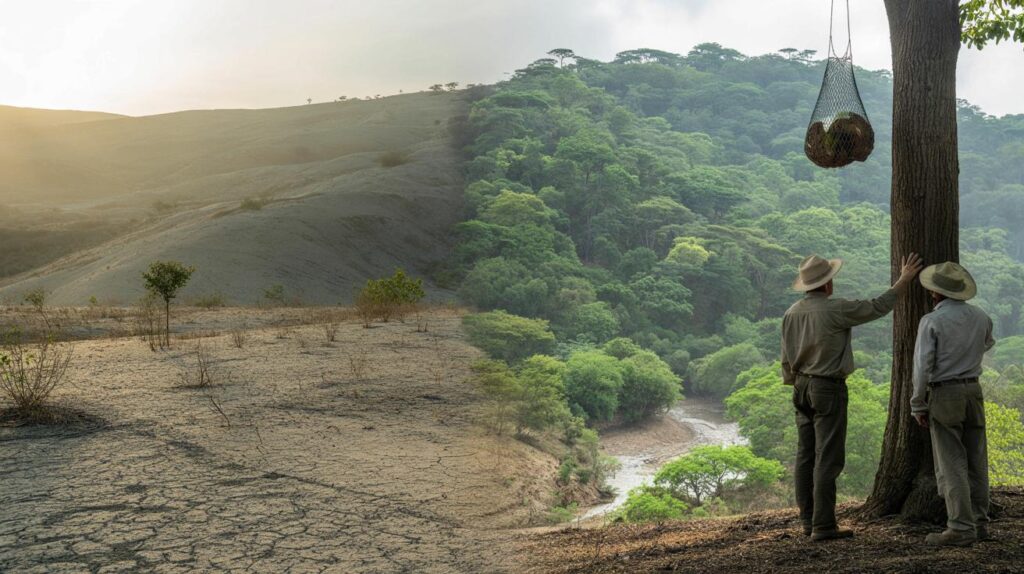
The air feels cooler than it should for this latitude. Birds argue in the canopy. A thin mesh bag, once wrapped around a sapling, hangs loose from a trunk as thick as a human leg.
Twenty‑five years ago, this slope was essentially a scar on the planet.
Today, it’s quietly swallowing carbon like a giant, living lung.
From moonscape to living sponge: what 25 years can do
Stand on an old satellite image of the Loess Plateau or the dusty hills of Ethiopia, and you’d think you were looking at a black‑and‑white photo of the moon. Pale, eroded, ribbed landscapes where rain simply bounced off and rivers ran the color of chocolate milk. Locals still remember when you couldn’t grow much more than tough scrub or a few rows of struggling maize.
Now, those same ridgelines are softened by the round crowns of acacia, pine, and native shrubs. From the air, the change is shocking: patches of green coalescing into corridors, then into continuous forest. The transformation is not a feel‑good rendering. It’s real ground, real roots, real shade.
Take the Loess Plateau in China, one of the most famous reforestation stories on Earth. At the end of the 1990s, vast swathes were degraded to the point that dust storms regularly swallowed Beijing’s sky. The government launched massive tree‑planting and terracing there and across northern provinces.
Today, scientists estimate that Chinese forests planted since the late 1990s absorb hundreds of millions of tons of CO₂ each year. In some years, new forests and recovering land across the country have soaked up as much as 1.5 billion tons of CO₂ — roughly a tenth of China’s total emissions. That’s not a rounding error. That’s a giant brake pedal.
The logic behind this is as old as photosynthesis class in middle school. Trees take CO₂ out of the atmosphere and lock the carbon into wood, roots, and soil. The more biomass, the more carbon stored. So when landscapes that were once bare or eroded begin to grow dense with vegetation, the entire region flips from being a source of CO₂ — through soil erosion, burning, and crop failures — to becoming a sink.
But the real twist comes with time. Young plantations absorb carbon fast, yet after twenty, twenty‑five years, those same areas start behaving like stable green infrastructures. They don’t just capture carbon; they cool the air, slow winds, and change local rainfall patterns. A one‑off campaign morphs into a living, breathing climate machine.
The slow, stubborn craft of growing a carbon sink
Reforestation on this scale doesn’t look glamorous up close. It looks like old trucks loaded with fragile seedlings bumping along bad roads at dawn. It looks like farmers digging planting pits by hand, sometimes for days, in land where rain falls wrong and the wind dries everything it touches.
The most successful projects start small and specific. Right species, right place, right people paid to care for them. That could mean native oaks on Mediterranean hillsides, mixed fruit and timber trees in the Sahel, or mangroves along tropical coasts. The technique is almost boringly simple: loosen the soil, plant, protect from grazing and fire, then wait — through setbacks, droughts, and years that feel like nothing is happening at all.
When projects go wrong, they often fail for very human reasons. Planting the wrong trees because they grow fast looks good in year five but collapses by year fifteen when monocultures get hit by pests or run out of water. Paying communities only for planting day, not for the next decade, leaves seedlings abandoned. Or authorities chase big numbers — “a billion trees!” — without asking how many survive.
We’ve all been there, that moment when enthusiasm outruns patience. The same thing happens with forests. People love the photo of a politician with a shovel. They care much less about the unglamorous job of guards patrolling against illegal logging, or villagers hauling water to young trees in scorching heat. That’s where real climate impact is quietly made or lost.
One forester in Rwanda summed it up during a break under the sparse shade of a five‑year‑old grevillea:
“Everyone talks about planting trees,” she sighed. “My job is to keep them alive long enough to matter.”
To shift from slogans to sinks that truly pull CO₂ out of the sky, long‑term care needs to be baked in from day one. That often means building in simple, stubborn practices like:
- Paying local communities not only to plant, but to protect and thin forests over 10–20 years.
- Mixing species so forests are resilient to drought, disease, and changing climate patterns.
- Leaving room for grazing, fuelwood, and food trees so people gain ongoing value.
- Monitoring survival rates, not just counting how many seedlings went into the ground.
- Planning for fire breaks, water access, and natural regeneration instead of endless planting.
Let’s be honest: nobody really checks every seedling every single day. Yet when local people feel the forest is theirs, they’ll walk those hills, argue over them, and defend them in ways no outside project ever could.
What these new forests really change for the rest of us
Twenty‑five years is both a long time and not long at all. For a teenager who planted a sapling in 2001, that tree is now taller than a house. For the climate system, it’s a blink. Still, the numbers are starting to bend. Global studies now suggest that restored and expanding forests worldwide absorb a significant share of our annual emissions — some estimates run into several billion tons of CO₂ a year when you add up natural regrowth and planned reforestation.
That doesn’t cancel the smokestacks or the exhaust pipes. It doesn’t erase the emissions from flights, factories, or food. *A forest is a buffer, not a magic eraser.* Yet it buys time. It lowers the peak. It offers a concrete, visible counter‑story in regions that were written off as ecological losses.
For people living on these once‑barren lands, the change is not an abstract carbon graph. It’s a slightly longer rainy season, fewer dust storms, cooler evenings. It’s women spending less time walking for firewood because branches are closer. It’s kids seeing birds and insects their grandparents thought were gone. More shade means better crops, better soil, and a tiny bit more predictability in a world where the weather has become a stranger.
From a distance, satellite images track the green wave and the CO₂ it absorbs. Up close, the story is human: farmers hesitating to give up fields for trees, then twenty years later harvesting fruit, honey, or sustainable timber from those same slopes. One act of faith at planting time, repaid very slowly over a generation.
These reforested landscapes don’t release us from cutting fossil fuels fast. They run beside that race, not instead of it. But they carry a kind of quiet, stubborn hope that policy papers struggle to convey. **Bare land can come back. Carbon curves can bend.** New forests in China, Ethiopia, Rwanda, Costa Rica, even unexpectedly in parts of Europe and North America, prove that.
The real question is whether we’re ready to think in decades rather than news cycles. Whether we can back community‑led restoration, not just flashy pledges. Whether we can see a dusty hillside and imagine the cool shade that could be there in 2049 if we act in 2024. These are the slow decisions that, multiplied across continents, end up drawing millions of tons of CO₂ out of the sky every single year.
| Key point | Detail | Value for the reader |
|---|---|---|
| Reforested land as carbon sinks | Once‑barren regions now absorb hundreds of millions of tons of CO₂ annually after decades of restoration | Shows that damaged landscapes near you may also have powerful climate potential |
| Time and care matter more than planting days | Projects that fund long‑term protection, mixed species, and community benefits are the ones that last | Helps you evaluate which tree‑planting or climate projects are truly worth supporting |
| Human gains beyond carbon | New forests cool local climates, protect soils, and support livelihoods and biodiversity | Reframes reforestation as everyday resilience, not just an abstract climate metric |
FAQ:
- How much CO₂ can reforested areas really absorb?Large‑scale restoration and new forests worldwide are estimated to absorb several billion tons of CO₂ each year, with countries like China alone accounting for hundreds of millions of tons annually as their 20–25‑year‑old forests mature.
- Is planting trees enough to stop climate change?No. Tree planting and forest recovery help slow warming but cannot replace deep cuts in fossil fuel use. They work best as a long‑term safety net alongside rapid emissions reductions.
- Do these new forests last, or will they just burn?The risk of fire and drought is real, especially in a warming world, which is why mixed species, fire breaks, community management, and planning for water are crucial to keep carbon locked away.
- What’s the difference between plantations and real forests?Monoculture plantations grow fast but are vulnerable and often poor for wildlife, while diverse, semi‑natural forests store carbon more stably and support many more species and local uses.
- What can an ordinary person do about all this?You can support credible, community‑led restoration programs, protect forests where you live through local campaigns, and reduce your own carbon footprint so those hard‑won green sinks aren’t overwhelmed.