
France is drawing attention with ambitious energy investment plans, but a closer look at the figures reveals a striking imbalance. While the country’s €72.8 billion nuclear fleet investment dominates headlines, it looks relatively small compared to the €200 billion needed to modernize France’s national power grid. This gap points to a broader challenge as France works to balance long-term energy security, climate commitments, and rapidly growing electricity demand. The debate is no longer limited to building reactors; it now centers on whether the underlying infrastructure can keep up.
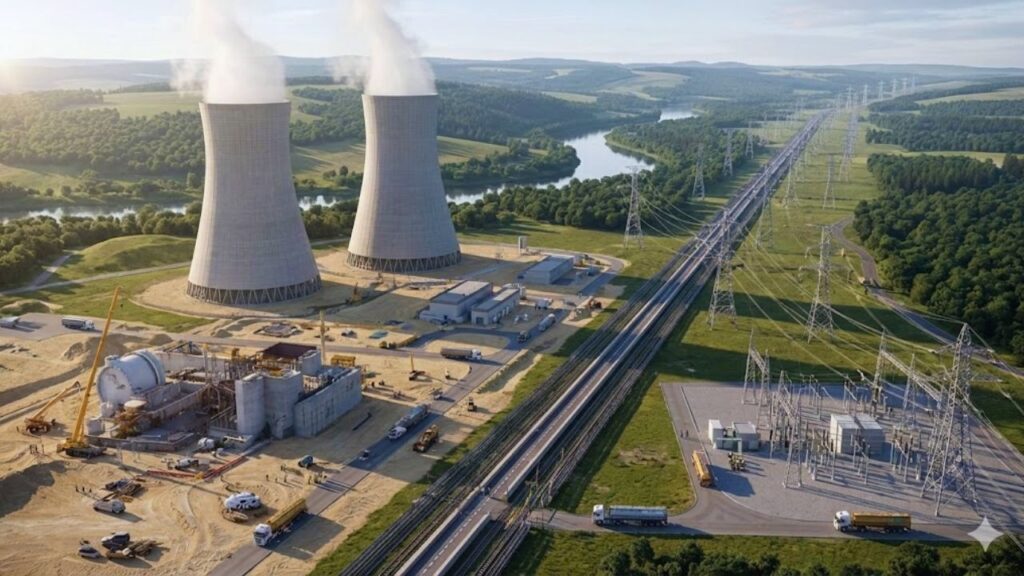
France’s Nuclear Expansion Meets Grid Constraints
The €72.8 billion nuclear fleet plan aims to protect France’s low-carbon electricity future, but it operates under significant limits. Funding must be shared across new reactor construction, life-extension programs, and strict safety upgrades, all while timelines extend well into the next decade. Meanwhile, rising power demand, aging reactor units, lengthy approval processes, and capital-intensive projects add further pressure. Nuclear investment alone cannot support the entire energy transition. Without matching upgrades to transmission and distribution networks, even dependable nuclear generation risks being delayed or failing to reach consumers efficiently.
 A Mine Worth €120 Billion Was Uncovered in the United States and Investors Are Watching Closely
Why Power Grid Investment Far Exceeds Nuclear Spending
The planned €200 billion grid modernization far outweighs nuclear spending because it affects every layer of the energy system. France’s grid must adjust to decentralized energy production, electric vehicle adoption, and expanding cross-border electricity flows. This includes capacity expansion, digital management systems, renewable integration, and climate-resilience improvements. Unlike nuclear projects, grid upgrades are less visible but deeply embedded across the country. They involve strengthening lines, upgrading substations, and deploying smart technologies, all while maintaining uninterrupted supply. The scale reflects the grid’s growing role in economic stability and energy reliability.
 This Normandy Safran Plant Just Won a Major Aviation Medal and France Is Bragging Rights Loud
France’s Energy Strategy Moves Beyond Reactors
France’s evolving energy strategy now reaches well beyond nuclear reactors. Policymakers increasingly identify infrastructure readiness as the main bottleneck, particularly as electrification accelerates. Achieving climate targets depends on flexible power delivery, regional load balancing, faster grid connections, and rising consumer electrification. While the nuclear fleet plan remains essential for stable baseload power, it cannot succeed on its own. Grid preparedness ultimately determines whether new generation capacity translates into usable electricity across the country.

The Cost Gap That Reshapes Energy Priorities
The sharp contrast between nuclear and grid investment is redefining France’s energy priorities. Nuclear power continues to anchor the system with low-emission stability, but the grid has emerged as the true backbone of transformation. Policymakers now face challenges tied to investment sequencing, public funding pressure, long-term returns, and system-wide coordination. If grid upgrades fall behind, the benefits of nuclear expansion could stall; if both advance together, France may unlock a more flexible and resilient energy model. The figures suggest the real focus is no longer reactor numbers, but network readiness.
| Investment Area | Estimated Cost (€) | Main Purpose |
|---|---|---|
| Nuclear Fleet Plan | 72.8 Billion | Low-carbon baseload power |
| National Grid Overhaul | 200 Billion | Modernize transmission and distribution |
| Smart Grid Systems | 40 Billion | Digital monitoring and control |
| Grid Resilience Upgrades | 30 Billion | Climate and weather adaptation |