
On the big screen in Pasadena, the Martian clock slipped out of sync with the one on the wall, and for a few long seconds nobody spoke. A line of red numbers marked “Sol 894” ticked forward, ignoring the neat, blue Earth time in the corner like a stubborn second hand. An engineer rubbed his eyes, then checked his laptop again, half laughing, half swearing – the rover’s logs, the orbiters’ pings, even the astronauts’ simulated schedules were drifting. Not by hours. By slivers. By crumbs of seconds that refused to match the time back home.
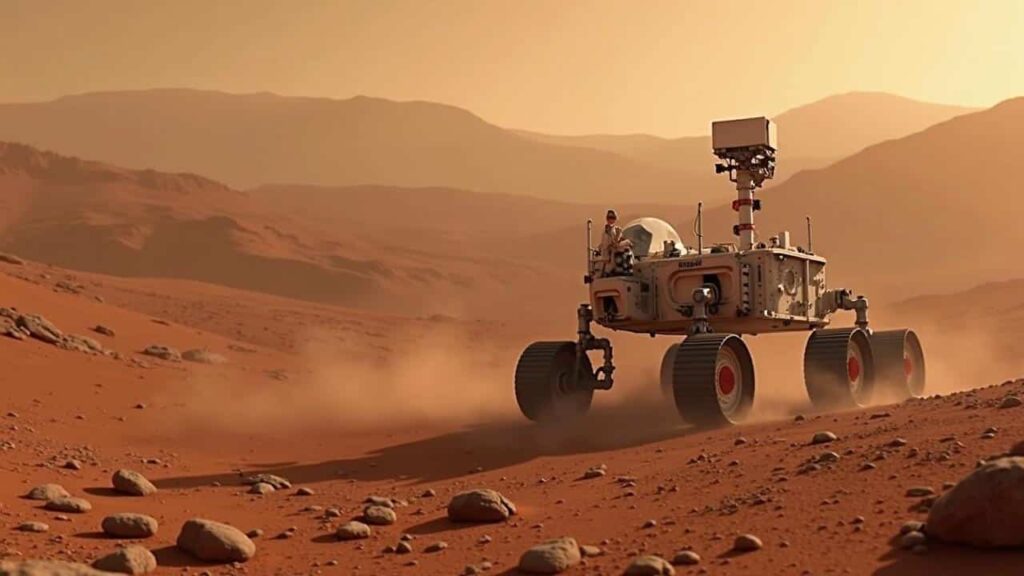
Something that sounded like science fiction was quietly becoming routine engineering.

On Mars, time really does behave differently.

Einstein’s quiet warning, and the Martian clock that wouldn’t behave
Einstein didn’t talk about Mars in his lectures. He talked about gravity, velocity, and the strange way time bends when both get extreme. For years, that felt like a theoretical playground, something for chalkboards and Nobel speeches. Then robotic wheels touched Martian dust, and the equations started tapping on mission control’s shoulder.

Engineers began to notice that the deeper their math went, the less “universal” time felt. The planet with its own rust-red sky was also running on its own subtle tempo. Not Hollywood-slow, but just enough to mess with precision.
The first big hint was almost boring: the Martian day is around 24 hours and 39 minutes long. A sol. That extra 39 minutes seems harmless on paper. It’s the length of a TV episode. A coffee break and a half. Yet when NASA teams designed early rover missions, they had to live on “Mars time” to squeeze every ounce of daylight out of each sol.
Within a week, people were eating breakfast at midnight and going to bed at noon. Their bodies hated it. Their families hated it. The clock on the fridge said one thing, the mission software said another. Time wasn’t just passing. It was splitting.
Behind the scenes, something more subtle was unfolding. Einstein’s relativity says time is not a rigid grid. Gravity slows it. Speed stretches it. Mars has lower gravity than Earth, sits in a different orbit, and the spacecraft hovering above it zip around at blistering speeds. Each of those elements nudges time, just a bit.
So when signals travel between Earth’s deep space antennas and a rover perched on an ancient crater, mission planners rely on **relativistic corrections** so tiny they sound absurd – microseconds, nanoseconds. Miss them, though, and your landing sequence fires a breath too early. Or too late. On a world with thin air and sharp rocks, that breath can mean a crater instead of a touchdown.
The survival problem no one can shrug off anymore
For short missions, the workaround has been simple: treat time like another annoying variable and brute-force it with software. That era is ending. The next wave of Mars plans isn’t about quick visits by robots. It’s contracts for habitats, mining systems, fuel depots, multi-year crews who’ll be sleeping, eating, arguing, and repairing machines in a place where time quietly drifts away from Earth’s schedule.
The survival question is becoming practical. How do you plan medical checks, power cycles, and emergency windows when the clocks on two worlds refuse to stay married?
Imagine a crew of six in a pressurized habitat, running on a carefully tuned routine: sleep cycles, work shifts, radiation checks, greenhouses that open and close their light panels with robotic precision. Their support teams on Earth track every detail. But the longer the mission lasts, the more those accumulated 39-minute days push Mars time away from Earth time. Week after week, those extra minutes pile up like delayed flights on a crowded runway.
After a few months, the “good” time for a live call is the middle of the Martian night. After a year, the perfect Earth window for a critical software patch overlaps with the crew’s mandatory rest. The planet has its own rhythm, and it doesn’t care where Houston wants to put its meetings.
Relativity adds another twist. Future high-speed transit ships, the kind that might shave months off the trip to Mars, will amplify these small distortions. Moving fast in deep space, under changing gravitational pulls, the onboard time will tick slightly differently from the clocks left behind. For a crew that spends years commuting back and forth, their personal timeline could peel away from Earth’s by more than just a philosophical margin.

We’ve all been there, that moment when jet lag turns a day into a blur and you’re not entirely sure if you’ve already eaten dinner. Stretch that confusion across millions of kilometers, toss in life-support systems and solar storms, and it stops being a curiosity. It becomes a design flaw.
Rewriting Martian survival plans, one clock at a time
The new generation of mission planners is quietly reinventing the clock. One strategy gaining ground is to anchor crews to strict local Mars time – sunrise, sunset, temperature swings – and let Earth be the one that adapts. That means accepting that mission control’s workday will slowly slide along the 24-hour grid, like a slow-motion shift system spread across continents.
Inside the habitat, digital systems will likely run not on a single clock, but on layers: local Mars time for human routines, spacecraft time for orbit and trajectory work, and Earth reference time for long-term synchronization. The game is not to find “the” right time, but to manage the overlaps without burning people out.
There’s a trap, and it’s purely human. The temptation is to pretend that the math has solved the problem once and for all. Just plug Einstein into the software and forget it. Let’s be honest: nobody really does this every single day. Fatigue creeps in. People start rounding. “It’s close enough.” A meeting that should be at 08:13 local time slips to 08:30 because someone read the wrong column. A maintenance check designed around a specific thermal window slides by a few minutes, then a few more.
On Mars, those margins are your oxygen, your battery, your backup link to home. Tired crews, tired controllers, and overly tidy spreadsheets are a bad mix.
The experts most worried about this talk less like physicists and more like veteran air-traffic controllers. They want redundancy, visibility, and habits that survive bad days. One senior engineer who worked on timekeeping for Mars orbiters summed it up to me in a sentence that stuck.
“Einstein gave us the rulebook,” she said. “Mars is where we find out whether we read the fine print.”
Around that fine print, new survival guidelines are taking shape:
- Use separate, clearly labeled clocks for Earth, ship, and Mars surface time, visible everywhere in the habitat.
- Lock critical operations – landings, dockings, EVA exits – to local environmental conditions, not someone’s calendar slot on Earth.
- Plan rotating Earth support teams that follow the slow drift of Mars time, rather than squeezing it into a fixed 9-to-5.
- Train crews psychologically for “temporal distance”: the feeling that your day is permanently out of phase with home.
- Design emergency protocols that can be triggered and completed without any real-time input from Earth at all.
When two planets disagree on what “now” means
The deeper this goes, the more unsettling – and strangely liberating – the picture becomes. A child born in a Martian settlement might grow up counting “sols” instead of days, celebrating birthdays that don’t line up with the calendar back on Earth. Video messages from grandparents would arrive stamped with a time that only roughly maps onto the rhythm outside the dome. *Their sense of “now” would already be bilingual: one timeline for the sky outside, another for the world that sent them there.*
For planners, this is not just a poetic twist. It changes how you think about shift work, holidays, even legal frameworks. When does a contract end if two planets age differently by the second? Which clock wins in a dispute? These questions sound abstract until a missed timestamp scrambles an orbital delivery or voids an insurance clause.
On a more personal level, the knowledge that your time is literally flowing at a slightly different pace than your family’s back home could cut in two directions. It might deepen the sense of isolation, turning each message into a kind of long-distance echo. Or it might offer something unexpected: permission to live by a different tempo, to accept that your days do not need to mirror the frantic pulse of Earth’s timelines.
Somewhere between NASA’s control rooms, private space firms’ glossy demos, and the quiet hum of physics labs, a simple realization is taking root. **We are not exporting our clocks to Mars. We are meeting a new one.** The skeptics who once rolled their eyes at notions of “different time” are watching their spreadsheets fill with proof. And the rest of us are left with a strange, almost intimate thought: as we spread into the solar system, even something as basic as a shared second starts to slip through our fingers, asking us who we are when we can no longer pretend that time is the same everywhere.
| Key point | Detail | Value for the reader |
|---|---|---|
| Martian time is structurally different | Longer sols, weaker gravity, and orbital dynamics create a distinct temporal rhythm | Helps you grasp why Mars isn’t just “another timezone” but a new way of living daily life |
| Relativity shapes mission safety | Small relativistic corrections affect landings, communications, and long-duration travel | Shows how abstract physics turns into very concrete risks and design choices |
| Future crews need layered time systems | Separate clocks for Earth, ship, and Mars surface, aligned with human limits | Gives a glimpse of how we’ll actually organize work, sleep, and survival on another world |
FAQ:
- Question 1Does time really pass at a different speed on Mars, or is it just the longer day?
- Answer 1Both. The most visible difference is the 24h 39m sol, which already shifts routines. On top of that, Mars’s gravity and orbital environment, plus the high speeds of spacecraft, introduce small relativistic effects. Over long missions and high-precision operations, those tiny differences have to be accounted for, or things go wrong.
- Question 2Is the effect strong enough for astronauts to “age slower” on Mars?
- Answer 2The effect is real but very small. An astronaut who spends years on Mars or in transit might end up a fraction of a second “younger” than someone who stayed on Earth. You won’t notice it in the mirror, but the mission’s navigation and communication software will definitely care.
- Question 3Why can’t we just use Earth time everywhere and avoid the confusion?
- Answer 3For early robotic missions, that was tempting. Once you put people on the ground for years, their bodies respond to local light, temperature, and work cycles. Forcing them to live by Earth clocks would cause chronic jet lag and operational mistakes. Local time keeps crews aligned with their actual environment.
- Question 4Will future Mars colonies have their own calendar?
- Answer 4Most likely yes. Several proposals already exist for Martian calendars that respect the length of the year and the sol. Settlements will probably keep a dual system for a while – local Martian dates for daily life, and Earth-based timestamps for trade, law, and interplanetary coordination.
- Question 5What’s the biggest risk if we ignore these time differences?
- Answer 5The headline dangers are mis-timed burns, landings, and EVAs – basically, critical actions happening slightly too early or too late. Beneath that, there’s a quieter risk: exhausted crews and controllers trying to juggle mismatched clocks, making human errors that no software patch can fully clean up.
